
Computational science and AI in service of science and society
By Karthik Duraisamy
Across every frontier of science, engineering and medicine, the convergence of computational science, high-performance computing and artificial intelligence is not merely accelerating research; it is transforming what questions we can ask, what problems we can solve and how quickly solutions can reach the people who need it most.
This transformation rests on a foundation that is deeper than any single technology. For centuries, science advanced on two great pillars: theory and experiment. In the latter half of the 20th century, computation emerged as a third pillar: a new way of knowing that could simulate physical reality, test hypotheses across vast parameter spaces and reveal structure hidden in complexity. Today, with the rise of AI, we are witnessing the emergence of a fourth pillar, one that complements and extends our theoretical understanding and opens pathways to discovery that none of the earlier pillars could reach alone. The most powerful science of our era lives at the intersection of all four, and this is precisely what the Michigan Institute for Computational Discovery & Engineering (MICDE) is pursuing in collaboration with other units across campus and our external partners.
Karthik Duraisamy appointed Arthur B. Modine Professor of Engineering
Michigan Aerospace Professor is appointed to prestigious endowed professorship by the College of Engineering
What does this look like in practice? Consider a neurosurgeon standing over an open brain, facing a decision that will shape a patient’s life: where exactly does the tumor end and healthy tissue begin? For more than a century, this question has not been easy to answer. Brain tumors do not form neat boundaries: they infiltrate, finger-like, into healthy brain tissue. One in 4 patients has historically left surgery with residual tumor. At Michigan Medicine, AI systems developed by Todd Hollon and his team now analyze tissue during surgery, providing diagnostic feedback in seconds with remarkable accuracy. The residual tumor rate has dropped from 1 in 4 to 1 in 25. This is not a future promise. It is happening today, with life-saving implications! It is important to note that this is only possible because of simultaneous advances in high-performance computing, real time computing, AI and optical technologies, all blending seamlessly with expertise in neurosurgery.
Charles Brooks, Jonathan Sexton and their research groups are using computational modeling and AI to simulate molecular interactions, predict toxicity and identify promising compounds before they ever reach a patient. What once required years of trial and error in the laboratory can now be explored computationally in a fraction of the time. At U-M, this advanced modeling has dramatically improved the odds of identifying a viable drug candidate.
The reach of computation extends far beyond medicine: into the deepest questions about the universe and the nature of reality. In elementary particle physics, researchers like James Wells are grappling with mysteries that define the frontier of human knowledge: the nature of dark matter, the origin of neutrino mass and the reconciliation of quantum mechanics with gravity. These are questions of extraordinary subtlety and critical to the advancement of human knowledge. High-energy colliders produce up to one million gigabytes of data every second: far more than can be stored, let alone analyzed by human beings.
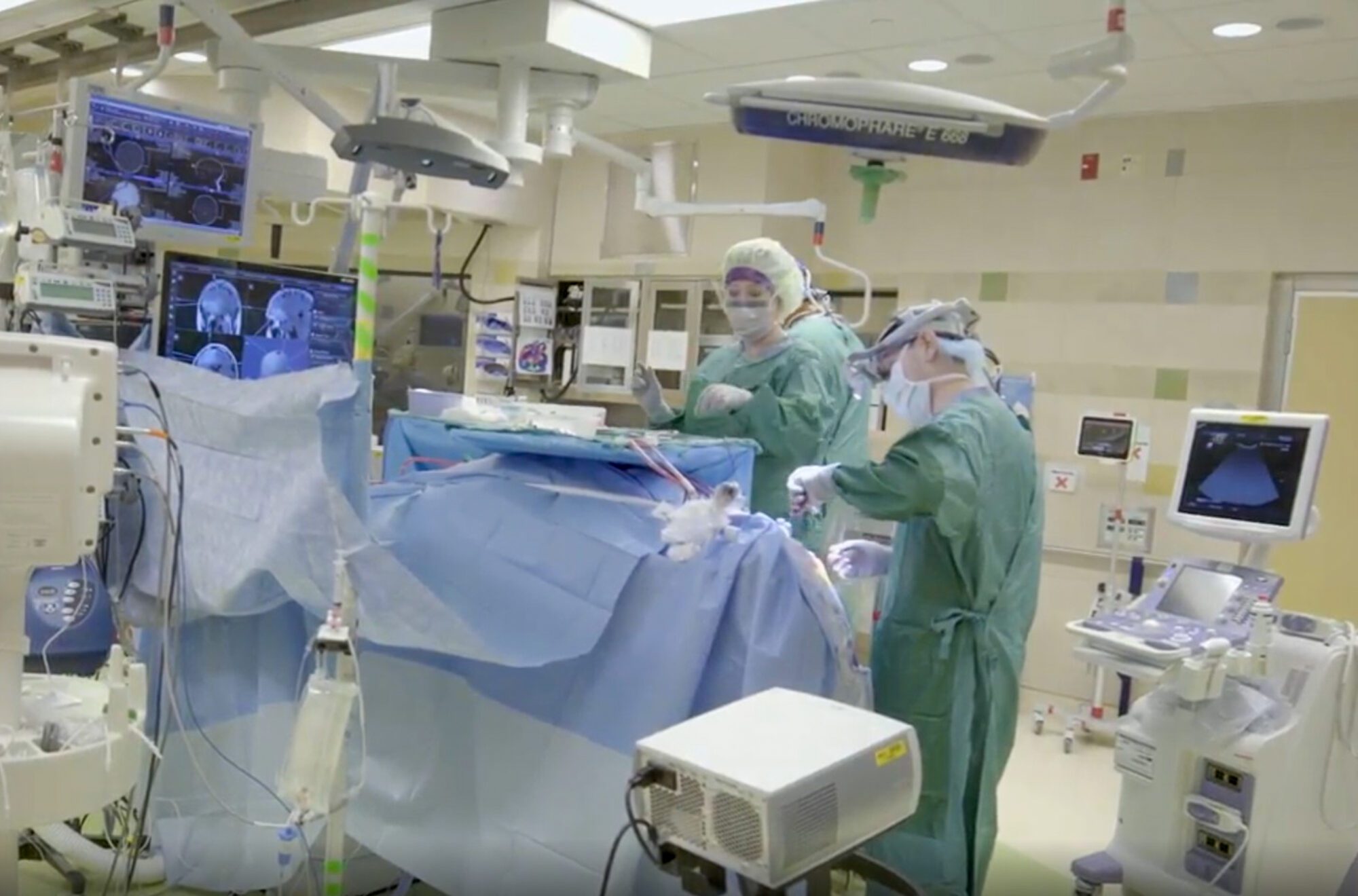
Surgeons at the University of Michigan perform brain surgery, utilizing FastGlioma’s real-time AI analysis of Stimulated Raman Histology (SRH) images to precisely identify and remove cancer tissue. Developed by Todd Hollon and his team.
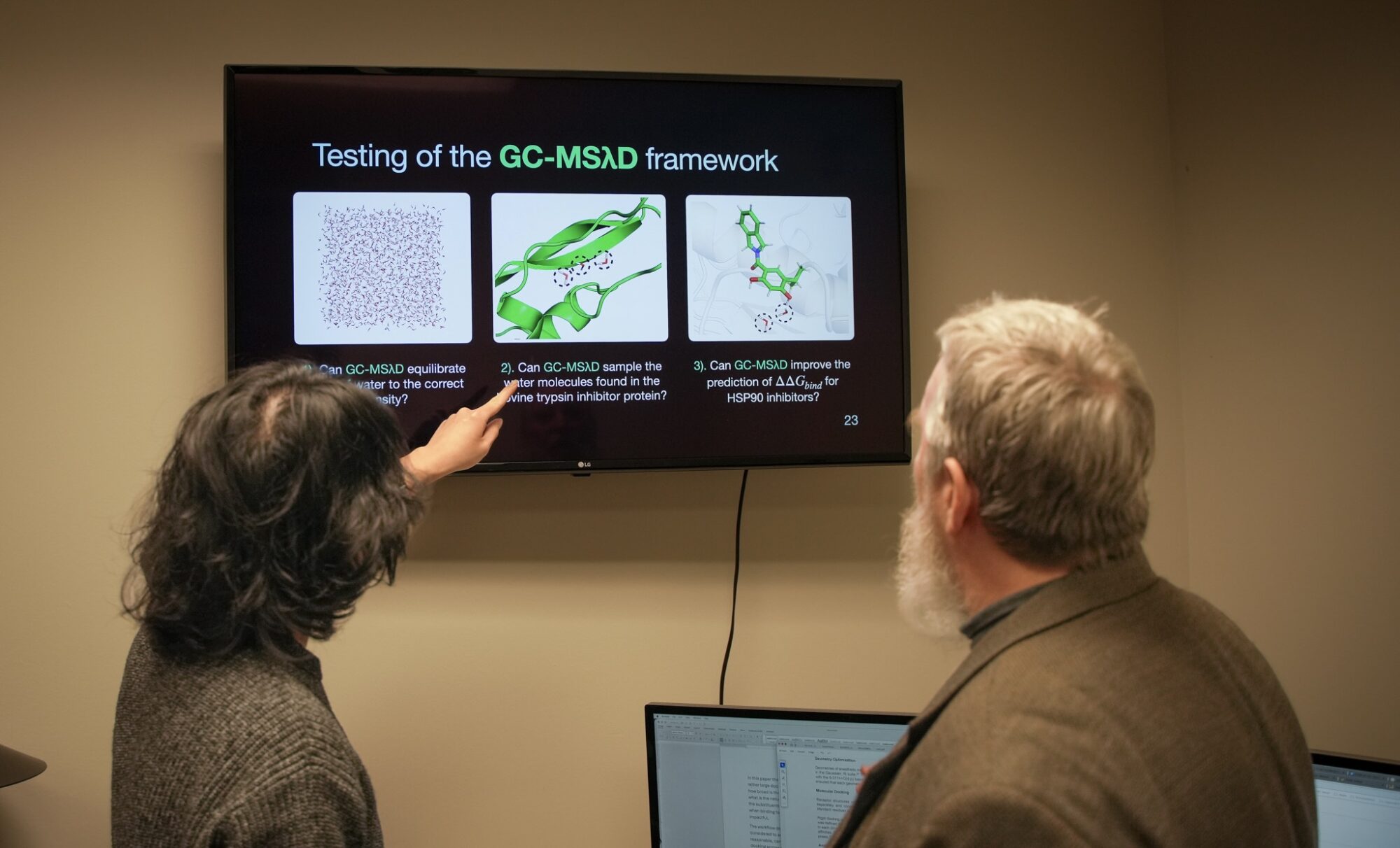
University of Michigan chemist Charles Brooks discusses computational drug-discovery research, reviewing molecular models and simulation results that power new approaches—like multisite lambda dynamics—to speed the search for life-saving medicines.
On the other end of the scale, Dragan Huterer and an international team of nearly a thousand scientists are using computational modeling and machine learning to map the evolution of tens of millions of galaxies, searching for evidence that dark energy (the mysterious force accelerating the expansion of the universe) may itself be evolving over time. If confirmed, this discovery will reshape our understanding of the cosmos. Computation is not merely a tool in fundamental physics; it has become the lens through which we see the subatomic world and the universe.
Closer to Earth, computation is reshaping the engineering of clean energy. Designing a modern wind farm is an enormously complex optimization problem: turbines interact through their wakes, atmospheric turbulence shifts constantly, and the terrain itself shapes airflow in ways that are difficult to predict. High-fidelity simulations that resolve flow physics coupled with AI-driven optimization are enabling engineers to design wind farms that extract significantly more energy from the same wind. In fusion energy (the cleanest possible energy source, yet notoriously difficult to realize) several U-M researchers use computational models to simulate the behavior of plasma confined by magnetic fields, searching for the conditions under which sustained fusion becomes achievable. Venkat Viswanathan’s group is using computation and AI to develop lightweight, durable batteries powerful enough for electrically powered vertical takeoff and landing vehicles.
Tuija Pulkkinen’s team models the violent physics of space weather: streams of charged plasma hurtling from the sun at hundreds of kilometers per second, to protect the satellites, power grids, and navigation systems on which modern life depends. My own students are using generative AI to predict extreme weather events such as Category 5 hurricanes. But where does the data to train these models come from? High-fidelity simulations, assimilating measured data from thousands of sensors and satellites. This is, again, a testament to a deeper truth: computation has become the connective tissue of modern science.
Trachette Jackson’s group has built frameworks that compress weeks of computational stress-testing for cancer models into minutes, making rigorous model validation routine rather than exceptional. Paul Zimmerman is using computations and AI to navigate the staggeringly complex landscape of chemical reactions, accelerating the discovery of new materials and molecular systems. In each case, the pattern is the same: computational science and AI are not replacing human insight. They are amplifying it, enabling researchers to see further, think bigger and act faster. In each of the problems I have described above, physical systems are too complex for intuition or analytical theory alone. Computation makes the intractable tractable.
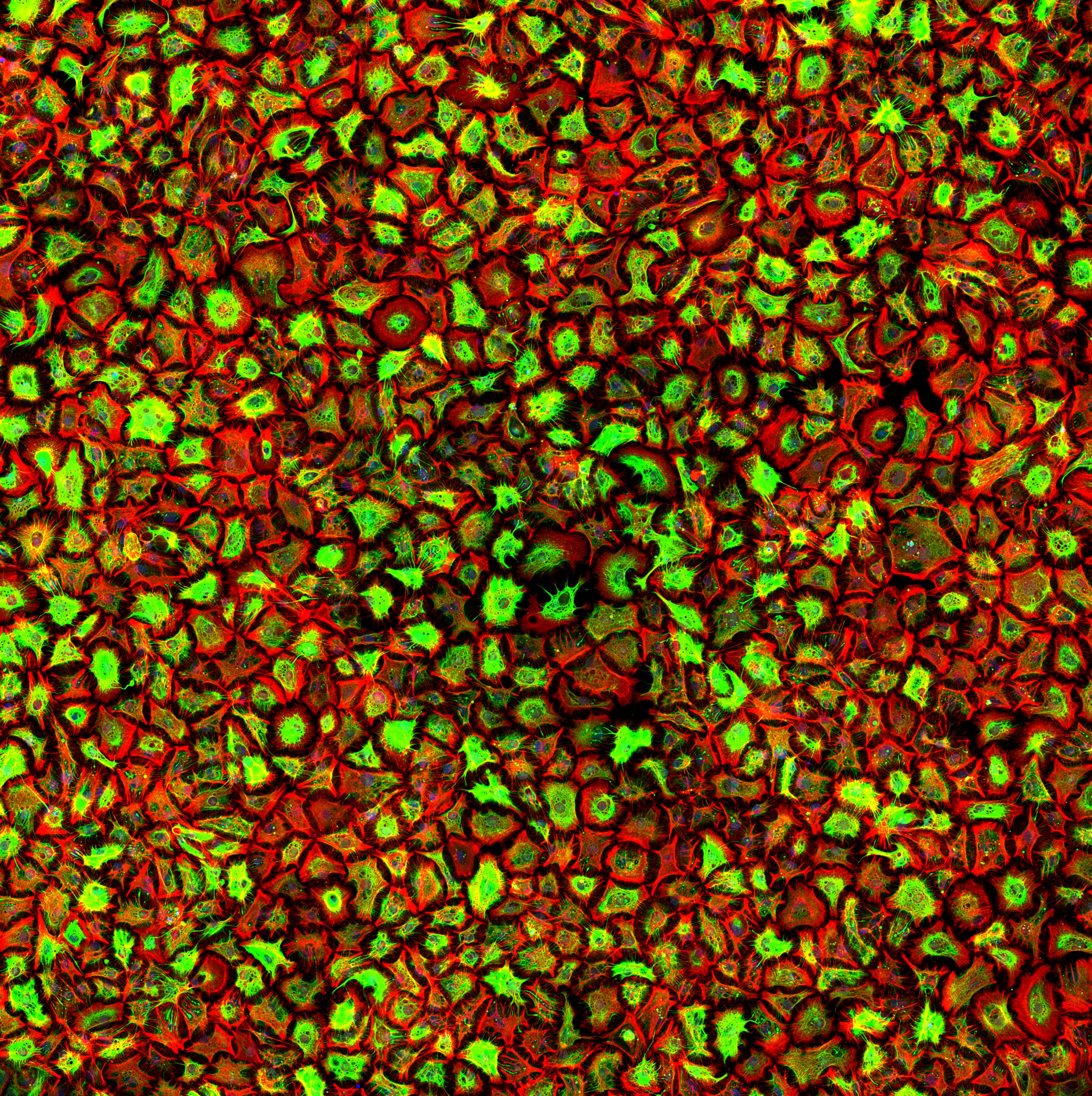
An example image of organoid cells from the microscope. These lung organoids have fibrosis (in green), and this is a model system for idiopathic pulmonary fibrosis that the team is actively researching. Research by Jonathan Sexton and team.
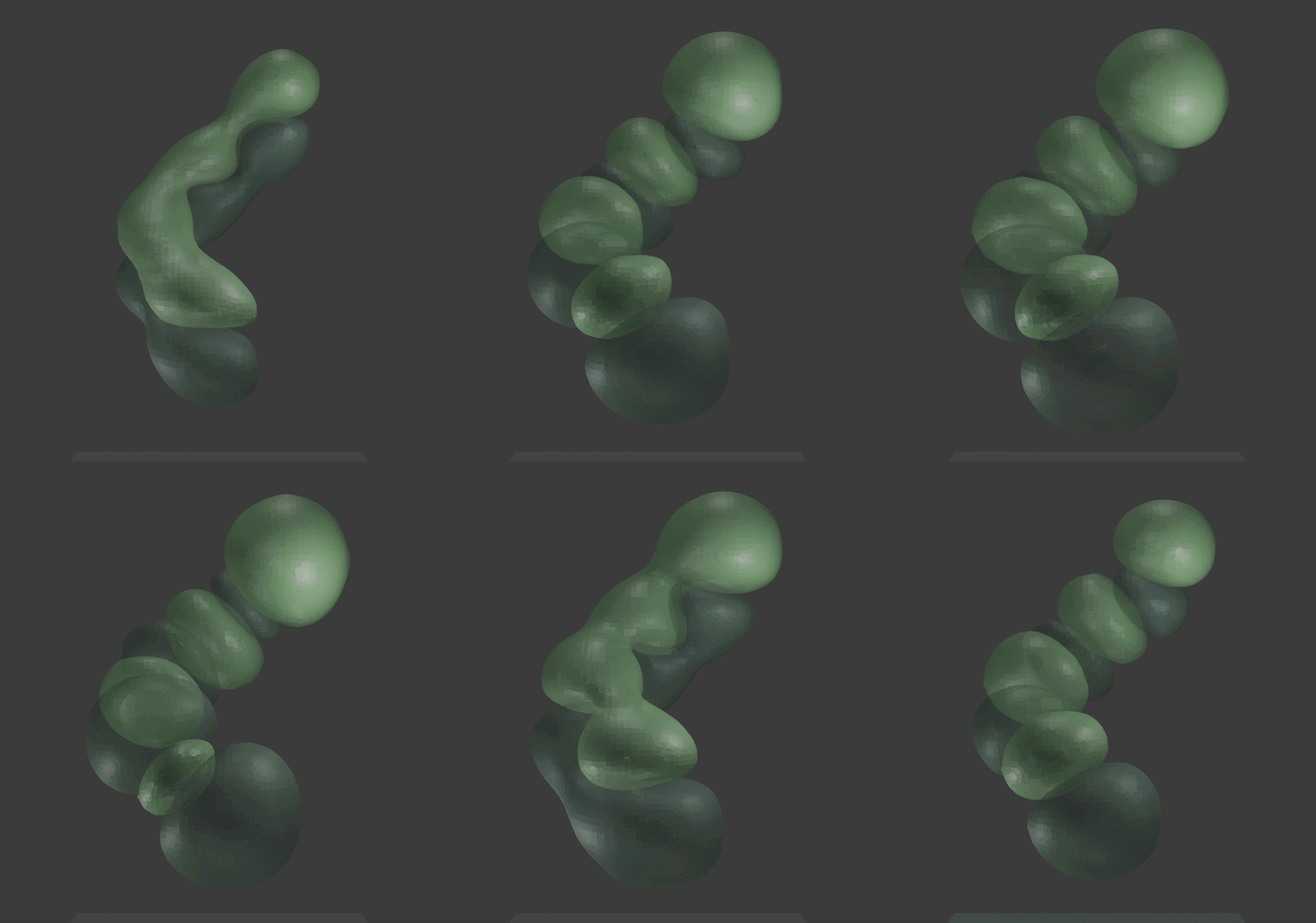
An electron moves through a helix, twisting as it goes and generating a magnetic field. Results like this from a DOE-sponsored SciDAC project may inform scientists to build new devices that transmit quantum information. Research by Paul Zimmerman and team.
Yet even as we celebrate these advances, we must be honest about the challenges they bring. As the appetite for computation grows, so does the environmental footprint, though not nearly as demanding as models trained by leading commercial AI companies. Some might argue this is a reason to slow down. I would argue the opposite: it is precisely why the University of Michigan must lead. The question is not whether these technologies will be developed and deployed at scale (they will). The question is whether that development will be guided by institutions committed to the public good, or left entirely to those with narrower interests. There is also a deeper irony worth noting. These computational tools that consume energy are also the tools we need to solve the clean energy problem: to design better wind farms, to model fusion plasmas, to optimize the power grid and to invent the next generation of energy-efficient computing itself.
U-M is choosing to lead on all of these fronts. U-M computer engineers are pioneering energy-efficient computing architectures and developing algorithms that achieve more with fewer computational resources. Mosharaf Chowdhury’s team is dissecting large AI algorithms – tracking every joule – and has shown that thoughtful system design can reduce energy consumption by more than half. Johanna Mathieu and her collaborators are working on resilient power grids and finding technical solutions within the evolving landscape while collaborating with energy policy and planning experts. We do not run from hard problems. We approach them with intent, and deliver solutions.
The challenges facing science and society today are not neatly contained within any single discipline. Climate change, pandemic preparedness, equitable healthcare, sustainable energy, national security: each demands the integration of theory, experiment, computation and data-driven discovery. A university is one of the few institutions in society broad enough to hold all of these modes of inquiry together and to direct them toward the common good.
There is a human dimension to this work that should not be overlooked. Every model that identifies a drug candidate faster is a patient who may receive treatment sooner. An AI system that guides a surgeon’s hand more precisely is a family whose world is not shattered by preventable harm. A simulation that forecasts a solar storm, optimizes a wind farm or predicts the failure of a building is a community better protected and better served. The computations are seemingly abstract but their consequences are profoundly human.