Reducing drug failures with AI, human liver organoids
By Kate Barnes
In conventional drug discovery, nine out of 10 drugs that enter human trials fail for two reasons: the drug does not produce durable effects, or it causes unanticipated side effects and toxicity.
Drug-induced liver injury remains one of the leading causes of human clinical trial failures, with more than 20% of promising medications failing due to toxicity issues not detected by traditional animal testing.
Through a collaborative national project that includes new experimental and computational technologies being developed at the University of Michigan, researchers aim to reduce this failure rate and improve the drug safety evaluation process, ultimately revolutionizing how drugs are developed.
Using human liver organoids and similar heart models combined with predictive AI and physiology-based mathematical models—also known as novel alternative methods, or NAMs—the project teams are evaluating drug toxicity in new and potentially lifesaving ways.
The ultimate goal? A future where drug development is guided by human biology from the very beginning, leading to safer medicines that reach patients faster.
The organoids being developed by U-M spinout company TorchBio are miniature, three-dimensional liver tissues grown from human stem cells derived from U-M patients who have experienced drug-induced liver injury. They can metabolize drugs, perform basic liver functions and respond to toxic compounds in ways that closely mirror how a human liver would behave, making them powerful tools for predicting how new medications might affect patients.
TorchBio was co-founded in 2023 by U-M faculty member Jonathan Sexton, an associate professor of internal medicine, along with Jesse Wotring, a senior research lab specialist at Michigan Medicine, and Joel Yates, a research lab specialist lead at Michigan Medicine, with the goal of “improving patient outcomes and advancing global healthcare.”
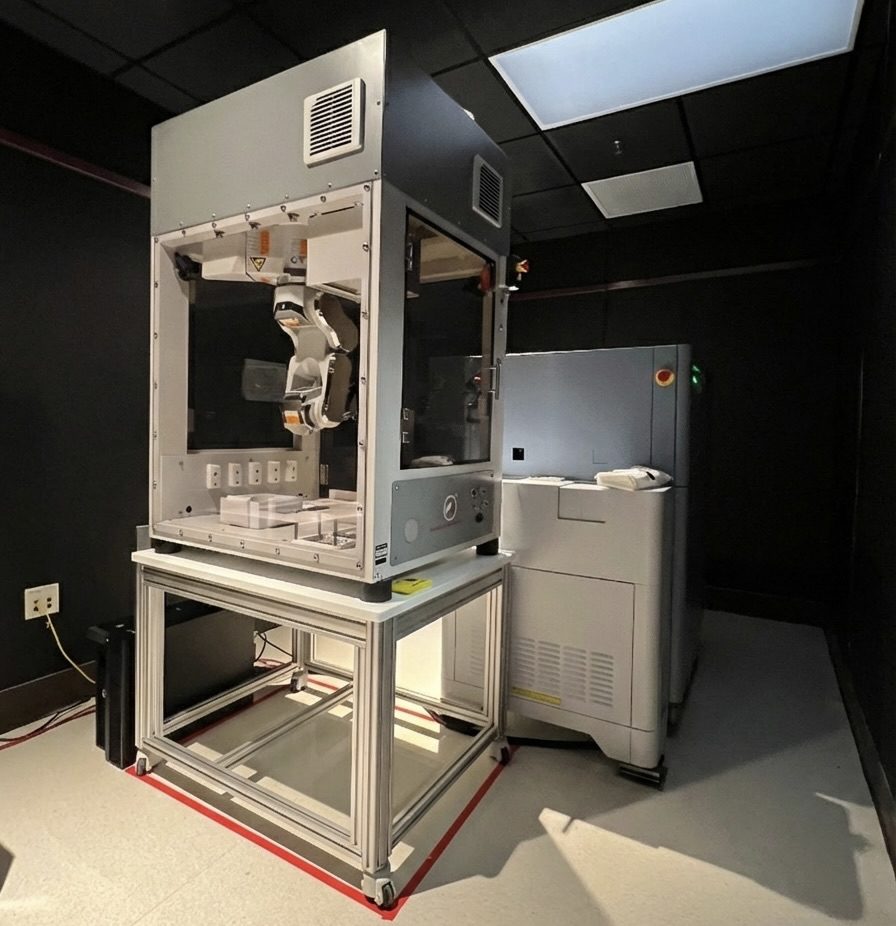
Yokogawa Cell Voyager 8000 microscope
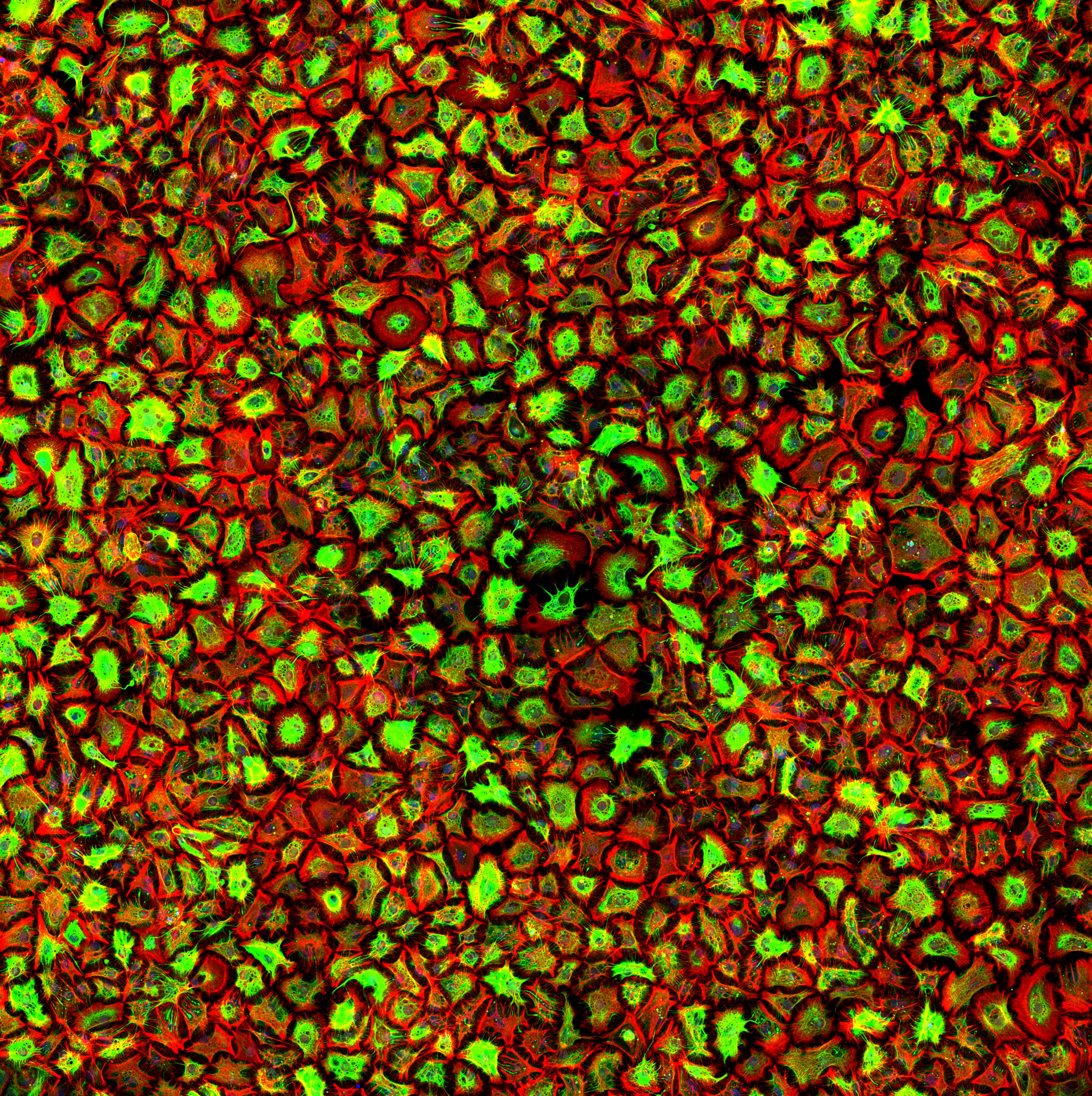
An example image of organoid cells from the microscope. These lung organoids have fibrosis (in green), and this is a model system for idiopathic pulmonary fibrosis that the team is actively researching.
“This national project represents a fundamental shift in how we evaluate drug safety,” Sexton said. “By using human liver organoids derived from diverse patient populations, we can test potential medications in systems that actually reflect human biology.”
The collaboration between TorchBio and the University of Michigan represents a new model for academic-industry partnership in biomedical research. By combining cutting-edge academic science with the practical focus of a startup company, the team seeks to rapidly translate discoveries into technologies that can be adopted by the pharmaceutical industry.
“This project wouldn’t be possible without the ecosystem that U-M has built to support innovation,” Sexton noted. “The university’s commitment to both basic research and commercial translation has created an environment where ideas can move from the lab to real-world impact.”
So, how do artificial intelligence and computational science realistically fit in? Very well, in fact, from the beginning and throughout the entire drug evaluation process.
Sexton and his team generate robotically controlled imaging from the organoids to see how a drug is impacting the human cells within the organoid. With millions of images generated per organoid, the team uses and trains AI models to narrow down which drug compounds work and more importantly, which don’t. The models are purposefully built with human genetic diversity in mind to ensure a robust data set from which the systems can pull.
In one afternoon, the models can run through one batch of toxicity tests, with each batch including roughly 20,000 tests.
The models built and trained by the U-M team can predict liver toxicity risk with approximately 90% accuracy. Previous traditional methods achieved closer to 50% accuracy and took months instead of days. This all happens before a drug moves forward to costly clinical trials.
“With systems like these, drug prescribing and management can and will be much more personalized and could potentially remove the trial-and-error approach altogether. This new paradigm of AI and drug discovery will allow us to solve the unsolvable, treat the untreatable and engage directly with patients by modeling their own tissues in the laboratory to find which drugs work best for them.”
This earlier and more accurate testing can improve processes at every stage of drug development, provide safer drugs and potentially drive the cost of medicines down by reducing toxicity prediction failures. The success of these models will also reduce the need for animal testing, which often fails to predict human responses.
“By using these patient-derived organoids, AI and computational techniques, we are able to interpret the data from these organoid images in a much more accurate and efficient way,” Sexton said. “The models that we are training and using are really the backbone of this entire project; we use AI components at every stage.”
Sexton’s work is part of a larger effort led by Inductive Bio, a technology company that uses machine learning (ML) and artificial intelligence (AI) to accelerate small molecule drug discovery by optimizing compound development, and funded by the Advanced Research Projects Agency for Health (ARPA-H) Computational ADME-Tox and Physiology Analysis for Safer Therapeutics (CATALYST). The project also includes biopharmaceutical company Amgen, Cincinnati Children’s Hospital Medical Center and Baylor College of Medicine.
The CATALYST program is a federal initiative designed to transform preclinical drug safety evaluation. Its vision is to enable regulatory approval for first-in-human clinical trials based on computational safety data, reducing dependence on animal models and improving toxicity prediction accuracy. Funded projects are developing human-relevant experimental and computational methods for predicting drug safety.
The national project, Digital Acceleration of Toxicity Assessment with Mechanistic and AI-driven Predictions (DATAMAP), seeks to transform preclinical drug safety assessment through cutting-edge technologies.
While Sexton’s team is focusing on liver toxicity for the project, the Baylor team is working to evaluate cardiac toxicity through a similar process. As they move through the 5-year initiative, the teams will eventually commercialize the product and produce a tool for Amgen to use, with the goal of other pharmaceutical companies to then incorporate it into their drug development processes.
As DATAMAP progresses, the team plans to expand to additional organ systems beyond the liver and heart, incorporate more diverse patient populations and work toward FDA regulatory validation of their experimental and computational models.
“With systems like these, drug prescribing and management can and will be much more personalized and could potentially remove the trial-and-error approach altogether,” Sexton said. “This new paradigm of AI and drug discovery will allow us to solve the unsolvable, treat the untreatable and engage directly with patients by modeling their own tissues in the laboratory to find which drugs work best for them.”
The researchers featured in this story worked with the following University of Michigan research cores throughout the course of their research work: iPSC core, BRCF Microscopy core and advanced genomics core.