
AI is saving lives by spotting cancer surgeons cannot see
By Wendy Sutton
For more than a century, neurosurgeons have faced a dilemma: remove too little brain tissue and cancer remains; remove too much and patients risk losing critical functions.
The most common adult brain cancer does not form a ball-shaped mass with distinct edges. Instead, gliomas branch out like fingers, invading healthy tissue. This invasive growth makes it difficult to distinguish tumor tissue from normal brain tissue. Ambient operating room lights make this challenge even more difficult.
As a result, one in four patients leave surgery with tumor tissue still in their brain. Now, artificial intelligence developed at the University of Michigan is solving this problem, reducing the rate of residual tumors from 24% of cases to just 4%.
About a decade ago, Daniel A. Orringer, assistant professor of neurosurgery, developed Stimulated Raman Histology, or SRH. This technique provides near real-time microscopic images of brain tissue without traditional staining or processing. Since that time, U-M surgeons have built a library of four million images from patients undergoing procedures, collected under Institutional Review Board (IRB) protocol to ensure ethical collection and use of patient tissue samples.
“We quickly realized that we can take all the great pictures we want,” said Todd Hollon, Joseph R. Novello MD and Alfredo Quinones-Hinojosa MD Research Professor of Neurosurgery and program director of artificial intelligence in neurosurgery. “But ultimately, we have to do something with them. We have to make a decision in the operating room about whether we continue to remove tissue or whether it’s normal.”
To solve this challenge, Hollon and his colleagues developed FastGlioma, an AI tool that analyzes the SRH images during surgery. Within approximately 10 seconds, it shows surgeons where residual cancer tissue remains and at what density, enabling real-time decisions about how to proceed.
FastGlioma’s foundation model was trained on millions of SRH images collected by U-M and collaborating institutions. Using deep learning technology similar to ChatGPT’s next word prediction, the model learned to identify patterns and key descriptive features of cancer tissue. The breadth and diversity of the image library made the model very precise at diagnosing cancer tissue.
“We hear a lot about the existential risk of AI, deep fakes and the issues related to employment,” Hollon said. “But, a lot of the best stories around AI don’t get nearly as much press. Ultimately the goal is to help patients. Using this technology, we decrease from 24% residual tumor to 4% using AI. That is a huge drop in residual tumor and relative risk of recurrence. We’re hoping to get that number down to around zero. That’s the next step.”
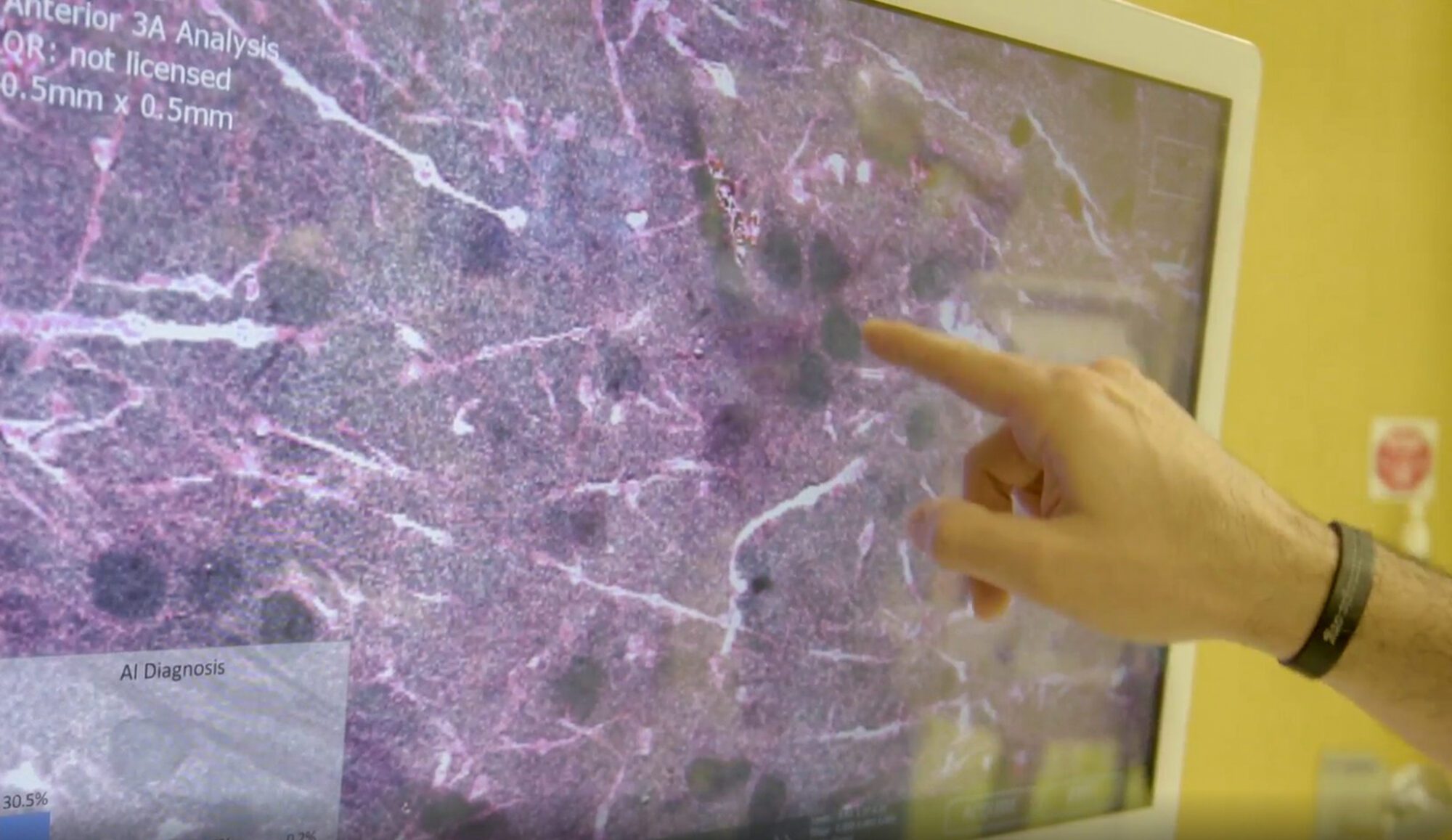
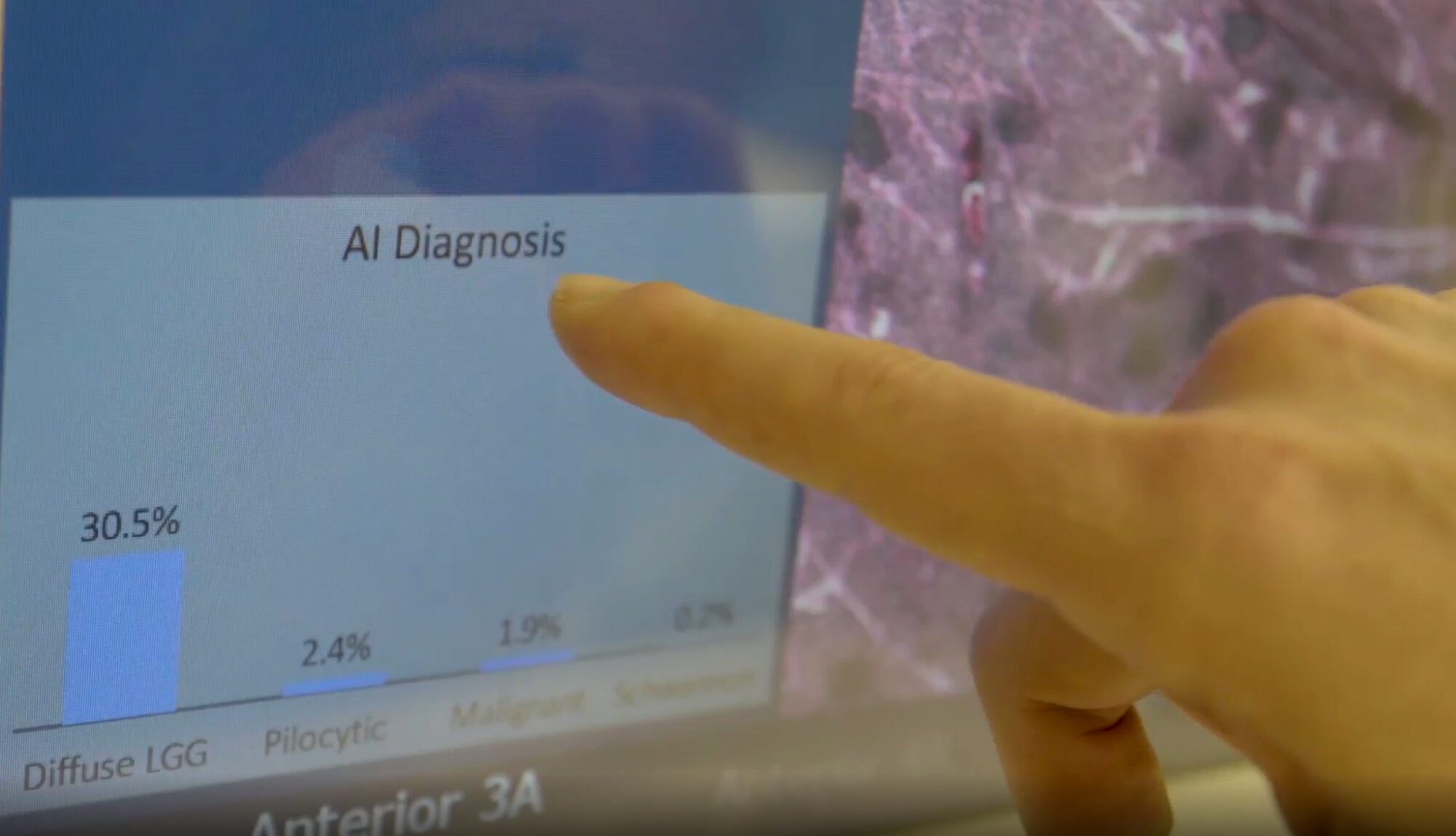
Images 1 and 2 – FastGlioma, an AI-powered tool developed at the University of Michigan, analyzes SRH images to identify and quantify brain cancer tissue during surgery.
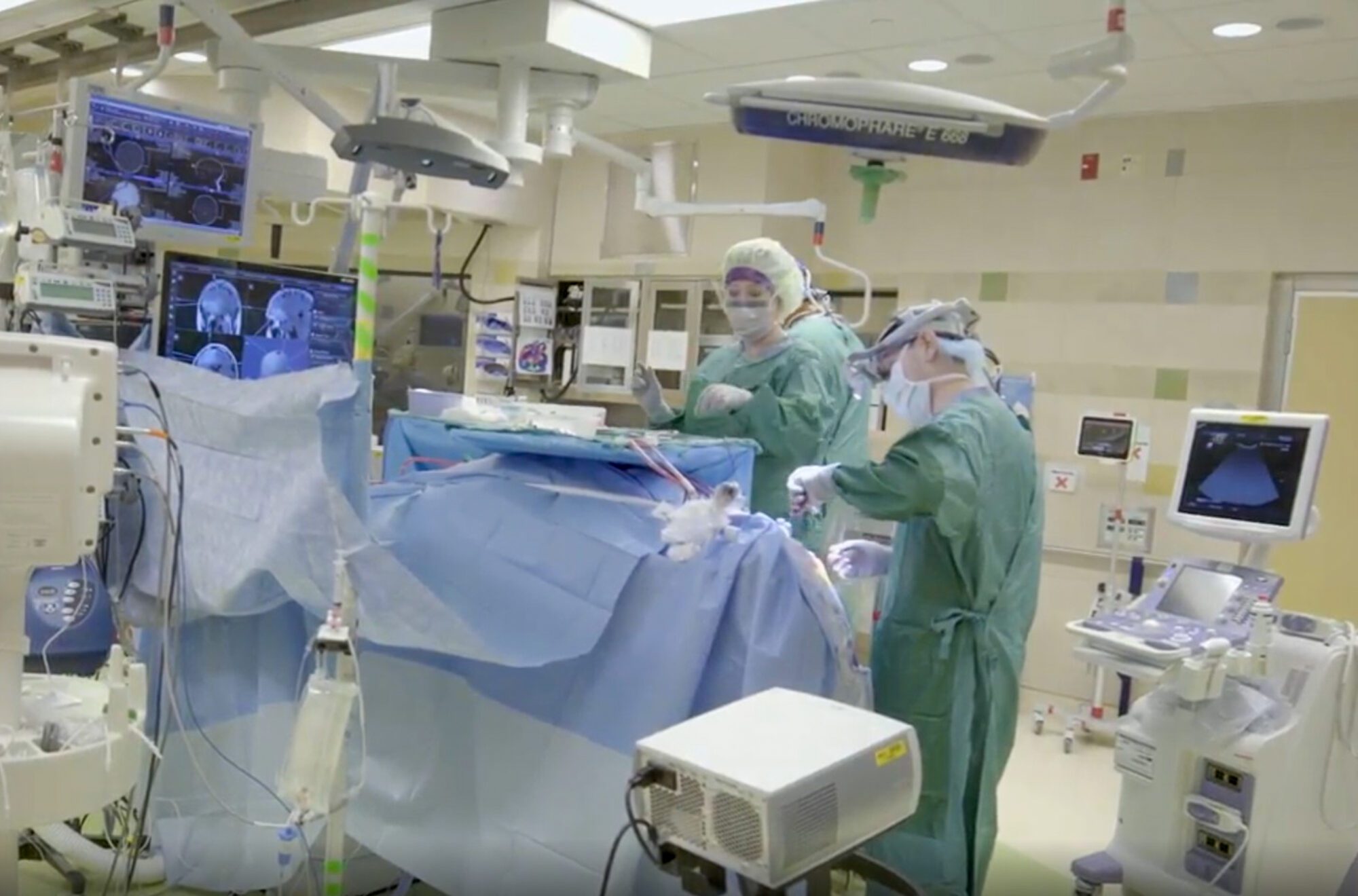
Surgeons at the University of Michigan perform brain surgery, utilizing FastGlioma’s real-time AI analysis of Stimulated Raman Histology (SRH) images to precisely identify and remove cancer tissue.
“It’s not just about the ability to detect tumor tissue, it’s about prolonging survival and hopefully preventing recurrence. FastGlioma is giving us a preview of a world where AI advances in optics and computations help surgeons make better decisions in the operating room. This is literally a case where computing and AI are saving lives.”
Surgeons currently rely on magnetic resonance imaging, or MRI, and fluorescent-guided surgery, which involves injecting a dye into the patient’s vein so that tumor tissue fluoresces. However, intraoperative MRIs require significant infrastructure and cost, and neither approach has the sensitivity needed for detecting small fragments of tumor tissue.
In the operating room, FastGlioma delivers its assessment with a sliding score from zero to one, where zero means no tumor detected and one indicates dense tumor tissue. A score of 0.25 might signal atypical cells, while scores like 0.5 or 0.75 indicate sparse to increasingly dense tumor. The system also pinpoints the precise location of any residual tumor tissue, giving surgeons a roadmap for their next move.
The technology was developed in collaboration with Stanford University, New York University, University of Miami and Columbia University and led by Hollon and Orringer at U-M. FastGlioma has the capacity to learn from billions of images, which means its diagnostic accuracy will continue to improve as it encounters more tissue types and tumor patterns.
The team is currently pursuing FDA approval for the AI models, with testing being conducted independently at multiple centers to meet regulatory requirements. The SRH imagers are commercially available through Invenio Imaging Inc. and are being used in brain tumor surgery, as well as lung and breast cancer procedures.
“It’s not just about the ability to detect tumor tissue, it’s about prolonging survival and hopefully preventing recurrence,” Hollon said. “FastGlioma is giving us a preview of a world where AI advances in optics and computations help surgeons make better decisions in the operating room. This is literally a case where computing and AI are saving lives.”