University of Michigan × Los Alamos Partnership
Advancing Discovery for the Public Good
The University of Michigan and Los Alamos National Laboratory are building on a longstanding research partnership to tackle some of today’s most complex scientific and societal challenges. Through the Strategic Partnership & Accelerated Research Collaboration (SPARC), the two institutions are deepening long-term collaboration in research requiring advanced computational expertise. Joint projects already span artificial intelligence, physics, engineering and other fields critical to national and public interests. As part of this expanding partnership, U-M and Los Alamos are also planning a new research computing center in Ypsilanti Township to strengthen computing capacity, accelerate discovery and create new opportunities for innovation, collaboration and economic growth.
A Longstanding Research Partnership
For decades, the University of Michigan and Los Alamos National Laboratory have partnered to advance research at the frontiers of science, engineering and national security. Together, U-M and LANL researchers have collaborated on breakthroughs in fields ranging from advanced energy systems and artificial intelligence to cancer research and materials science.
As research challenges have grown more complex and computationally intensive, the partnership has continued to expand through shared research initiatives, talent development programs and new investments in advanced computing and innovation infrastructure. Today, this longstanding collaboration is helping position Michigan as a national hub for high-impact research, technology development and scientific innovation.
Partnership Highlights
Since 1973, U-M and LANL researchers have coauthored nearly 2,000 scientific publications spanning physics, engineering, energy, medicine and other disciplines, with more than half published since 2017.
U-M and LANL researchers have collaborated on major national initiatives in nuclear energy, power-grid resilience, artificial intelligence and nuclear nonproliferation, including DOE Energy Innovation Hubs and recurring National Nuclear Security Administration consortia.
Since 2018, Los Alamos has hosted more than 120 U-M students and hired 32 U-M graduates as postdoctoral researchers — more than any other nonregional university — helping create a strong pipeline of scientific talent and research collaboration between the two institutions.
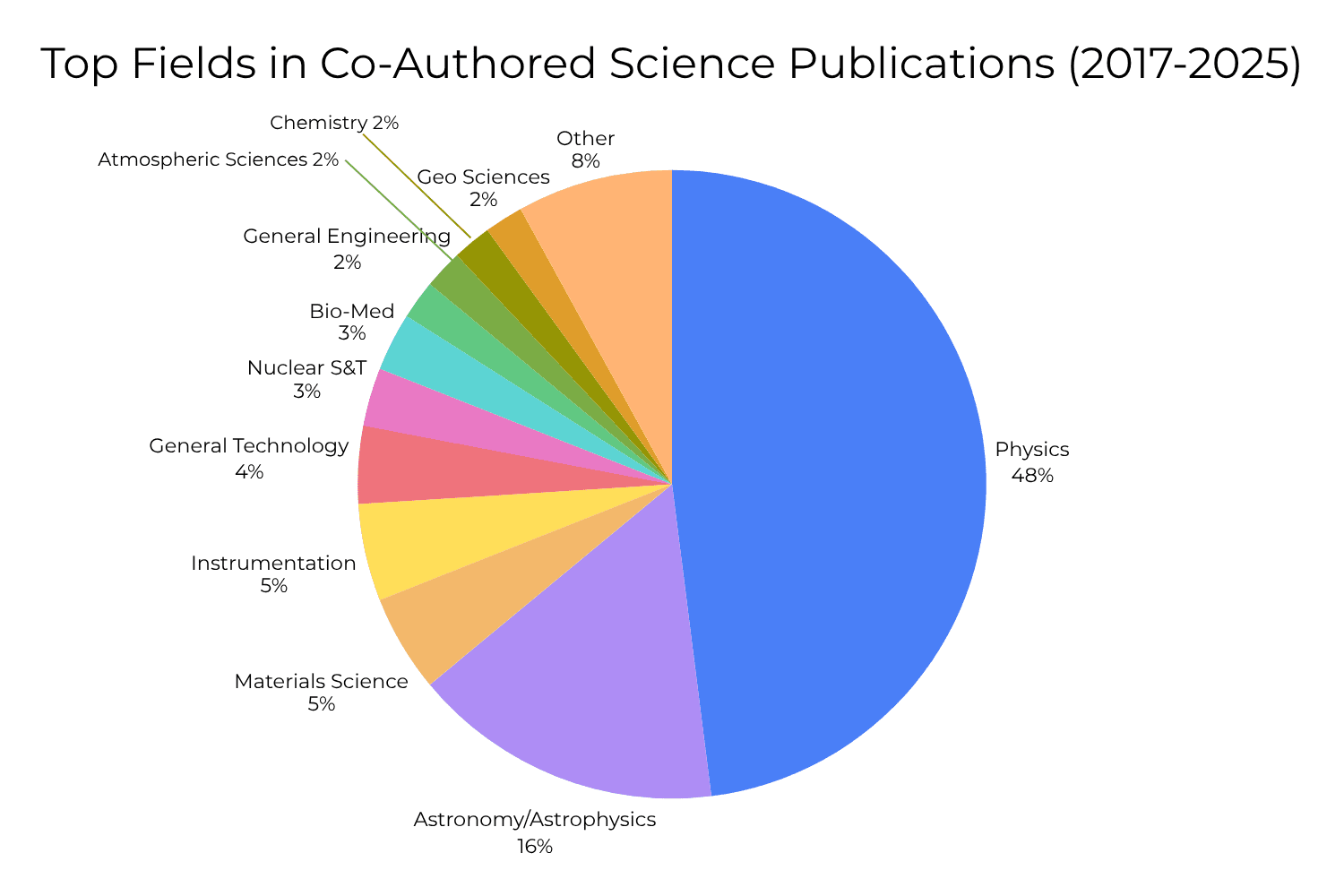
Since 2017, Los Alamos National Laboratory has published more research with the University of Michigan than with any other university. The following chart shows the fields in which researchers from the two institutions have jointly published.
Research Addressing Global Challenges
Current research collaborations between the University of Michigan and Los Alamos National Laboratory span advanced computing, artificial intelligence, physics, engineering and other fields critical to national and societal needs. Together, researchers are developing new computational tools and scientific approaches to tackle complex challenges in energy, national security, materials science and beyond.
How Computing and AI Could Help Unlock Fusion Energy
Researchers from the University of Michigan and Los Alamos National Laboratory are combining advanced computing, AI and plasma physics to tackle one of science’s most complex challenges: understanding how matter transitions into the plasma state. Their work could help accelerate fusion energy research while advancing new computational methods with applications across science, engineering and national security.

What is SPARC?
The Strategic Partnership & Accelerated Research Collaboration (SPARC) is a long-term initiative between the University of Michigan (through the Michigan Institute for Computational Discovery & Engineering) and Los Alamos National Laboratory. SPARC supports joint research in areas that require deep computational expertise, cross-disciplinary collaboration and scalable infrastructure.
The Michigan SPARC is headquartered on the university’s North Campus, where LANL scientists collaborate face-to-face with faculty, students and research staff. This structure fosters sustained engagement and enables breakthroughs in science, engineering and national security.
To learn more about the national scope of this collaboration, visit the LANL SPARC website.
High-Performance Computing in Action
University of Michigan researchers are already using high-performance computing and AI to accelerate breakthroughs in medicine, energy, space weather prediction and other critical fields. Their work demonstrates how advanced computational tools are transforming discovery today, and what expanded computing capacity could make possible in the future.
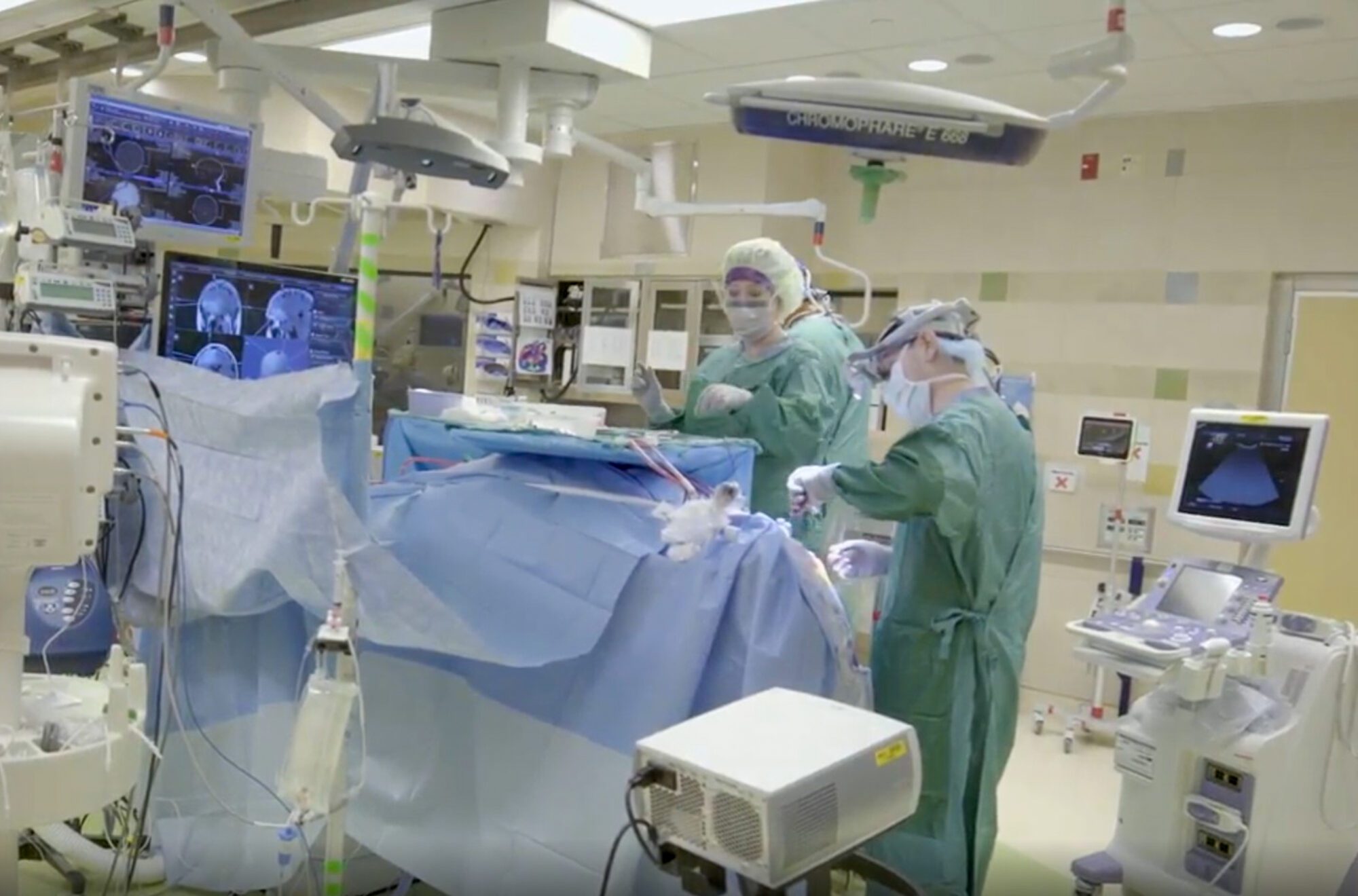
AI is saving lives by spotting cancer surgeons cannot see
One in four brain cancer patients used to leave surgery with residual tumor. An AI tool developed at U-M now analyzes tissue in seconds during surgery, cutting that rate to just 4%.
Read how U-M neurosurgeons are using AI to see what the human eye cannot.
Duraisamy: Supercomputing in service of science and society
For centuries, science advanced on two great pillars: theory and experiment. In the latter half of the 20th century, computation emerged as a third pillar: a new way of knowing that could simulate physical reality, test hypotheses across vast parameter spaces and reveal structure hidden in complexity. Over the past few years, with the rise of AI, we are witnessing the emergence of a fourth pillar, one that complements and extends our theoretical understanding and opens pathways to discovery that none of the earlier pillars could reach alone.

U-M teams up to predict—and protect against—space weather
Streams of charged particles hurtling at 800 kilometers per second can disrupt satellites, power grids and GPS. U-M researcher Tuija Pulkkinen is building computational models to forecast these solar storms before they strike.

A faster path to finding life-saving medicines
Researchers at the University of Michigan are transforming drug discovery with advanced computational modeling and AI. By simulating many molecular possibilities at once and combining predictions with lab experiments, they identify promising therapies faster, boost success rates and accelerate the path toward life-saving medicines.
Press Inquiries
Please reach out to the Office of Public Affairs at (734) 936-5190 or [email protected].