
University of Michigan × Los Alamos Research Computing Center
The University of Michigan and Los Alamos National Laboratory (LANL) are partnering to create a new national research center in Ypsilanti Township. This research computing center will support scientific research that delivers tangible benefits for Michigan residents, while creating a new sector of research and innovation for the entire state.
Community Town Hall Resources
The University of Michigan hosted two community town halls on Sept. 9 and Oct. 1 to hear from residents, answer questions and share additional information about plans for the new high-performance research computing center. Click here to view the town hall presentation.
About the Project
The following questions and answers were compiled by U-M to help inform faculty, staff, students and community members about the proposed project, the site evaluation process and environmental considerations.
Research Scope & Partnership
What kind of research will U-M & Los Alamos National Laboratory (LANL) be conducting at this new center?
The new research computing center will allow scientists to tackle problems that are too complex for standard computers. By modeling, simulating, and analyzing massive data sets at lightning speed, this facility will enable discoveries in fields such as medicine, materials science, clean energy, engineering and national security.
For example, U-M researchers are applying AI and high-performance computing to improve brain cancer surgery outcomes, accelerate drug discovery and predict extreme weather events. Meanwhile LANL scientists have used these tools to model wildfire behavior, track the spread of disease and study changes in Arctic sea ice.
LANL’s national security research at the center will include nuclear stewardship — using advanced computational modeling to ensure the safety and reliability of our nation’s existing nuclear stockpile as it ages, without the need for live testing. LANL’s national security research is broader than many people realize, however, and also includes work such as strengthening the resilience of the U.S. power grid against cyber threats and improving critical infrastructure systems.
What is “high-performance computing” and how is it used?
High-performance computing involves solving complex problems by running sophisticated algorithms across thousands of processors (smaller computers) working together in parallel. High-performance computing, for example, allows researchers to rapidly test millions of potential drug compounds and identify promising candidates for treating diseases far more quickly than traditional laboratory methods. Other applications include the discovery and design of new materials, calculations on climate preparedness, and sustainability.
U-M has been doing this type of high-performance computing research for many years, but at a smaller scale. As the university looks to solve more complex problems, it needs faster computing speeds and more computing capacity.
What will researchers be able to accomplish with greater computing capacity?
Across the university, researchers are demonstrating how advanced computing can accelerate discovery. Expanded capacity will allow them to build on that work, opening new possibilities in areas such as:
- Improving Cancer Care: An artificial intelligence tool developed at U-M can analyze brain tumor tissue during surgery. By giving surgeons instant, real-time feedback, this advanced computing technology has already dropped the rate of residual cancer tissue from 1 in 4 down to 1 in 25.
- Strengthening the Power Grid: Advanced computing enables scientists to model increasingly complex electrical systems, helping utilities integrate renewable energy, improve reliability during extreme weather and prepare for growing energy demand.
- Accelerating Drug Discovery: Advanced computational modeling and artificial intelligence is being used to simulate thousands of molecular interactions simultaneously, dramatically reducing the time needed to identify promising new medicines and helping bring new therapies to patients faster.
- Making Computational Science More Sustainable: Innovative technologies are reducing the energy required to train artificial intelligence models, helping make future AI systems more efficient, affordable and environmentally sustainable.
- Cardiovascular health: By combining noninvasive imaging such as results from MRI and CT scans with a physical model of blood flow, computing helps doctors estimate artery stiffness within an hour of a scan, serving as an early predictor of diseases such as hypertension.
These examples represent only a small fraction of the research that will benefit from expanded computing capacity.
What is the history of the partnership between U-M and LANL?
U-M and LANL have worked together for decades, producing nearly 2,000 co-authored publications across diverse scientific fields. Since 2017, LANL has published more research with U-M than with any other university. The volume of work reflects an enduring and productive relationship and initiatives such as Michigan SPARC (Strategic Partnership & Accelerated Research Collaboration) have enriched this collaboration.
In 2024, U-M and LANL reached a major milestone in establishing a bilateral Joint Appointment program, which currently includes LANL staff and U-M faculty working in areas such as radiation detection, computational physics, and electrical grid design. Today, the research partnership is thriving with LANL managing a $40M portfolio of research contracts with U-M.
What are the factors bringing this new facility to U-M and Michigan?
As a global leader in research and discovery, U-M is uniquely positioned to host this research computing center because of its combination of world-class faculty and the infrastructure needed to support advanced computational science.
By co-locating, U-M and LANL will create a first-of-its-kind innovation ecosystem where LANL’s pioneering computing techniques will add speed and depth to U-M’s world-renowned research to spur breakthroughs across a multitude of fields – including medical, energy, and environmental – that will benefit the people of Michigan and society more broadly.
What other National Laboratories does U-M partner with?
In addition to its deep partnership with LANL, U-M maintains strong collaborative research agreements with a number of other National Laboratories, including Idaho National Laboratory, Argonne National Laboratory and Fermilab in Illinois, Oak Ridge National Laboratory in Tennessee and Pacific Northwest National Laboratory in Washington state.
Facility Security
Will there be any hazardous or nuclear materials, such as plutonium, at the facility?
No.
The facility will be dedicated entirely to scientific computational research. There will be no hazardous nuclear materials on site and no manufacturing of any kind — including plutonium pits.
Weapons production will never happen at the Michigan site because those activities are strictly limited to specialized, highly regulated facilities.
What would you say to concerns that this facility presents a security risk, and what security measures will be in place?
This facility is a scientific research center — not a production site or military installation. Facilities that handle hazardous materials, sensitive information or house command centers are located in highly specialized federal sites, not university-based research environments.
Security at this facility will be consistent with other major research campuses and national labs, including controlled, badged access, cameras and on-site security personnel, as well as other measures, to ensure a safe environment for researchers while maintaining the accessible, collaborative nature of a university setting.
U-M will also maintain coordination with local and federal partners to ensure the safety of both the facility and the surrounding community.
Will this facility play any role in real-time operations or national defense activities?
No. The facility is for research and will not provide real-time operational support during any conflict or national emergency. Its mission is focused solely on advancing long-term scientific understanding through computational modeling.
Project Location & Scale
Where will this facility be located?
The University of Michigan has selected a 144-acre site along Textile Road in Ypsilanti Township as the preferred location for the research computing center. The site—which was already zoned by Ypsilanti Township for light industrial use—offers the technical infrastructure and operational requirements needed to support advanced research computing while allowing the university to preserve significant natural areas and maximize separation between the facility and nearby homes and parks.
Why was the Textile Road site selected over the Willow Run site?
U-M spent over a year evaluating potential locations, including an extensive re-review of the historic Willow Run complex requested by Ypsilanti Township leadership and local stakeholders. Ultimately, the Willow Run site proved impractical due to the comprehensive brownfield redevelopment requirements and complex real estate issues. While initial assessments indicated that existing contamination at Willow Run remains stable if undisturbed, active construction there would require additional preventative measures to mitigate the risk of spreading contaminants into surrounding areas. U-M, the Michigan Economic Development Corporation (MEDC) and other partners worked to determine whether the site could be made viable, but doing so would have required a level of local governmental partnership and support that ultimately was not achievable.
The Textile Road site emerged as the best location capable of meeting the project’s technical and operational requirements, while allowing the university to build responsibly for the future. Already zoned by Ypsilanti Township for light industrial use—and previously approved by township officials for a large Amazon distribution center—the site offers proximity to electrical and data infrastructure, development flexibility, and long-term capacity. Compared to the previously approved Amazon project, U-M’s research center will occupy a substantially smaller footprint and generate far less daily traffic.
How is this facility different from a commercial data center?
This is a specialized research hub, not a commercial data center. Unlike large commercial facilities designed to support cloud computing, streaming, e-commerce and other consumer or business applications, this center would be dedicated to advanced scientific research and high-performance computing in areas such as medicine, energy, climate science, engineering and national security.
This facility will use less than 1/10th the energy of commercial data centers, starting at 50 megawatts with a maximum planned capacity of 100 megawatts. The physical footprint and energy usage of this facility will be comparable to a modest industrial facility rather than a commercial data center.
Why was Ypsilanti Township chosen for this facility?
U-M first explored building this facility on campus in Ann Arbor, but existing campus properties do not have the necessary infrastructure. Specifically, any selected site must feature direct access to high-capacity electrical infrastructure (near a main transmission line), proximity to a municipal water system with sufficient capacity, and links to crucial utilities like data lines and sanitary sewers. Additionally, the location must offer adequate acreage to accommodate the building, an on-site DTE electrical substation and necessary infrastructure support, while also leaving enough space to preserve natural features and community buffer zones.
Has the university considered locating the facility on the former Concordia campus?
The property is not being considered for the Los Alamos high-performance computing project. The site lacks the specialized infrastructure and high-voltage electrical transmission capacity required for advanced high-performance computing operations.
Where is the project in the planning process, and what is the timeline?
The project remains in the planning and design phase. U-M selected the Textile Road property as the preferred site in August 2026 and is now conducting environmental studies and site-specific design work while continuing community engagement. Construction is expected to begin in late 2027, with initial operations anticipated in 2030.
Impact on Environment & Local Utilities
Will this facility affect the local water supply or the Huron River?
No. The facility will not draw water from or discharge water into the Huron River, nor will it use local groundwater. Furthermore, U-M intends to preserve the Huron River waterfront portion of the Textile Road property as undeveloped natural open space to protect wildlife habitat.
In direct response to community feedback regarding municipal water consumption, the university is reviewing facility designs to consider closed-loop cooling systems and the use of reclaimed wastewater. These technologies would significantly reduce freshwater consumption compared to similarly sized computing facilities.
Any municipal water required for operations will be purchased through the Ypsilanti Community Utilities Authority (YCUA)—which draws from the Detroit River rather than local sources—and all stormwater management and wetland protections will undergo formal review and permitting by the Michigan Department of Environment, Great Lakes, and Energy (EGLE).
How will the research center impact the surrounding landscape on the Textile Road site?
U-M is committed to being a responsible steward of the land. Under the current site plan, approximately 25% of the 144-acre property would be developed for the research computing center and dedicated substation, while about 75% would remain green space. The research center will be positioned to blend aesthetically with the surrounding area, maximizing separation from neighboring homes and local parks and preserving wetlands, mature vegetation and natural buffers. Furthermore, U-M intends to preserve the Huron River waterfront portion of the property as natural open space, ensuring the river corridor remains undeveloped and wildlife habitats are protected.
What commitments has U-M made for the responsible development of the research computing center?
U-M has issued a Responsible Development Pledge outlining commitments to develop and operate the center responsibly, including paying project-related infrastructure costs, protecting the grid and ratepayers, protecting water and natural resources, and supporting Michigan jobs and communities.
What is the expected energy usage of this facility and how will it impact my electricity rates?
To ensure the local power supply remains stable and unaffected, U-M is paying for the construction of a dedicated DTE substation specifically for this facility. By funding its own infrastructure, the project avoids placing a direct financial or technical burden on the local residential grid and ratepayers. When the facility opens, we expect to initially use around 50 megawatts, and it will be several years before we ramp up to the 100 megawatt capacity being planned.
The project also aligns with U-M’s commitment to reach net-zero emissions for purchased electricity by 2027, as the university has already secured large-scale solar power agreements to account for the center’s academic energy needs. Facility designers are targeting LEED Silver certification — with a stretch goal of LEED Gold — through a fully electric building design and a solar-ready roof capable of supporting future renewable energy installations.
What impact will the facility have on local air quality?
As a fully electric facility, the operation will not produce smoke, odors or harmful emissions. For essential backup power during emergencies, we have limited the system to just 10% of the facility’s load. These backup generators will utilize Hydro-treated Vegetable Oil (HVO), a renewable, bio-based fuel, which is significantly cleaner than traditional diesel and reduces greenhouse gas emissions by up to 95%.
What environmental studies are being conducted?
U-M is conducting a comprehensive review of potential site impacts as design work continues. Studies include noise and vibration, air quality, ecological resources, water and stormwater, traffic, historical and cultural resources, lighting and visual impacts, and other potential construction and operational impacts. The findings will help inform the site-specific design.
What should neighbors expect regarding noise and site activity?
The facility is designed for quiet operation. Current planning estimates indicate noise levels from the facility itself would be approximately 40–50 decibels. At roughly 800–900 feet from the facility, noise is expected to be comparable to a quiet indoor conversation. The facility will be designed to meet the same noise standards U-M uses on its Ann Arbor campus, with limits of 61 decibels during the day and 55 decibels overnight.
Notably, the Textile Road site was previously approved for an Amazon “last-mile” distribution center. The proposed research computing center would have a much smaller footprint, generate less traffic and have minimal impact on neighbors.
Community Investment
Who is funding this project?
The total investment for the project is estimated at $1.25 billion. Under an agreement between LANL and U-M, the national laboratory will directly contribute $300 million. U-M will provide direct contributions of $220 million and facilitate the financing of $630 million. The state of Michigan will provide $100 million through a Strategic Site Readiness Program grant earmarked for site development, construction and other related activities necessary to construct the new research centers.
How will the new U-M–LANL research center benefit the local community and Michigan residents?
Once a site is selected, U-M will work with local leaders and residents to identify opportunities for the project to provide meaningful long-term value to the Ypsilanti Township community.
The project is expected to create approximately 300 union construction jobs, more than 200 high-paying permanent research positions, and 30–50 technical support roles. The center also has the potential to strengthen regional economic development by attracting additional research activity, businesses and investment to the area.
For Michigan residents, the facility represents a $1.25 billion investment in scientific discovery and advanced research infrastructure. Research conducted at the center will help accelerate breakthroughs in areas such as medicine, energy and climate science, while creating new opportunities for innovation, collaboration and high-skilled careers across the state.
The partnership between U-M and LANL will help position Michigan as a national leader in advanced computing and scientific research, while creating opportunities for students, researchers and workers to contribute to cutting-edge discoveries without leaving the state.
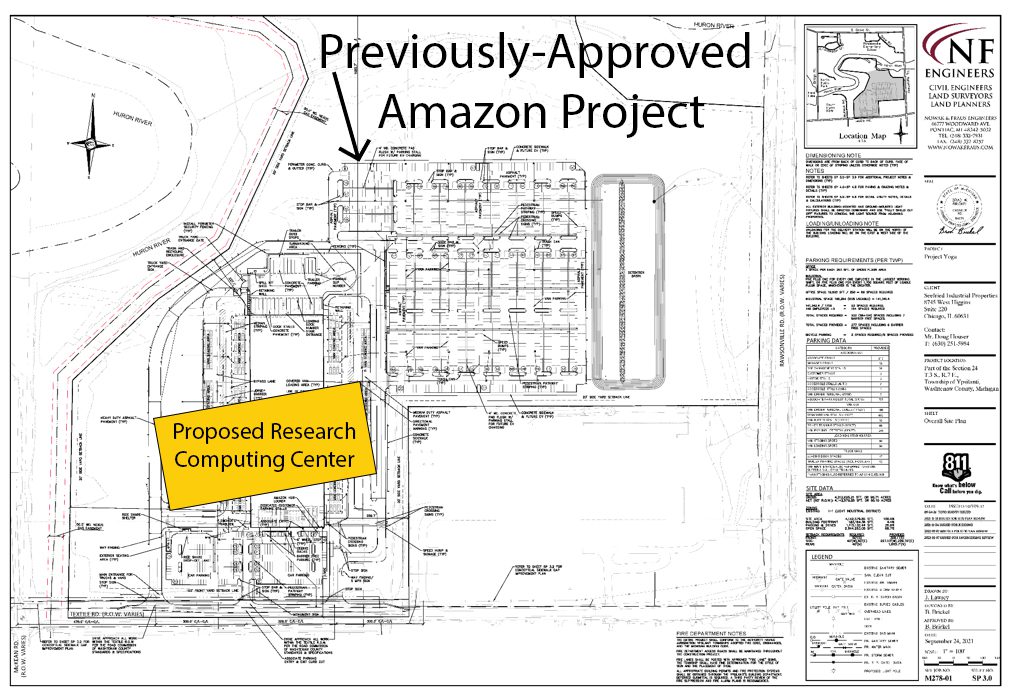
Compared to an Amazon distribution center project approved by Ypsilanti Township officials in 2021, U-M’s research center will occupy a substantially smaller footprint and generate far less daily traffic.
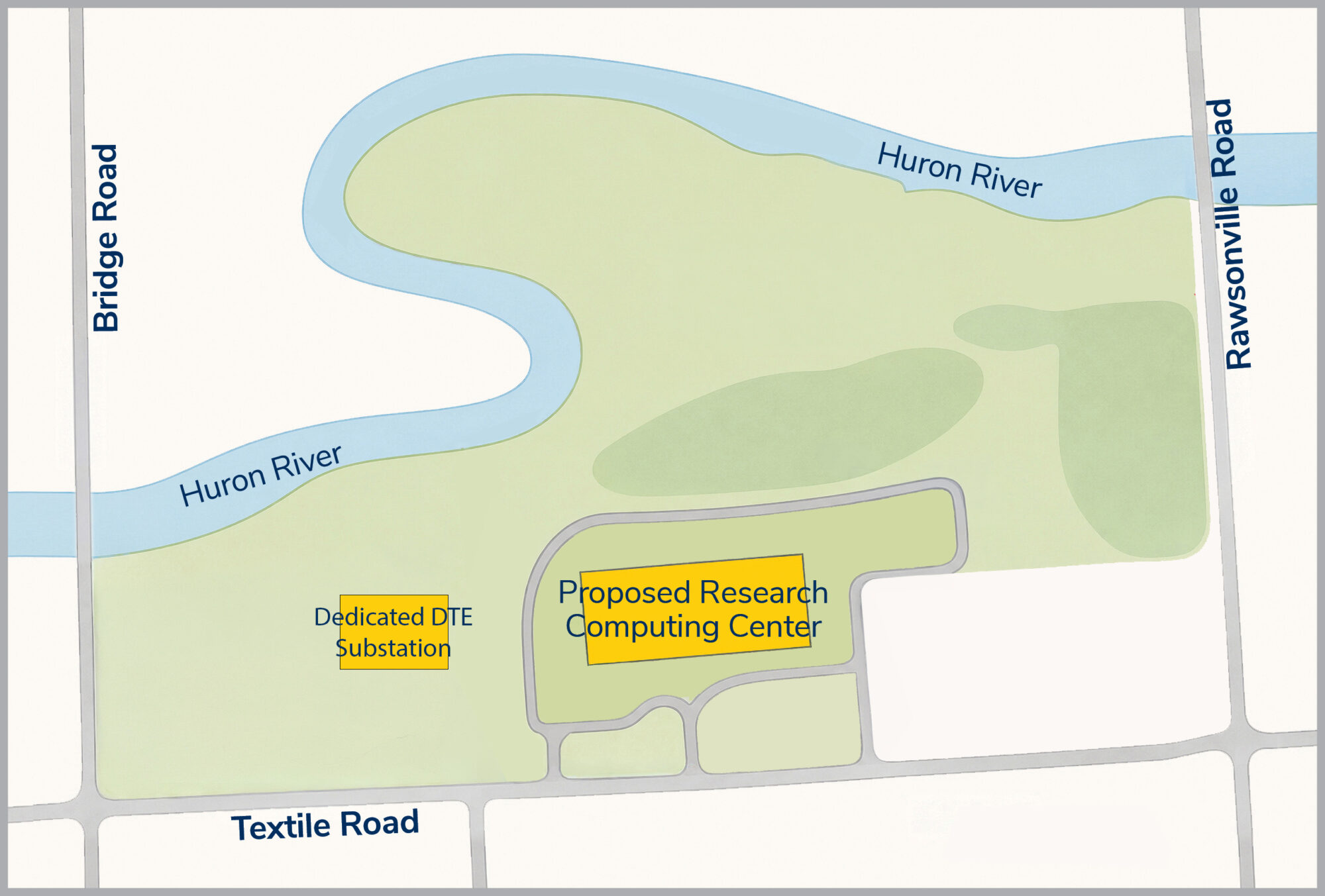
U-M plans to develop a limited portion of the site’s 144 acres. The research center will be positioned to blend aesthetically with the surrounding area and preserve the Huron River waterfront portion of the property as natural open space.
Research Computing Center Timeline
MAY 2024
U-M and Los Alamos begin a five-year collaboration to develop advanced computing technologies to address critical research challenges.
MAY 2024 – JAN. 2025
U-M evaluates multiple potential locations across Washtenaw County for a possible research computing center, including early feasibility reviews of the Willow Run site.
OCT. 2024
U-M Board of Regents approves the purchase of a 20-acre parcel on Textile Road in Ypsilanti Township for a future research computing center.
DEC. 2024
U-M and Los Alamos publicly announce plans to develop a research computing center.
DEC. 2024
Michigan House and Senate Appropriations committees approve a $100 million state grant for the project.
JAN. 2025 – JUL. 2026
U-M conducts site-selection due diligence.
JAN. 2025 – APR. 2026
Site-agnostic design development, independent of final site selection.
JUNE 2025
U-M Board of Regents approves the purchase of an additional 124-acre parcel on Textile Road for potential development of the research computing center while site-selection due diligence continues.
AUG. 2025 – JAN. 2026
U-M conducts additional due diligence at the Willow Run site.
SEPT. 2025
U-M hosts a community open house on campus.
JAN. 2026
U-M hosts a community open house in Ypsilanti Township.
FEB. 2026
Ypsilanti Township leadership speaks at a U-M Board of Regents meeting expressing preference for the Willow Run site.
FEB. 2026 – JUL. 2026
U-M conducts additional intensive environmental and legal due diligence at Willow Run at Ypsilanti Township’s request.
MARCH 2026
U-M completes the purchase of the additional 124-acre Textile Road parcel while evaluation of potential project sites remains underway.
APR. 2026
U-M hosts a student town hall.
AUG. 2026
Following completion of the site-selection process, Textile Road in Ypsilanti Township is selected as the preferred site for the research computing center.
SEPT. 2026
U-M hosts a community town hall in Ypsilanti Township.
SEPT. 2026 – MARCH 2027
U-M conducts site-specific environmental studies and develops the site-specific design.
SEPT. 2026 – MARCH 2027
Continued community engagement.
OCT. 2026
U-M scheduled to host a community town hall in Ypsilanti Township.
JAN. – JUL. 2027
U-M expected to finalize construction design and begin procurement activities.
LATE 2027
Construction is expected to begin.
2030
The facility is expected to begin initial operations.
What We’re Building
The $1.25-billion project, funded by the University of Michigan, Los Alamos, and the State of Michigan, will create world-class facilities:

Federal Research Facility
(240,000 sq. ft.)
Supporting national research and security challenges, including classified research.

Academic Research Facility
(~50,000 sq. ft.)
For non-classified research by U-M faculty, staff, students, and partners, including basic and applied research in science and engineering, the results of which are published and shared broadly within the scientific community.

DTE Electrical Substation
A new, dedicated substation that will exclusively power the facility and accommodate the facility’s energy needs, funded by U-M. No negative impacts to adjacent businesses and residences — preserves their electrical capacity.
This is not a commercial data center or manufacturing site.
It is a computing and research hub designed to advance science and education.
Environmental Commitments
The facility will be designed to run cleanly, efficiently, and sustainably.

- No impact to the Huron River — no water drawn from or discharged into it
- Cooling water and sanitation handled by existing municipal utilities with plenty of existing capacity
- Fully electric operations — in the event of an outage, only 10% of the facility’s power will be supplied by back-up generators
- Energy-efficient design: 20%+ better than code requirements
- LEED Silver certification
- Direct-to-chip computer cooling, which is 10-15% more efficient than air-cooled systems often used in typical data centers
- Minimal operational noise, no louder than a household air conditioner at property lines
Stay Connected to the Project
Submit a Question or Suggestion: Share your priorities and community project ideas at [email protected]
Join Our Mailing List: Click here to sign up for email updates on the project