
When AI Meets Poverty: U-M Researchers Chart a New Course
By Eric Shaw
Office of the Vice President of Research
An interdisciplinary group of U-M researchers map where AI can address poverty’s toughest barriers—and where it risks making them worse
Nearly 700 million people worldwide live in extreme poverty, surviving on less than $2.15 per day, and another 3.5 billion live on less than $6.85, according to the World Bank.
In the United States, about one in five children lived in poverty in 2023, the highest rate among comparable wealthy countries, according to the OECD, an international body that compares economic data across wealthy nations.
Artificial intelligence is rapidly reshaping industries from finance to pharmaceuticals. But its potential to address poverty, or to make inequality worse, has often been explored in isolation. A new whitepaper from the University of Michigan AI Laboratory brings these threads together in a single framework.
The paper, “Mapping Poverty Challenges to AI-driven Solutions,” offers a comprehensive framework for understanding how AI can help address poverty’s core barriers: food and housing insecurity, unequal access to healthcare and education and structural imbalances in power and representation. It also examines how AI can deepen those same inequalities if deployed carelessly.
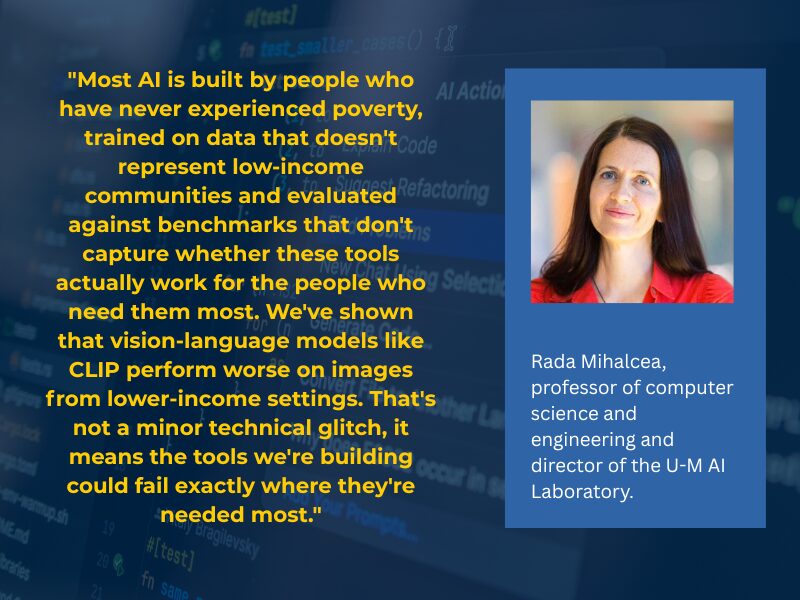
“Most AI is built by people who have never experienced poverty, trained on data that doesn’t represent low-income communities and evaluated against benchmarks that don’t capture whether these tools actually work for the people who need them most,” said Rada Mihalcea, professor of computer science and engineering and director of the U-M AI Laboratory. “We’ve shown that vision-language models like CLIP perform worse on images from lower-income settings. That’s not a minor technical glitch, it means the tools we’re building could fail exactly where they’re needed most.”
The paper grew out of a workshop that brought together nearly 30 researchers from poverty studies, artificial intelligence, social work, psychology, education, public health, robotics and design. It represents the kind of cross-disciplinary collaboration that U-M’s scale makes possible.
Current AI systems are largely developed in what some researchers call “WEIRD” contexts: Western, Educated, Industrialized, Rich, and Democratic. Low-income communities are underrepresented in data, in the problem definition and on developer teams. U-M researchers have demonstrated that widely used vision-language models recognize and caption images from lower-income environments less accurately than those from wealthier contexts. The team is now developing strategies to improve AI performance across socioeconomic conditions.
The whitepaper maps five domains where poverty creates barriers (limited resources, education, power imbalances, healthcare disparities and lack of trust in systems) and examines both “top-down” approaches like government services and institutional tools and “bottom-up” alternatives like community-owned platforms, worker cooperatives and local economic structures.
For each domain, the researchers identify concrete opportunities. AI-driven predictive models could identify households at risk of eviction before crisis strikes. Mobile applications could guide people to emergency shelters and food assistance even in areas with weak internet infrastructure. Machine learning algorithms could flag students at risk of dropping out, enabling earlier intervention.
“Working with poverty researchers has fundamentally changed how I think about what we’re building,” Mihalcea said. “They ask questions that don’t show up in our standard benchmarks. Who is this tool actually for? What happens when it fails? Who bears the cost of those failures? Those questions should be central to AI development, not afterthoughts.”
The whitepaper also tackles algorithmic bias head-on. When AI models are trained on historical data from institutions that have discriminated, they can perpetuate those patterns in lending, housing, hiring and benefits decisions. The researchers call for diverse data, clear fairness metrics, transparency and the ability for people affected by AI decisions to contest them.
“In my work with community health centers in Detroit, I’ve seen how much effort it takes to build trust with communities that have been over-studied and under-served,” said Minal Patel, professor of health behavior and health equity at the U-M School of Public Health and a faculty affiliate with Poverty Solutions. “They’ve been promised solutions before. If AI tools are going to make a difference, communities need to be involved in designing them from the start,not as research subjects, but as partners who shape what gets built and how it gets used.”
Job displacement presents another risk. AI-driven automation is already reducing or reshaping many routine tasks in manufacturing, finance and retail, disproportionately affecting low-wage workers. Drawing on global estimates, the authors note that analyses by McKinsey and others suggest around 60% of jobs could see significant changes in their task mix due to AI and automation. A 2025 World Economic Forum report projects a net gain of 78 million jobs globally by 2030—170 million roles created and 92 million displaced, assuming reskilling keeps pace.
What distinguishes this work from typical academic research is its integration of technical AI expertise with decades of on-the-ground poverty research. Poverty Solutions, U-M’s university-wide initiative focused on action-based research, brings long-standing partnerships in Detroit and across Michigan. The AI Laboratory brings computational methods and the technical capacity to build and evaluate tools.
The collaboration also includes researchers developing “generative justice” frameworks, economic models where AI helps communities retain value rather than having it extracted by corporations. One example: Ubuntu-AI, a platform where African artisans co-develop AI tools and retain control over how their work is used, receiving compensation when their images are licensed for AI training.
“Social work holds that the people with lived experience of a problem have a unique understanding of its causes and implications,” said Laura Lein, the Katherine Reebel Collegiate Professor Emerita of Social Work. “The question isn’t whether AI can address poverty. It’s whether AI tools can empower communities to address problems.”
“What excites me about this collaboration is the focus on navigation and accessibility,” Patel said. “A lot of my research is about helping people access resources that already exist but are difficult to find or use, such as health insurance, financial assistance and chronic disease management support. AI could make those systems easier to navigate, but only if it’s designed with the people who actually have to use them.”
This work represents an interdisciplinary collaboration spanning AI, social work, psychology, public health, education, design, robotics, and secondary education. Contributors include Laura Lein, Angana Borah, Zara Burzo, Ron Eglash, Mazhad Khoshlessan, Zhijing Jin, Ram Mahalingam, Joan Nwatu, Minal Patel, Alvaro Vega Hidalgo, Tiffany Wu, and Rada Mihalcea. The paper can be accessed at https://ai.engin.umich.edu/research-insights/white-papers/