
U-M researchers explore the trade-offs of putting data centers in space
By Wendy Sutton
As artificial intelligence drives demand for computing power, the need for data centers is growing.
Now, a team at the University of Michigan is looking at the potential benefits and challenges of placing some of that computing infrastructure in space to reduce pressure on Earth’s resources, increase efficiency and help position the nation at the forefront of the emerging space economy.
The project, “In-Space Data Centers and Earth-to-Orbit Supply Chains,” is led by Siqian Shen, professor of the department of industrial and operations engineering and civil and environmental engineering and funded through the Office of the Vice President for Research’s Bold Challenges 2026 Boost Program. The semester-long program provides support to early-stage collaborative teams with large-scale funding potential in the next five years.
The data center effort draws on U-M’s broad expertise in orbital computing, space manufacturing, infrastructure and supply chain optimization, artificial intelligence, materials, communications, business and policy.
“What sets U-M apart is that we are bringing space computing and space manufacturing together,” Shen said. “We’re not just asking how to put one computer in space. We’re looking at the infrastructure needed to build data centers at scale, how government and industry should participate and how the entire system can benefit society as a whole.”
“What sets U-M apart is that we are bringing space computing and space manufacturing together. We’re not just asking how to put one computer in space. We’re looking at the infrastructure needed to build data centers at scale, how government and industry should participate and how the entire system can benefit society as a whole.”
Commercial activity in space is accelerating rapidly, and several companies are now testing whether computing infrastructure can move to orbit. Google recently launched a prototype satellite carrying its AI chips under Project Suncatcher, an early step toward studying solar-powered data centers in space. SpaceX and Blue Origin have both filed plans for large satellite networks intended to host AI computing.
If space-based computing continues to grow, it will require significant changes to Earth-based supply chains and logistics. Those changes will have implications not only for large launch providers, but also for smaller companies and national security efforts.
Building data centers in space will require coordinating with many suppliers to align with launch schedules, fitting components into rocket payloads, launching them into orbit and assembling them in space. Labor or raw material shortages can create a bullwhip effect in which small disruptions at the start of the supply chain become amplified, causing larger shortages at the end of the chain. Shen’s team is developing ways to help businesses anticipate these disruptions, identify alternative suppliers and prevent shortages while avoiding excess inventory.
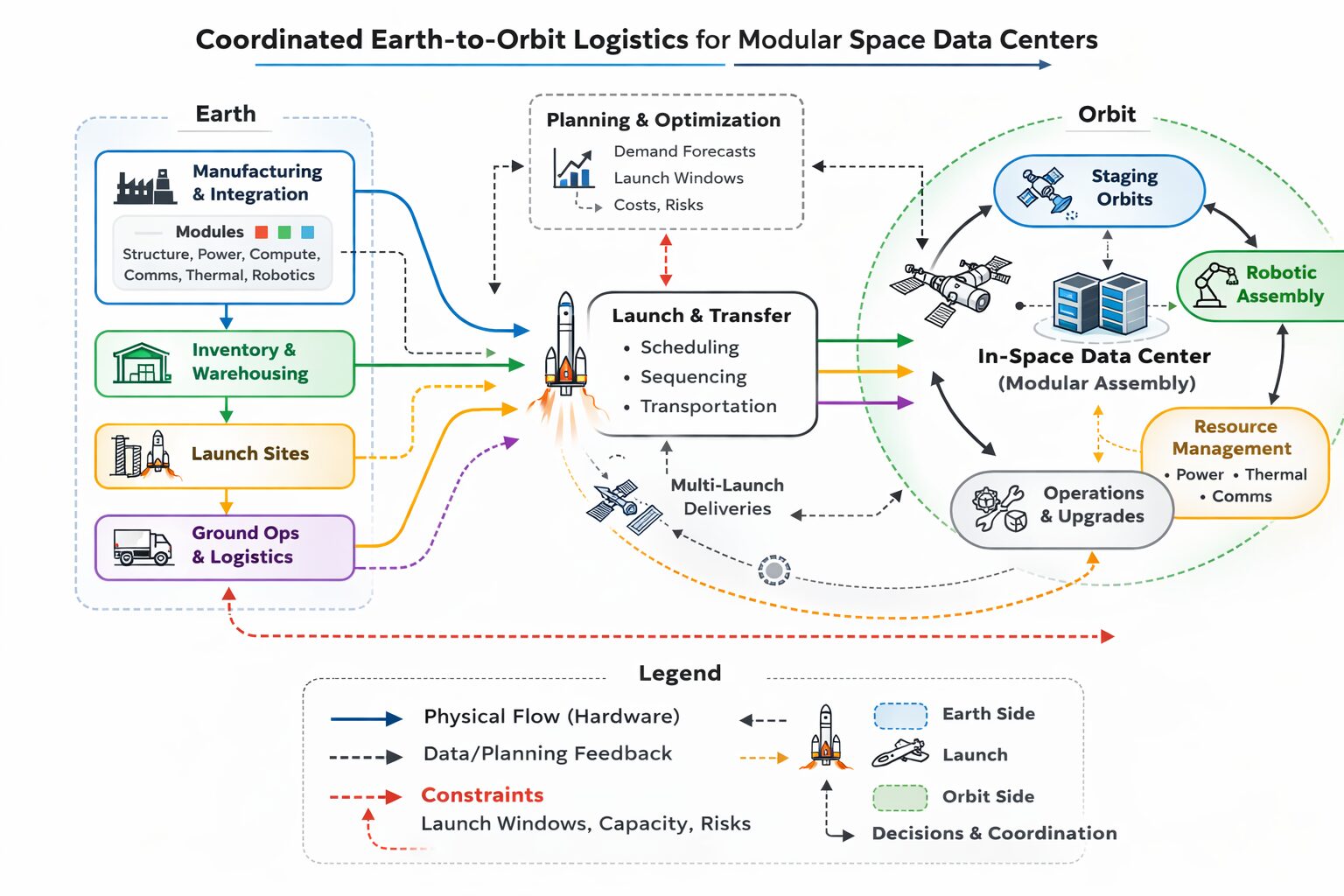
Longer text description of the image
Coordinated Earth-to-Orbit Logistics for Modular Space Data Centers
The diagram shows how Earth-based production and logistics connect to the assembly and operation of a modular data center in orbit.
Earth-based activities
- Manufacturing and integration: Produce modules containing structure, power, computing, communications, thermal systems, and robotics.
- Inventory and warehousing: Store and manage modules before launch.
- Launch sites: Provide facilities for launching hardware.
- Ground operations and logistics: Support transportation and launch preparation.
These activities are connected in a downward sequence and feed into launch and transfer, which coordinates scheduling, sequencing, and transportation. Multiple launches deliver hardware to orbit.
Planning and optimization
A planning function above launch and transfer considers demand forecasts, launch windows, costs, and risks. Dashed connections show data and planning feedback between planning, Earth-side activities, launch and transfer, and orbital activities.
Orbital activities
- Staging orbits: Hold hardware before assembly.
- Robotic assembly: Integrates modules into the in-space data center.
- In-space data center: The central modular assembly, depicted as two server cabinets.
- Resource management: Manages power, thermal systems, and communications.
- Operations and upgrades: Supports ongoing operation and changes to the assembled system.
Connections link staging, assembly, resource management, and operations around the data center. Return paths connect orbital activities with launch coordination and ground logistics.
Meaning of the connections
Solid arrows represent physical hardware flows. Dashed arrows represent data and planning feedback. Additional dashed paths indicate coordination and constraints, including launch windows, capacity, and risks. Outlined regions distinguish Earth-based activities from activities in orbit.
The team is beginning its work by examining supply chains and rocket assembly processes at companies like SpaceX to determine whether new suppliers or a larger launch network will be required. Research will also examine which orbits are best suited to different types of data centers and which launch sites can reach them most efficiently. Depending on the payload’s destination, a launch site’s latitude can significantly affect how much fuel is needed. However, planners must balance fuel efficiency with proximity to suppliers to avoid the higher cost of shipping components to remote locations.
Researchers must also address long-distance communications, networking, security, radiation and cooling. Some tasks will be more efficient on Earth. Others will be better suited for space, where solar panels in certain orbits receive nearly continuous sunlight and can generate several times more energy than on Earth. Space-based computing also offers the benefit of processing satellite data closer to where it is collected, which could reduce communication delays.
In September, the team hosted “From Grid to Orbit: Space Data Centers and Economy at Scale,” a workshop connecting experts in space manufacturing, logistics and computing from industry, academia and government. Experts from NASA, the National Science Foundation, the U.S. Space Force, SpaceX and Aethero discussed infrastructure, technology, logistics and policy.
The goal was to bring groups working on different aspects into the same room to explore what it would take to build and operate large-scale data centers in space. Participants considered infrastructure needs, opportunities for collaboration between space manufacturing and computing researchers and the roles of government and industry.
The workshop marked a first step toward understanding whether and how space-based data centers could operate and communicate with data centers on Earth. A second workshop with a broader audience and more government and industry attendees is being planned.
Core team members include Jun Li, professor of technology and operations at the Ross School of Business; Max Li, assistant professor of aerospace engineering; Ruiwei Jiang, associate professor of industrial and operations engineering; Xun Huan, associate professor of mechanical engineering; and Nathan Bleier, assistant professor of computer science and engineering.
“Space exploration isn’t going away,” Shen said. “Advancing humanity is a step-by-step process. As a civilization, we develop infrastructure and then new technology makes it obsolete. But what we’re building is a complex system that will remain useful, not only for space-based computing, but also for continued space exploration and the broader space economy. It’s important to have a plan and think about the best way for all parties to participate, including government, industry, academia, communities and the people using the resources. This ensures that we do this responsibly, in a sustainable and economically viable way. That is what we really want to achieve.”