U-M pharmacy collaborative puts tribal community needs first — and lets research follow
By Eric Shaw
Nicholas Cushman knows what it looks like when researchers arrive in tribal communities with a proposal already written. As an enrolled member of the Sault Ste. Marie Tribe of Chippewa Indians and a pharmacist who has spent years working within the Indian Health system, he has seen the pattern often enough to want to build something different.
The result is the Collaborative for Indigenous Resources in Care, Learning, and Excellence, launched in 2024 within the University of Michigan College of Pharmacy. Co-directed by Cushman and clinical oncology pharmacist Emily Mackler, CIRCLE operates on a deliberate premise: listen to what tribal health leaders actually need, respond to those needs first and let research develop from that foundation — if it belongs there at all.
“We don’t come into tribal communities focused on research,” Cushman said. “We focus on community needs first. If research follows, it’s because it supports that work.”
That sequence matters. Rooted in community strengths, progress in care and health outcomes in American Indian and Alaska Native communities depends as much on trust and partnership as on clinical and technical expertise. Communities with long experience as research subjects rather than research partners have reason to be skeptical of outside institutions. CIRCLE is built on the belief that meaningful change begins with earning that trust.
Strengthening what’s already there
One of CIRCLE’s active initiatives focuses on pharmacy operations at a Tribal Health Center: medication governance, workflow clarity and scope of practice. The approach is deliberately incremental.
Rather than arriving with a redesign plan, CIRCLE staff started with listening sessions and process mapping. Tribal pharmacy staff described existing workflows, identified what was working and flagged where variability created uncertainty. Academic collaborators contributed evidence-based frameworks as reference points, not templates. Conversations are ongoing about whether formal governance structures, including a pharmacy and therapeutics committee, could support more consistent decision-making at the health center.
None of this is a completed intervention. It is foundational work — clarifying processes, aligning expectations and identifying areas for gradual refinement in a way that respects local authority.
Mackler brought prior experience to that approach. She founded Pharmacists Optimizing Oncology Care Excellence in Michigan, a statewide quality improvement collaboration, housed by the Michigan Oncology Quality Consortium (MOQC) and the Michigan Institute for Care Management and Transformation (MICMT). Otherwise known as POEM, it supports the integration of clinical pharmacists into oncology care teams across the state. POEM demonstrated that pharmacist integration can be structured, supported at scale and demonstrate meaningful clinical outcomes. CIRCLE has drawn on those lessons while being clear about their limits.
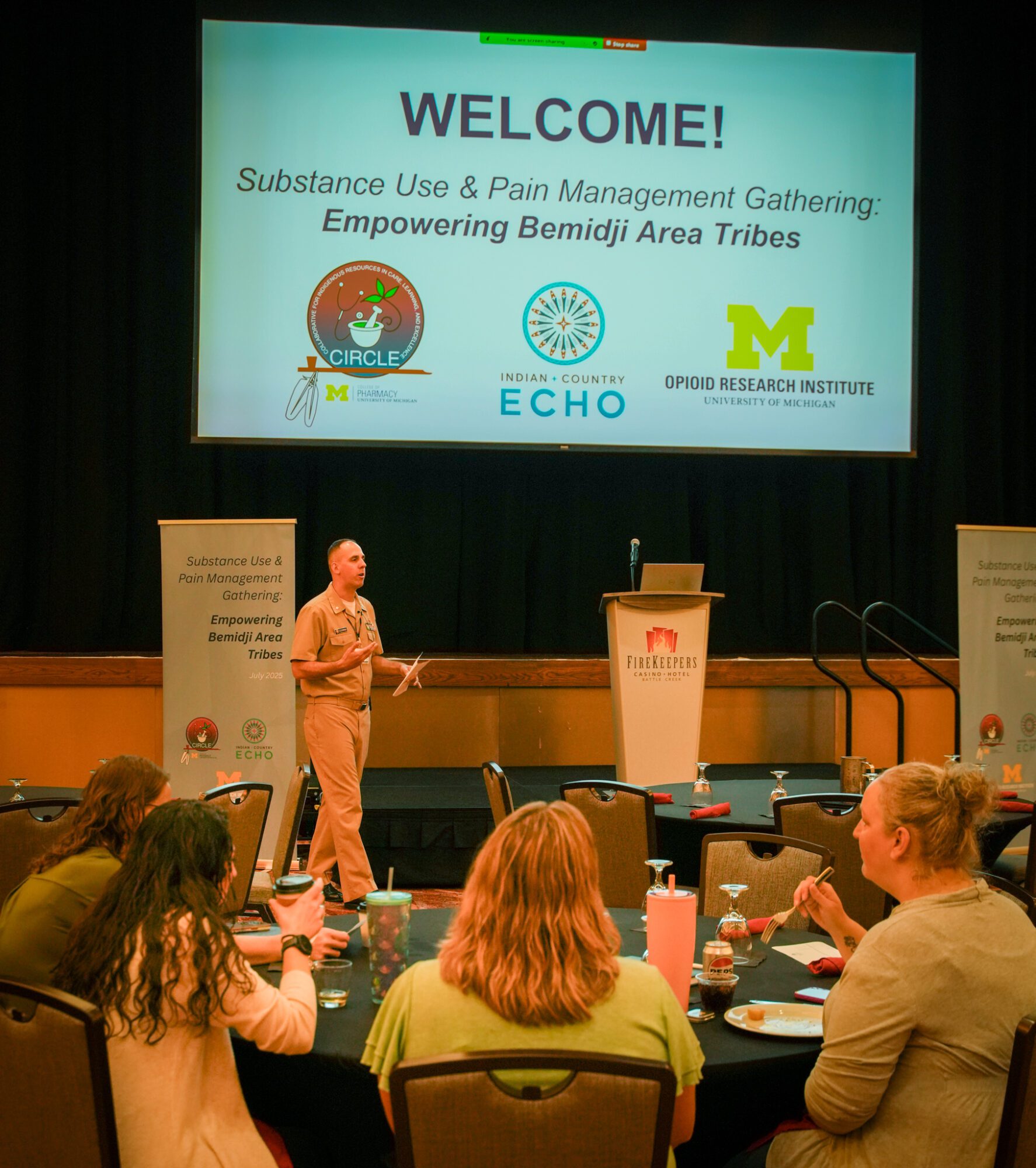
Nicholas Cushman delivers opening remarks at the Substance Use & Pain Management Gathering: Empowering Bemidji Area Tribes, a collaborative event focused on supporting Tribal communities through culturally responsive approaches to substance use and pain management.
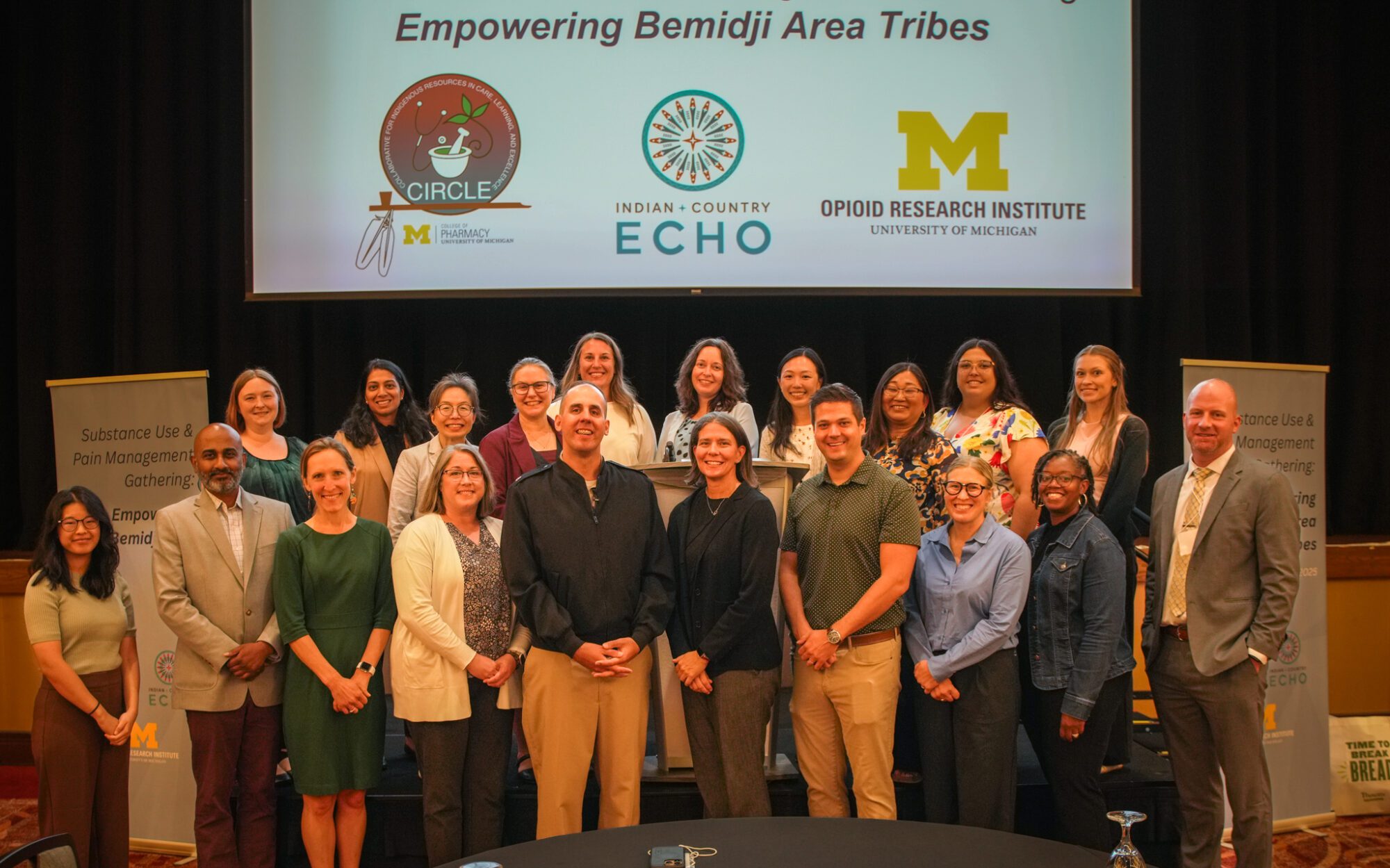
Nicholas Cushman joins event staff and invited speakers for a group photo at the Substance Use & Pain Management Gathering: Empowering Bemidji Area Tribes.
“What worked in one setting doesn’t automatically transfer to another,” Mackler said. “The question is how to take lessons from prior experience, refine them and apply them in ways guided by tribal priorities so they truly fit each health center.”
In tribal settings, role definitions, referral pathways and sustainability planning are being developed collaboratively with clinic leadership and care teams, not imported from a prior model. Over time, the scientific contribution will come from documenting how clinical pharmacist integration takes shape in sovereign health systems and what factors influence its outcomes and sustainability.
A gathering and what followed
In July, CIRCLE co-hosted the Bemidji Area Substance Use and Pain Management Gathering with the university’s Opioid Research Institute, which provided substantial programmatic support and expert speakers. More than 100 people attended, including university faculty, students and tribal health leaders and clinicians from across the region.
Topics were shaped with input from tribal partners and included both clinical evidence and culturally responsive perspectives. Among 42 respondents to a post-event evaluation, 96%agreed the gathering met its learning objectives and 93%reported greater social support for their work. Participants identified concrete changes they planned to make, including refining screening practices, strengthening harm reduction strategies and improving team communication.
They also named real barriers: limited administrative resources and time constraints. CIRCLE is not offering itself as a fix for those pressures. But the relationships built at the gathering have since generated new collaboration and contributed to research proposals now in development — a downstream product of convening rather than the original objective.
“What worked in one setting doesn’t automatically transfer to another. The question is how to take lessons from prior experience, refine them and apply them in ways guided by tribal priorities so they truly fit each health center.”
What the model asks of the university
CIRCLE’s structure places the university in a supporting role, which is not how academic research partnerships typically operate.
Tribal Health Centers set priorities and retain authority over governance and decision-making. The university brings dedicated faculty time, grant administration, evaluation design and technical assistance in clinical and operational areas. As a large institution, it can absorb administrative burden, coordinate reporting requirements and adapt its processes to align with tribal review structures and timelines.
Regionally, the collaborative offers a model for how academic institutions can engage without dominating. Co-implementation, shared decision-making and transparent evaluation provide a framework other partnerships can examine and adapt.
Nationally, the contribution is conceptual as much as clinical: research need not be the starting point. When listening precedes proposal writing and service precedes study design, research questions are more likely to reflect what communities have prioritized.
Where things stand
The initiatives are still early. Pharmacy operations work is ongoing. Pharmacist integration continues to evolve. Research collaborations are developing on timelines that tribal partners lead.
What is already clear is the underlying logic of the work. Strengthening access to care in tribal communities requires building the clinical infrastructure to support that access, and building that infrastructure requires relationships that were not extracted from communities but built with them.
“Research, when it develops, should align with those goals rather than the other way around,” Cushman said. “That’s what it means to treat tribes as sovereign partners.”