
How cells keep RNA from clumping under stress — and why it matters for neurodegenerative disease
By Paul Avedisian
Center for RNA Biomedicine
A new study from the University of Michigan’s Stephanie Moon Lab offers fresh insights into how cells manage molecular crises.
Stephanie Moon, assistant professor of human genetics, has for years focused on how cells respond to stress, and the resulting RNA-protein clumps that are close relatives of the amyloid plaques found in many neurodegenerative diseases like amyotrophic lateral sclerosis, or ALS.
The fundamental insights gained from the new study could ultimately help inform the development of new treatments and therapeutic interventions to maintain healthy protein synthesis in diseases where the stress response goes awry.
That’s where fundamental science becomes human-centered.
“Discovering new therapeutics for neurodegeneration is critical,” Moon said, “But where do you start?”
Her answer: look upstream.
In healthy cells, most RNA molecules are covered with ribosomes, which function like miniature factories, translating genetic instructions in RNA into the proteins essential for cellular function.
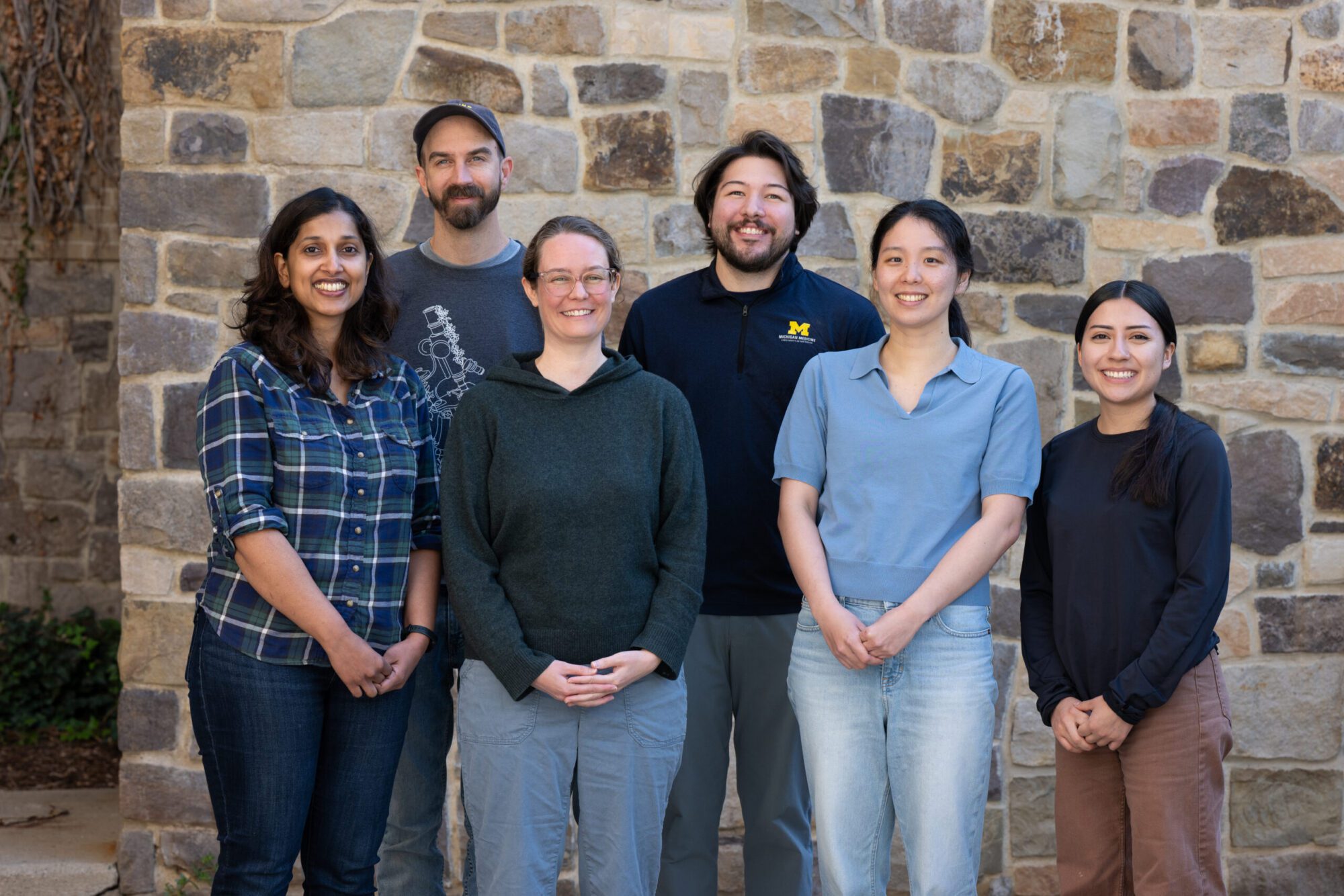
The Moon Lab team.
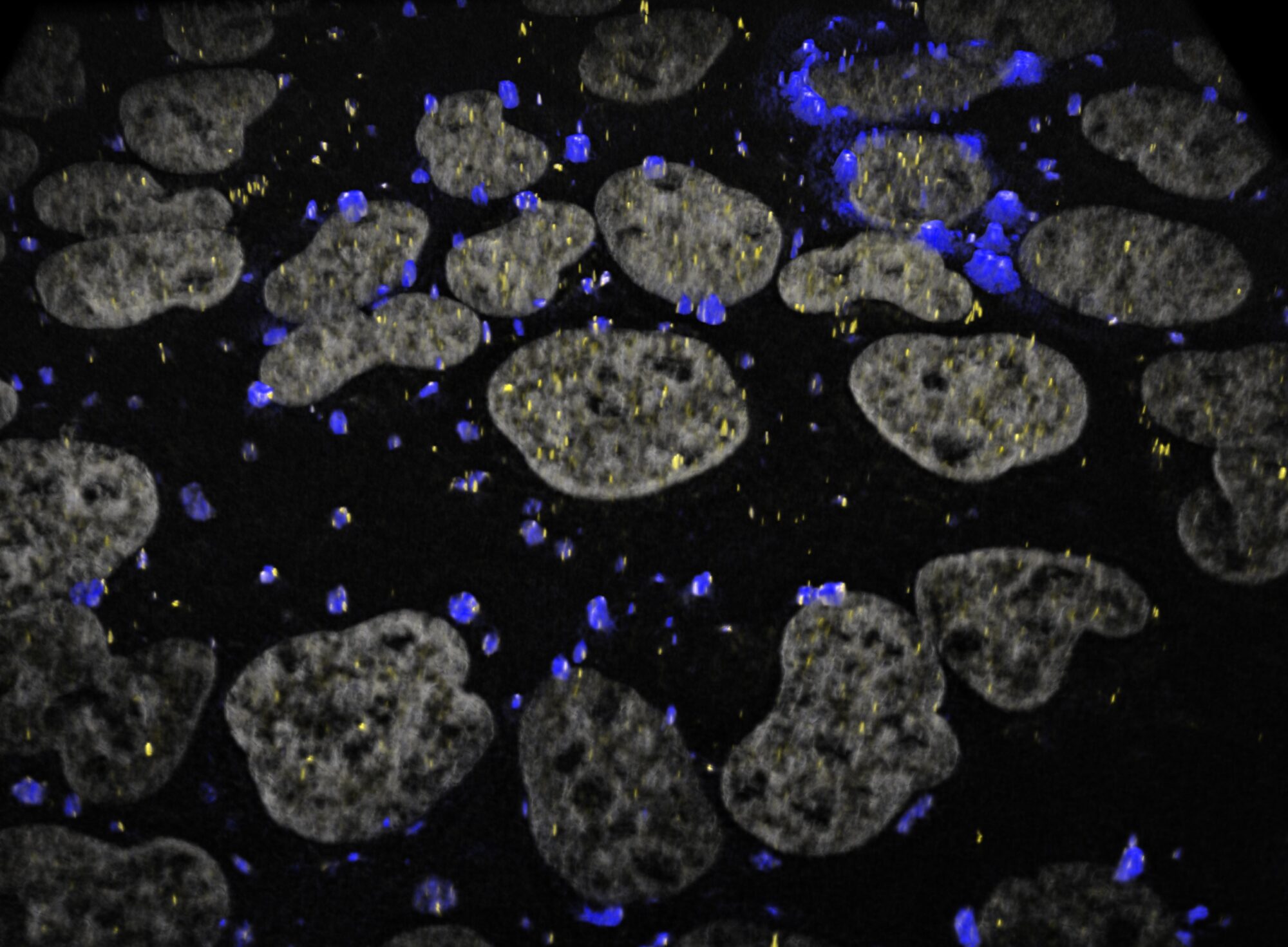
Stress granules (blue) form in stressed cells and contain RNA (maize). Cell nuclei are shown in grey.
When cells are stressed by heat, toxins, inflammation or other challenges, most cellular processes, including protein production, are temporarily shut down to help the cell survive.
Ribosomes typically detach or “run off” RNAs as part of this response. These unprotected RNAs then attract protein molecules like two polar-opposite magnets and clump together in blobs called “stress granules.” These “reversible” RNA-protein condensates act as temporary storage sites until conditions return to normal, and the stress granules typically “dissolve.”
Sometimes, stress granules can linger persistently and “harden” or aggregate from their normal liquid-like state to a gelatinous, solid consistency much more difficult to break down and clear — a road that could lead to pathogenesis.
Understanding the integrated stress response pathway is therefore paramount to Moon and her team, since neurodegenerative diseases like ALS, Alzheimer’s and frontotemporal dementia have long been linked to RNA-protein aggregates, making them close cousins of the stress granules Moon and her team are studying.
To avert the pathogenic highway and help the cell recover and adapt, Moon and her team knew that certain mRNAs (messenger RNAs) needed to be expressed during stress.
“These specialized mRNAs are like emergency vehicles speeding toward a wreck on an interstate highway where they can quickly respond,” Moon said. “Some of the ‘regular’ traffic (other mRNAs) is sent off the road (into granules) during the crisis.”
Before this study, it wasn’t clear if or how these specialized mRNAs were kept out of stress granules. While many studies hinted that translation of these mRNAs during stress would exclude them from stress granules, other recent studies found evidence that these mRNAs could translate inside stress granules.
This study, published in the journal Genes & Development and first-authored by Ph.D. candidate Noah Helton, showed that these vital mRNAs escape stress granules by interacting with ribosomes. Trapping these mRNAs in stress granules would halt their protein production at a time when the cell may need them most.
In their experiments, they confirmed that “extra instructions” tacked onto these mRNAs led to greater association with ribosomes under stress. Removal of those instructions caused loss of ribosome association, and more of the mRNAs ended up in stress granules. They also found that having just one ribosome attached to mRNA is enough to keep them out of stress granules, flipping an established “multiple ribosomes” theory on its head.
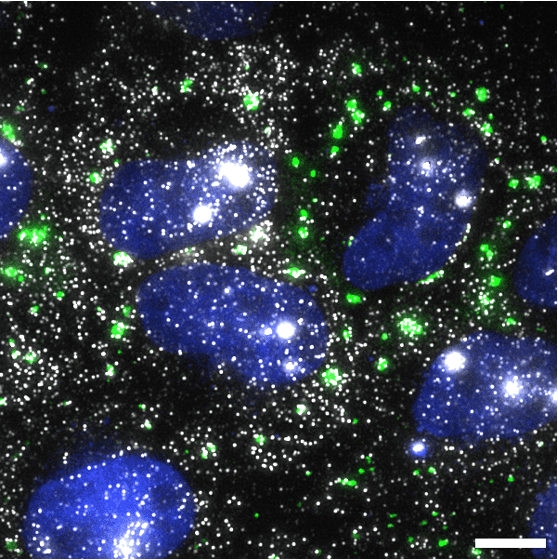
Single molecules of RNA (white) can coalesce into stress granules (green) in stressed human cells (nuclei in blue).
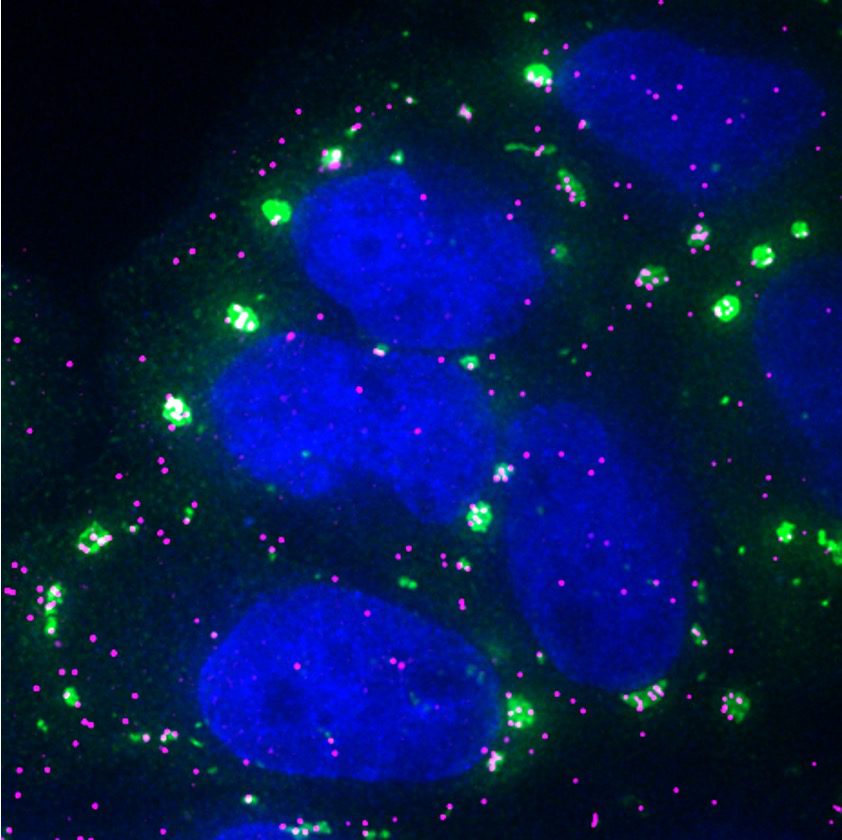
Individual mRNA molecules (pink) are detected in human cells (nuclei in blue) and localize to stress granules (green).
“These are such complex diseases that require a multifaceted approach. It’s my hope that these and future studies from our lab will help develop viable therapeutics by further defining the driving mechanisms behind the pathogenesis at or at least very close to the source. That’s multi-dimensional, full-spectrum fundamental science at its core.”
“If you think of RNA as a string and the ribosome as a bead,” said co-author Benjamin Dodd, “it has been the prevailing thought that multiple beads on the string act as a shield. What this paper reveals is that having just one bead does the same thing.”
Follow-up work in Genes & Development and RNA added another wrinkle: cells sometimes let ribosomes “park” on their RNAs and sit idle during the stress response, which proves to be a double-edged sword.
Dodd elaborates, “Perhaps cells have evolved to think they should tolerate these ‘squatters’ because at least they’re not allowing the formation of the granules. You want the stress granules to form as part of the healthy normal response, but they could also form into these pathogenic aggregates — it’s a compromise.”
For Moon, mapping the primordial upstream mechanics in healthy cells lays the foundation to better identify the earliest intervention points long before the system breaks down, and you have a better shot at finding where to intervene before disease takes hold.
“These are such complex diseases that require a multifaceted approach,” Moon points out. “It’s my hope that these and future studies from our lab will help develop viable therapeutics by further defining the driving mechanisms behind the pathogenesis at or at least very close to the source. That’s multi-dimensional, full-spectrum fundamental science at its core.”
Papers cited:
- “Ribosome association inhibits stress-induced gene mRNA localization to stress granules.” Genes & Development. DOI: 10.1101/gad.352899.125
- “Tuning tRNA synthetase inhibition reveals parabolic induction of stress granules limited in size and RNA content.” RNA. DOI: 10.1261/rna.080883.125
- “tRNA synthetase activity is required for stress granule and P-body assembly.” Genes & Development. DOI: 10.1101/gad.353535.125
Funding:
Supported by National Institute of General Medical Sciences (R35GM146711) and the Chan Zuckerberg Initiative
Read more about Dr. Stephanie Moon’s work in the article, “Under Pressure,” in the 2025 issue of RNA Translated.