
Engineers and Surgeons, One Mission
By Wendy Sutton
Inside the department that’s restoring natural movement to amputees and rewriting what’s possible.
At the University of Michigan’s Biomedical Engineering (BME), engineers and clinicians work side by side to advance research that addresses some of society’s greatest challenges.
U-M is one of only a few universities in the nation with a top-ranked engineering college and medical school on the same campus, and BME is even more of a rarity – an academic unit jointly administered by both.
Cynthia Chestek, professor of biomedical engineering, electrical engineering and computer science, robotics and neurosurgery, and Paul Cederna, the Robert Oneal Collegiate Professor of Plastic Surgery, began their collaboration more than a decade ago through BME’s Coulter Translational Research Partnership Program, which supports promising research progressing toward commercial development and clinical use.
“As an undergraduate, I spent the summer working in a neuroscience lab where they recorded from live neurons,” Chestek said. “It was amazing and I knew from then on that I wanted to do research where electrical engineering meets the brain. When I started my faculty position at U-M, I met Paul, a wonderful surgeon who invented a way to take a small nerve signal and make it big. That was the start of our collaboration.”
At the time, Cederna was working under a Department of Defense Army Research Office grant to develop an advanced prosthetic device control system that would allow a hand or leg to move naturally while providing sensory feedback to the brain. His team made significant progress establishing the regenerative peripheral nerve interface (RPNI), a technique that involves wrapping a small piece of muscle around a nerve.
The interface allows the muscle to amplify signals otherwise too weak to record. Moving the research forward required Chestek’s expertise. Her arrival enabled research to advance into large-animal models and human studies.
“Her skills were exactly what we needed to move our work from the lab to the clinic and help the 100,000 people with limb loss following devastating amputations,” Cederna said. “It began as a great partnership and only got better. Our skills were complementary, allowing us to advance the field at a shockingly fast pace. What an exciting time to be part of this team and to have Dr. Chestek as a close collaborator.”
Supported by a Coulter Program seed grant, Chestek and Cederna launched a project using RPNI. Chestek uses those amplified signals and applies algorithms to control the movements of a prosthetic hand.
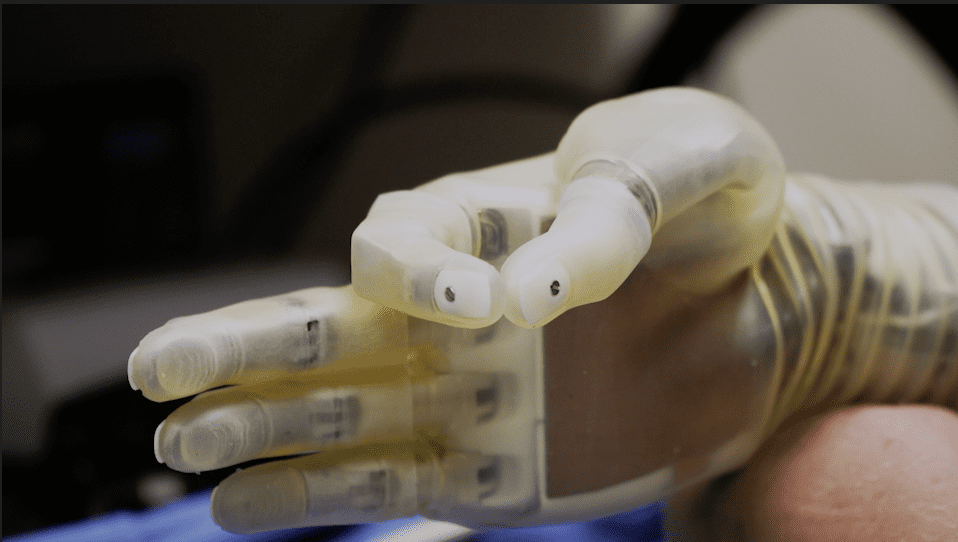
A prosthetic device control system that allows a hand or leg to move naturally while providing sensory feedback to the brain.
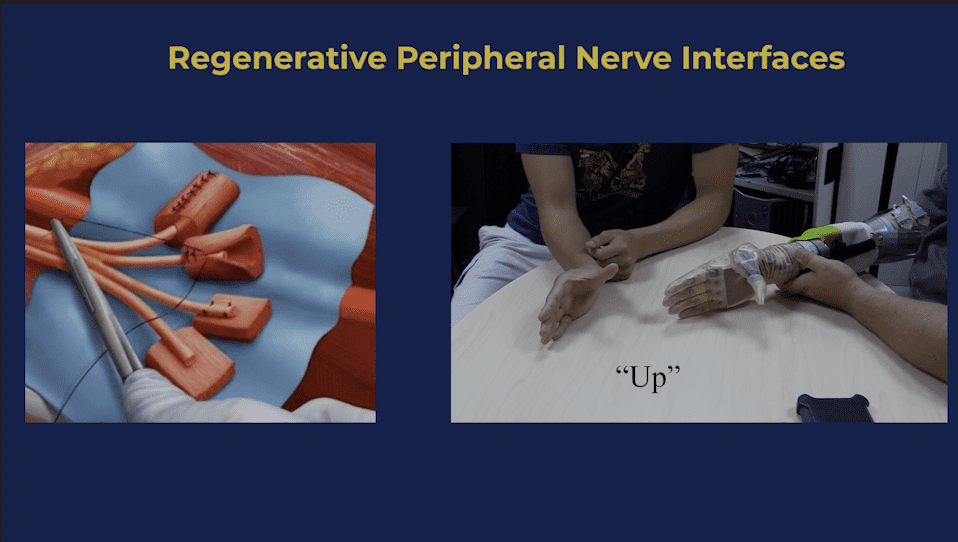
Regenerative peripheral nerve interface (RPNI) – technique that involves wrapping a small piece of muscle around a nerve
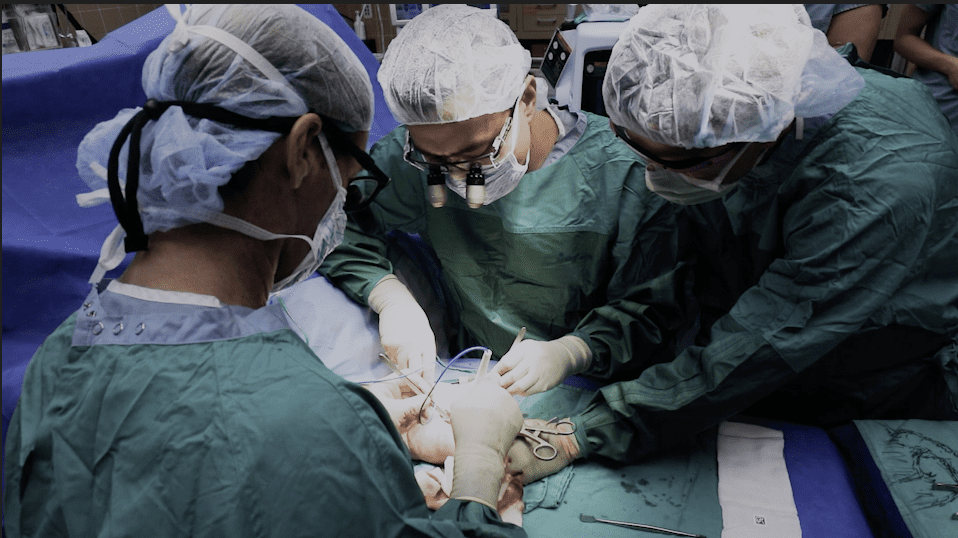
More than 500 patients have benefited from RPNI surgery at the University of Michigan alone to reduce neuroma pain and phantom limb pain following amputation.
“You need close collaboration between engineering and medical doctors to do this work. You need an engineering lab with access to advanced techniques, and we have one of the top plastic surgery departments in the world. You must be state-of-the-art on both the medical and engineering sides to make experiments like this happen.”
“You need close collaboration between engineering and medical doctors to do this work,” Chestek said. “You need an engineering lab with access to advanced techniques, and we have one of the top plastic surgery departments in the world. You must be state-of-the-art on both the medical and engineering sides to make experiments like this happen.”
Neural interface engineering labs began forming in 2005, building on neuroscience discoveries from the 1980s that mapped neural firing to hand movements in animals. Those early findings paved the way for today’s advances in prosthetic control.
As the RPNI project grew, refining prosthetic hand movements became essential. Cederna and Chestek partnered with Deanna Gates, director of the Rehabilitation Biomechanics Laboratory in the School of Kinesiology, to advance the research. Most RPNI experiments now take place in this central campus lab, which uses motion-capture technology to study and test daily movements.
Their research is moving beyond the lab. More than 500 patients have benefited from RPNI surgery at the University of Michigan alone to reduce neuroma pain and phantom limb pain following amputation.
Blue Arbor Technologies, a startup dedicated to nerve-controlled prosthetic hands, was founded in Ann Arbor and is led by Cederna. The technology has the potential to expand to other uses, such as controlling lower extremity prostheses, providing exoskeleton control for individuals with paralyzed limbs and restoring sensation to the feet of those with numbness.
Patient take-home trials, led by Gates and focused on movement quality, allow volunteers to think about moving their missing hand, like flexing a finger or gripping an object. The brain sends signals to muscles as if the natural limb were still present.
“We’re grateful to the people who have volunteered for these studies,” Chestek said. “They’re part of our study team. They know this research won’t benefit them today, so we’re grateful for their selfless donation of time and effort to help us get this technology to the world.”
U-M’s strategy of placing a top medical school alongside a leading engineering college has allowed innovators like Cederna and Chestek the freedom to collaborate, creating breakthroughs not possible anywhere else.
“The Medical School is full of brilliant faculty with innovative and creative solutions to the most challenging problems,” Cederna said. “But they don’t have the skills, expertise or time to make those ideas a reality. U-M Biomedical Engineering is full of talented engineers who can create anything. By combining physicians and engineers, you have everything needed to make a huge impact on the world through innovation and discovery. As an individual, you can travel fast. As a team, you can travel far. And we have traveled far.”