
The Michigan Center for Materials Characterization, also known as (MC)², offers some of the highest-resolution electron microscopes available at the University of Michigan.
The facility houses several of the most advanced micron and nanoscale imaging tools available, providing researchers with the ability to view objects the size of one millionth and one billionth of a meter. To put that into perspective, a human red blood cell measures about 8 micrometers, while the diameter of a DNA double helix stretches 2 nanometers across.
Scientists use imaging tools like these to study how certain materials behave under varying conditions and react to circumstances at an atomic level. Some of the tools act as particle accelerators, while others are among the highest resolution microscopes in the world. One example is the Spectra 300 Transmission Electron Microscope, which has allowed scientists to view the smallest structures and interactions ever seen.
“In a lot of ways, these tools are like nano laboratories,” said Bobby Kerns, the center’s manager. “Much of the work being done has never been done before. As of now, we’re the only place in the world where these experiments can be executed.”
Materials analysis is a key component of the research process in several medical fields, as well as many other disciplines focused on chemical and nuclear engineering. The depth and breadth of the equipment and services at (MC)² make the center uniquely valuable to researchers in all aspects of scientific exploration.
The equipment is available for students and faculty to use freely once they have completed the appropriate training. The center’s team of experts also offers more comprehensive services, including datasets and detailed analysis.
“What our researchers want is the confidence to know that the equipment is cutting-edge, top of the line, running well and their students can gain access to it quickly,” Kerns said. “We create an environment of both leading equipment and open access, so they can truly explore.”
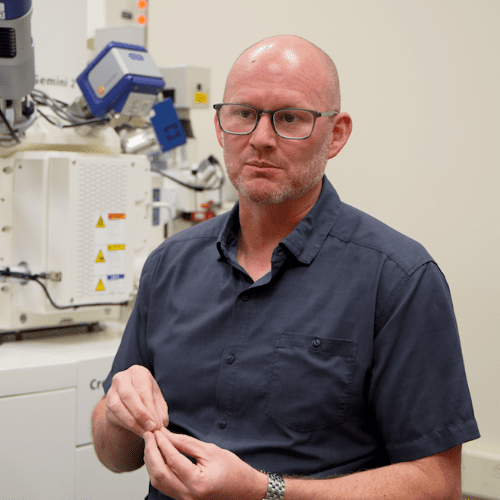
Bobby Kerns
Center for Materials Characterization (MC)2 – Center Manager
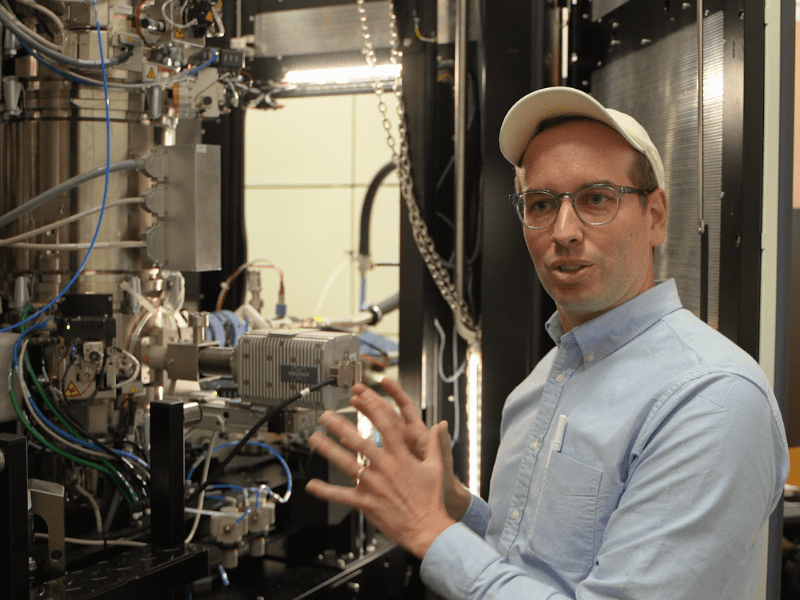
Robert Hovden at the Michigan Center for Materials Characterization (MC²), where he and collaborators conducted the ultracold electron microscopy project and tested the new technology.
Research cores are shared university facilities which offer specialized research services, equipment or expertise to U-M researchers, often at a recharge rate.
Kerns leads the team’s day-to-day operations, training new users and acquiring new equipment that further expands the center’s capabilities. He views the center’s role as not only supporting the world’s leading researchers, but also as part of the university’s efforts to recruit future researchers at the forefront of their disciplines.
“By working to acquire and bring cutting-edge instrumentation into the university, we’re working to recruit high-impact researchers,” Kerns said. “The world’s best faculty will bring the world’s best research projects, which bring the world’s best students. It really filters through the whole system.”
The center is an essential asset for researchers due to its ability to provide a low-vibration, low-field, environmentally controlled laboratory space, as well as its focus on training faculty and students. The lab’s users are primarily graduate students. Kerns has made the training and education of these students a leading priority.
The center frequently offers seminars to students focused on topics ranging from how to incorporate open source software into their research to how to go about purchasing an electron microscope, an expensive piece of equipment that is central to many kinds of research projects.
“Students are the reason why we’re here,” he said. “I want to help educate them on how the equipment works, because when you know how it works, you know what you might be able to do with it.”