
A leukemia drug the industry said was too challenging to develop
By Alexi Pierce
Innovation Partnerships
Most cancer drugs work by killing tumor cells. A new drug developed by University of Michigan researchers Jolanta Grembecka and Tomasz Cierpicki does something different: it convinces cancer cells to stop growing and reprograms them to resemble normal cells.
Komzifti (ziftomenib), approved by the U.S. Food and Drug Administration in November, is the first once-daily pill for patients with a specific form of acute myeloid leukemia whose cancer has come back or refused to respond to prior treatment. The drug is based on Grembecka and Cierpicki’s work.
The researchers spent nearly two decades chasing a target that drug companies dismissed as too challenging or even impossible to hit.
Acute myeloid leukemia, or AML, is one of the deadliest blood cancers with roughly 22,000 Americans receiving the diagnosis each year. The median age of AML diagnosis is 69 and the five-year survival rate is about 33%.
The standard treatment has barely changed in 50 years. Patients receive intense IV drugs pumped through a central line over four to six weeks of nonstop time in the hospital. The side effects are brutal. About 12% of patients wind up in intensive care during treatment.
For those whose cancer comes back or never responds, the picture is even worse. Median survival in that group is roughly five months.
Komzifti is approved for patients whose leukemia carries a change in a gene called NPM1. It is the single most common genetic flaw in AML, found in about 30% of cases. In a clinical trial of 112 patients with this type of relapsed or resistant AML, roughly one in three patients responded to the treatment and about 22% reached complete remission. That beat the expected response rate for this group and led to a median survival of more than 18 months for those who responded, compared to about 3.5 months for those who did not.
A target no one tackled
The drug’s origin story starts not with a company but with two scientists and a problem the drug industry thought was too challenging to be solved.
In healthy bone marrow, young blood cells follow a set path. They divide, mature into working white blood cells and then die on schedule. In NPM1-mutant AML, a protein called menin interacts with another protein, KMT2A, and the pair keeps certain genes switched on that should turn off. Those genes trap leukemia cells in a young, immature state. The cells divide without end, never mature and eventually crowd out healthy blood cells.
Blocking the menin-KMT2A protein pair was the clear goal. But the drug industry had long viewed such targets as out of reach. The surfaces where the two proteins grip each other are often broad and flat, with none of the deep pockets where typical drugs can lodge.
Grembecka and Cierpicki began their work on blocking menin around 2007 at the University of Virginia and kept going after they moved to U-M in 2009. They had to build their tools from scratch: making the human menin protein, creating screening methods to identify inhibitors and mapping its structure.
“For years, we have generated many small molecules blocking the menin-KMT2A interaction and tested their activity in pre-clinical models of leukemia,” said Grembecka, professor of pathology and the Richard and Susan Rogel Professor of Cancer Therapeutics. “The first time we saw clinical data showing the drug was actually working in patients, that changes how you think about everything you’ve done.”
Their 2012 paper in Nature Chemical Biology reported the first small molecules that could block the menin-KMT2A interaction. Over the years that followed, the team tested more than 1,000 candidate compounds, steadily making the compounds stronger and easier to take as a pill.
In 2014, Innovation Partnerships licensed the intellectual property portfolio to Kura Oncology, which in collaboration with Grembecka and Cierpicki built the clinical drug known now as Komzifti. Blood Cancer United (formerly the Leukemia & Lymphoma Society) put millions of dollars into the pre-clinical research at U-M over the life of the program. Clinical trials evaluating Komzifti started in 2019. In late 2024, Kura partnered with the Japanese drug company Kyowa Kirin to bring the treatment to patients worldwide.
What the drug actually does
Chemotherapy works by killing all fast-dividing cells, cancerous or not. The menin inhibitor Komzifti takes a different approach. It fits into the pocket on menin where KMT2A normally docks and blocks the two proteins from interacting. Without that interaction, the genes keeping leukemia cells immature switch off. The cells pick up where they left off, maturing in a similar way as normal blood cells that die on their own.
“We’re not necessarily directly killing the cancer cells,” said Cierpicki, professor of pathology and biophysics. “With Komzifti we are reprogramming these cells, so they differentiate and die on their own, the same way as mature healthy blood cells are supposed to.”
The closest parallel is ATRA, a form of vitamin A that in the 1980s turned one of the deadliest blood cancers, acute promyelocytic leukemia, into one of the most curable. ATRA works by the same basic logic: release a block on cell growth rather than kill cells outright. Menin blockers apply a similar idea to a much larger group of patients. As a single drug in patients whose cancer has already resisted other treatments, Komzifti is a new treatment option.
For patients, the day-to-day change matters too. Standard AML treatment means roughly a month in the hospital hooked to an IV line. Komzifti is three capsules once a day, taken mostly at home.
What comes next
“We’re not necessarily directly killing the cancer cells. With Komzifti we are reprogramming these cells, so they differentiate and die on their own, the same way as mature healthy blood cells are supposed to.”
The FDA approval covers patients with relapsed or resistant disease, the hardest group to treat. But ongoing trials are testing Komzifti paired with other drugs for newly diagnosed patients, where early results have shown complete remission rates above 85%. A large Phase 3 trial plans to enroll 1,300 patients to test combinations of Komzifti with other drugs.
“Getting a molecule from a university lab to an FDA-approved drug is one of the hardest things you can do in science. Most never make it across what we call the ‘valley of death,'” said Kelly Sexton, associate vice president for research – innovation partnerships and economic impact. “What made this breakthrough possible was the strength of the science from Drs. Cierpicki and Grembecka and the ability to bring the right industry partners in at the right time to move the discovery toward patient impact.”
Another menin blocker was approved for a related use around the same time, a sign that the field Grembecka and Cierpicki helped create is growing. More menin drugs from other companies are in clinical testing.
“People told us for years that you couldn’t drug a protein-protein interaction with a small molecule,” Grembecka said. “This approval doesn’t just help patients with leukemia. It shows the field that these targets are reachable. That opens doors for other diseases.”
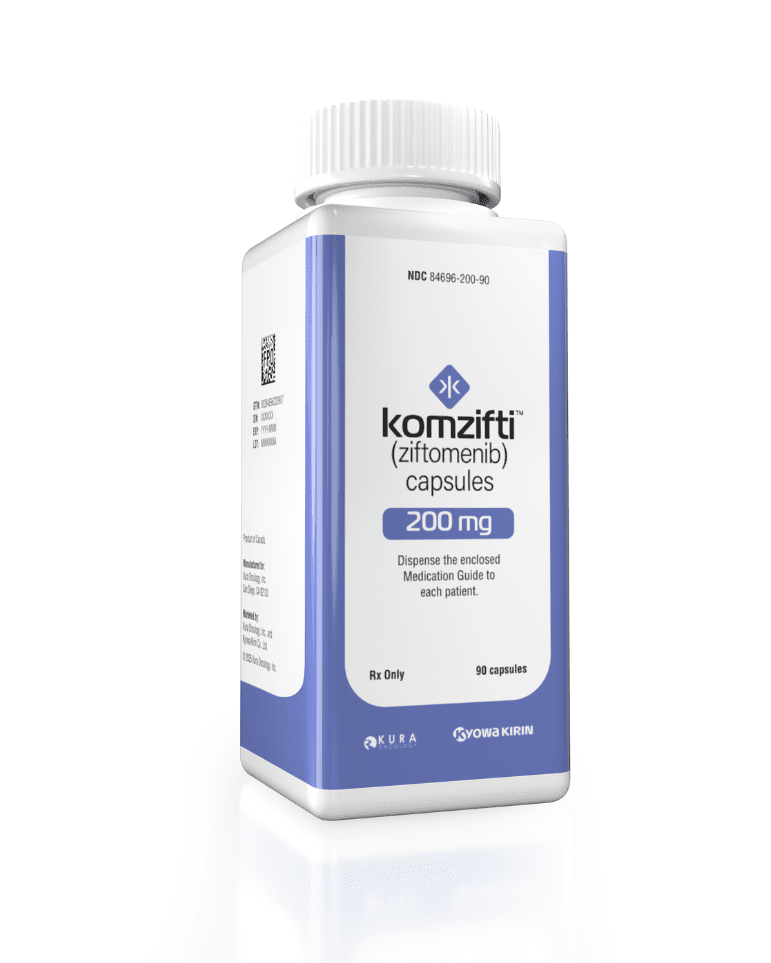
Komzifti (ziftomenib), approved by the U.S. Food and Drug Administration in November, is the first once-daily pill for patients with a specific form of acute myeloid leukemia whose cancer has come back or refused to respond to prior treatment.
Cierpicki, Grembecka and U-M have a financial interest in Kura Oncology. The technology was licensed to Kura Oncology by Innovation Partnerships. Ongoing clinical trials are exploring the use of Komzifti in combination with other therapies for leukemia and solid tumors.