
Engineering new tools to push early, less invasive cancer detection
By Michele Santillan
At the University of Michigan, teams of engineers and clinicians are leading the way in collaborating on the latest healthcare innovations.
The Department of Biomedical Engineering is a joint department in the College of Engineering and Medical School that shares the ultimate goal of solving important challenges in medicine and life sciences for the benefit of humanity. This fusion of disciplines is redefining early cancer detection and personalized care.
From everyday skin patch to early melanoma warning
What if the same routine as a COVID-19 or home pregnancy test—buying an over-the-counter product and performing a test in the privacy of one’s home—could apply to detecting melanoma?
A University of Michigan team led by chemical and biomedical engineering professor Sunitha Nagrath —in conjunction with key partners in U-M’s Rogel Cancer Center and the Biointerfaces Institute, has developed the ExoPatch, an innovative silicone patch covered in star-shaped microneedles that work at the surface of your skin and do not draw blood.
The patch works in minutes, detecting exosomes—tiny parcels sent by our cells, loaded with DNA and RNA that whisper about what’s brewing deep below. Detecting melanoma-specific exosomes at the skin’s surface means a test far less invasive than biopsies and blood draws, right where melanoma starts.
Tested in animal models, with eyes on home use
Tested with partners at the Rogel Cancer Center, the ExoPatch successfully differentiated melanoma tissue from healthy skin in mice. With microneedles 0.6 mm long—hundreds of times shorter than a grain of sand—the patch isolated over 11 times more cancer-associated proteins than it did from healthy tissue.
Following patch application, placing the microneedles in an acid bath dissolves the gel, freeing up exosomes to be tested with a dipstick. Positive results—two lines—mean a fast referral, not a wait for lab work.
“A fair-skinned person with moles must go to the doctor about every six months to send off a biopsy to see if they’re malignant or benign,” said Nagrath, the Dwight F. Benton Professor of Chemical Engineering and professor of biomedical engineering. “With this test, they could instead test at home, get the results right away and follow up with a dermatologist for a positive result.”
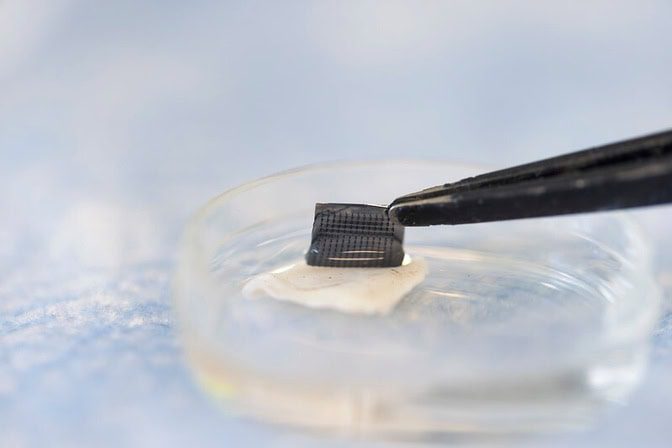
The newly designed ExoPatch being removed from a sample of mouse skin successfully distinguished melanoma from healthy skin in mice. A gel coating the microneedles picks up cancer indicators from the top-most layer of the skin. Dissolving the gel releases exosomes into a solution, which is then used on a two-lined test strip, similar to an at-home COVID-19 test.
Photo credit: Jeremy Little, Michigan Engineering.
The researchers are already thinking beyond melanoma: with slight tweaks, the patch could help spot exosomes from other solid tumors, such as lung, breast, colon and brain cancer.
“This is the first patch designed to capture disease-specific exosomes from fluid under the skin,” Nagrath said. “The potential applications are huge.”
Reducing guesswork in assessing cancer risk
Meanwhile, U-M teams are demonstrating that engineering solutions—from microneedle patches to miniature blood sorters—can help tailor treatment choices for millions of people.
Of the 2.3 million women with breast cancer today, around a quarter are diagnosed at an early stage before cancer has spread, called ductal carcinoma in situ, or DCIS. While these patients tend to have a good prognosis, the cancer can become invasive in 10% to 53% of untreated cases.
With such high stakes, and no accurate way to predict what will happen for any single patient, clinicians recommended that all women with DCIS receive treatment, which can include lumpectomy or mastectomy.
Radiation therapy is recommended for patients who get a lumpectomy, and patients who test positive for hormone receptor-positive DCIS can also receive anti-hormonal therapy.
U-M researchers, alongside those at the University of Kansas, have published evidence that the answer may be circulating within us—in rare cancer cells shed early by the tumor.
“Since early detection can save lives, physicians are now recommending mammograms at younger ages, so more young women have to make some life-altering choices,” Nagrath said. “Currently, patients are often presented with treatment options without adequate information regarding which choice may be most effective based on their individual risk factors.”
Patients’ blood may contain the markers of a progressing disease—cancer cells that shed from tumors and circulate below the detection levels of common lab techniques. Such cells may go on to seed new tumors.
To find them, Nagrath launched a “labyrinth chip” in 2017 with Max Wicha, the Madeline and Sidney Forbes Professor of Oncology and professor of internal medicine at the U-M Medical School. Pushing a blood sample through the chip’s maze-like channels separates the larger cancer and white blood cells into a separate stream from smaller blood cells. After processing a few milliliters, researchers can obtain enough cancer cells for diagnostic testing.
Their new work shows specific genetic patterns in tumors and matching circulating cells—a leap toward targeted, personalized care, with less overtreatment and unnecessary discomfort, time and expense.
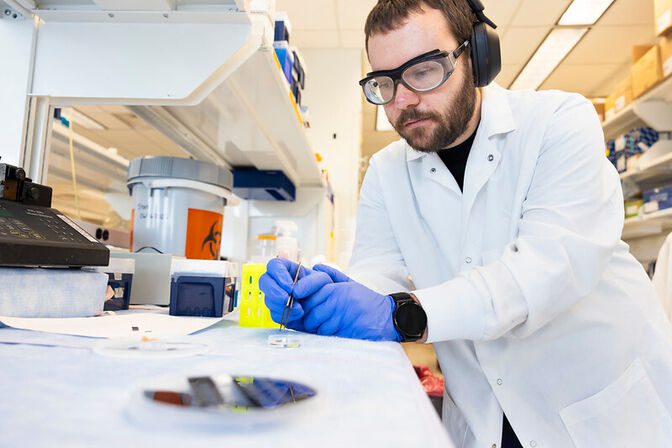
Chemical engineering doctoral student Scott Smith places the ExoPatch into a petri dish containing a mouse skin sample to test for melanoma.
Photo credit: Jeremy Little, Michigan Engineering.
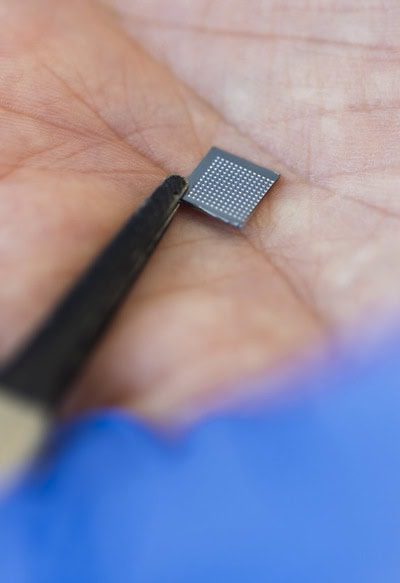
The silicone patch for at-home melanoma testing has star-shaped microneedles, just 0.6 millimeters long, that press into skin without drawing blood. A gel that coats the needles attracts exosomes that come from cancerous cells.
Photo credit: Jeremy Little, Michigan Engineering.
On the horizon: Predicting glioblastoma treatments
In a third major front, U-M researchers are examining how predicting glioblastoma’s susceptibility to drug therapies could transform survival in those facing brain cancer. Groundbreaking studies now suggest the dynamic release of diagnostic nano-sized particles after the blood-brain barrier opens may signal how well tumors respond to paclitaxel, a common chemotherapeutic.
U-M researchers have designed a small microchip “GlioExochip” that can effectively isolate the tumor-specific nanoparticles that carry various cargoes of tumor using one-tenth a teaspoon of blood. These nano carriers can help us to assess not only tumor-related information, but also indicative of how tumors are responding to the treatment.