
What a guaranteed income pilot reveals about gig workers in Ann Arbor
By Eric Shaw
Office of the Vice President for Research
When Ann Arbor launched a guaranteed income pilot in 2024, it joined more than 100 similar experiments across the country. But Guaranteed Income to Grow Ann Arbor—GIG A2—is unusual: it focuses specifically on gig workers, entrepreneurs and the self-employed.
Two years and $1.6 million later, University of Michigan researchers have early answers about what happens when low-income workers in the gig economy receive $528 a month with no strings attached.
Guaranteed Income to Grow Ann Arbor (GIG A2) is a two-year guaranteed income pilot to provide monthly payments of $528 to 100 entrepreneurs with low and very low incomes in Ann Arbor.
The short version: they spend it on necessities. And while that spending hasn’t yet produced measurable improvements in food or housing security, it has changed how participants feel about their lives and work.
“Guaranteed income recipients can spend the cash however they want – there are no strings attached or expectations that they use the money a certain way. We see that people are largely using the extra money on necessities, including household supplies which cannot be purchased using food assistance that is also known as SNAP,” said Kristin Seefeldt, principal investigator for the evaluation of GIG A2, faculty director of Poverty Solutions, and an associate professor of social work.
The pilot, funded by the City of Ann Arbor with federal American Rescue Plan Act dollars and the Ann Arbor Area Community Foundation, provided monthly payments to 100 Ann Arbor residents who earn low incomes through gig work or self-employment. Another 100 similar workers participated in surveys and interviews as a comparison group but did not receive the payments. The city selected Poverty Solutions at U-M to design, implement and evaluate the program.
Among the 86 guaranteed income recipients who responded to surveys, 68% reported spending the money on food, 60% on household supplies and personal care items and 50% on housing costs like rent or mortgage.
—GIG A2 participant
After one year of payments, researchers found no statistically significant differences in food security, housing stability or utility access between the two groups. Both groups reported high rates of food insecurity—58% to 61%, compared to 37% among lower-income households nationally—and housing insecurity ranging from 53% to 61%.
The finding reflects the math of stretching $528 across multiple urgent needs in a high-cost city, said Rebeccah Sokol, co-principal investigator and associate professor of social work.
“When we’re talking about $528 each month, that only goes so far in Ann Arbor where the cost of living is relatively high,” Sokol said. “If people are using the cash to address multiple needs, that would explain why we’re not seeing significant differences in one single area.”
But interviews with participants pointed to changes that don’t appear in standard economic measures. Many described reduced stress and a sense of relief knowing they had a small buffer if a client payment came late or an unexpected expense arose. Others said the flexible cash let them afford experiences or resources for their children that had previously felt out of reach.
“GIG A2 participants emphasized that the program provided a sense of dignity. They did not feel shamed for struggling economically or needing financial support,” said William Lopez, co-principal investigator and clinical associate professor of health behavior and health equity. “Health outcomes are linked both to financial situations and how people feel judged or stigmatized because of those situations.”
With the pilot’s final payments issued in December 2025, the research team is now conducting analyses of final surveys before producing a comprehensive report, expected by the end of 2026.
“GIG A2 participants emphasized that the program provided a sense of dignity. They did not feel shamed for struggling economically or needing financial support. Health outcomes are linked both to financial situations and how people feel judged or stigmatized because of those situations.”
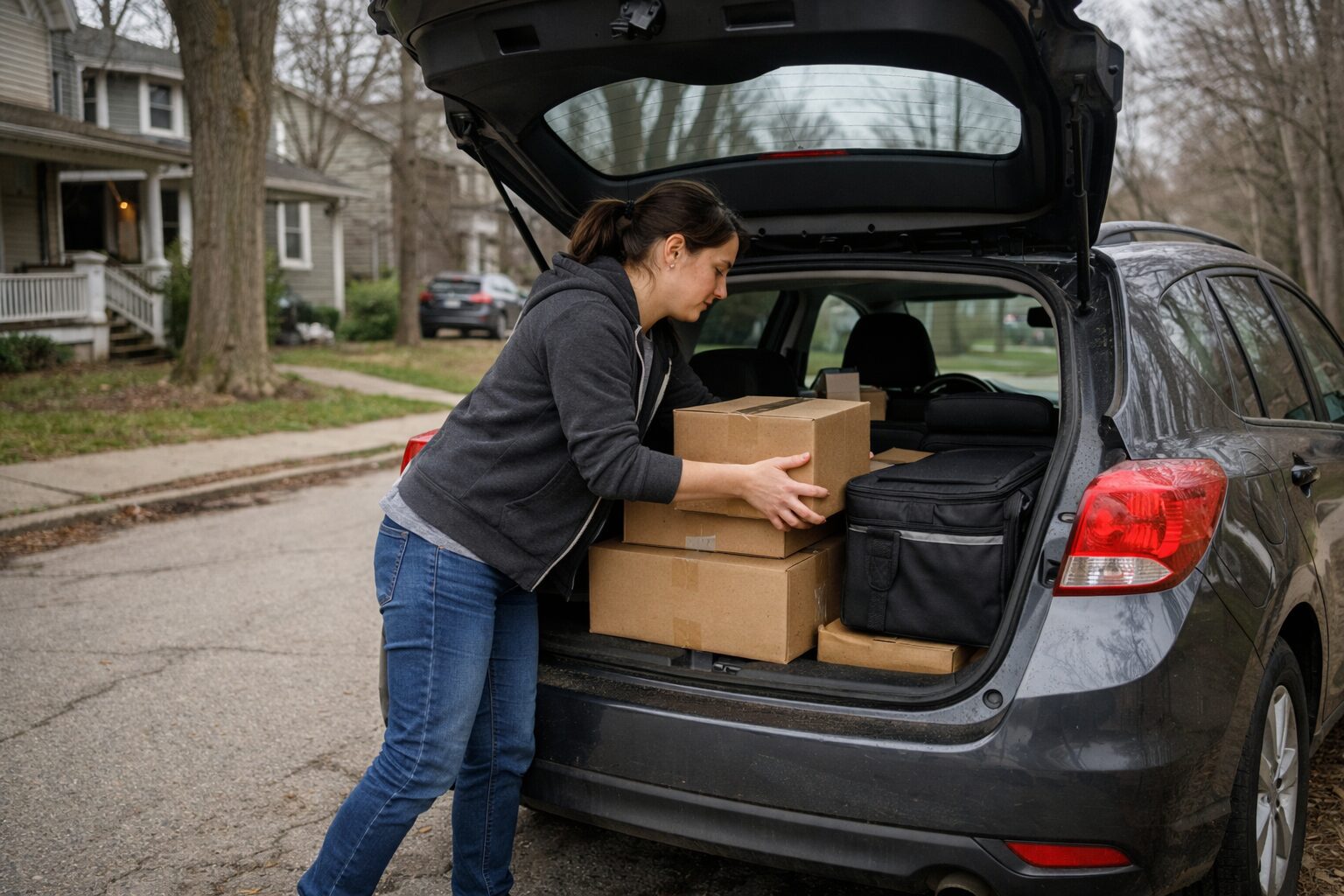
A gig worker loads delivery boxes into the back of her car on an Ann Arbor neighborhood street—everyday logistics that mirror how participants in the GIG A2 guaranteed income pilot described using $528 a month to cover basic needs and keep a small buffer when work and pay fluctuate.

Images 1, 2, 3: Key partners involved in the pilot – University of Michigan, City of Ann Arbor and Ann Arbor Area Community Foundation