
For millions of Americans, sunscreen has become part of a critical summer routine, not only protecting them from painful sunburns, but also reducing the risk of skin cancer.
Now, two researchers at the University of Michigan are hoping to give high-risk individuals a similar preventative option for aggressive oral cancer.
Joerg Lahann, director of the Biointerfaces Institute, and graduate research assistant Albert Chang are focusing their efforts on site-specific drug delivery. Nanoparticles, particles thousands of times smaller than the width of a human hair, can be engineered to carry medications directly to precise locations in the body. Each is designed to find a specific target, much like applying sunscreen to a scar or a mole that is especially susceptible.
“If you have a tumor, you want the drug delivered directly to it,” said Lahann, Wolfgang Pauli Collegiate Professor of Chemical Engineering. “It is important to avoid having the drug circulate throughout the body, since these medications may cause harm to healthy organs. One of the challenges is that the mucosal layer in the mouth is a barrier that effectively protects cancer cells, making it difficult for drugs to reach them. A second challenge is that eating or drinking can wash away anything applied inside the mouth.”
To address these obstacles, the team is developing nanoparticles that bind to the mucosal layer at the targeted area, preventing them from being washed away. By encapsulating the chemopreventive agent inside the nanoparticles, the drug can be released at a controlled rate to target cancer before it develops.
Lahann and Chang rely on specialized equipment at the Nanotechnicum, one of the shared core facilities at the Biointerfaces Institute. Managed by Sarah Spanninga, senior research laboratory specialist, the Nanotechnicum is open to all and supports researchers across disciplines.
Research cores are shared university facilities which offer specialized research services, equipment or expertise to U-M researchers, often at a recharge rate.
The Biointerfaces Institute brings together faculty from the dental, pharmacy, engineering and medical schools and is organized into six research clusters. In 2024, 168 researchers used the shared resource.
“The core works well on many fronts,” Spanninga said. “First, it provides a dedicated person to train all users including faculty, undergraduate and graduate students, postdocs and industry professionals and to ensure instruments are properly calibrated and maintained. Second, finances are centralized, so (principal investigators) don’t need to purchase equipment or manage service contracts. Finally, the core serves as a collaborative space that provides continuity. When students graduate or postdocs move on, their experience stays with the facility.”
Within the lab, researchers carry out nearly every stage of the process, from creating nanoparticles to analyzing their behavior and properties. They use methods such as dynamic light scattering to measure particle size and properties for surface binding. Thermogravimetric analysis measures how the nanoparticles’ weight changes with heating and cooling, while also confirming that the loaded drugs remain active.
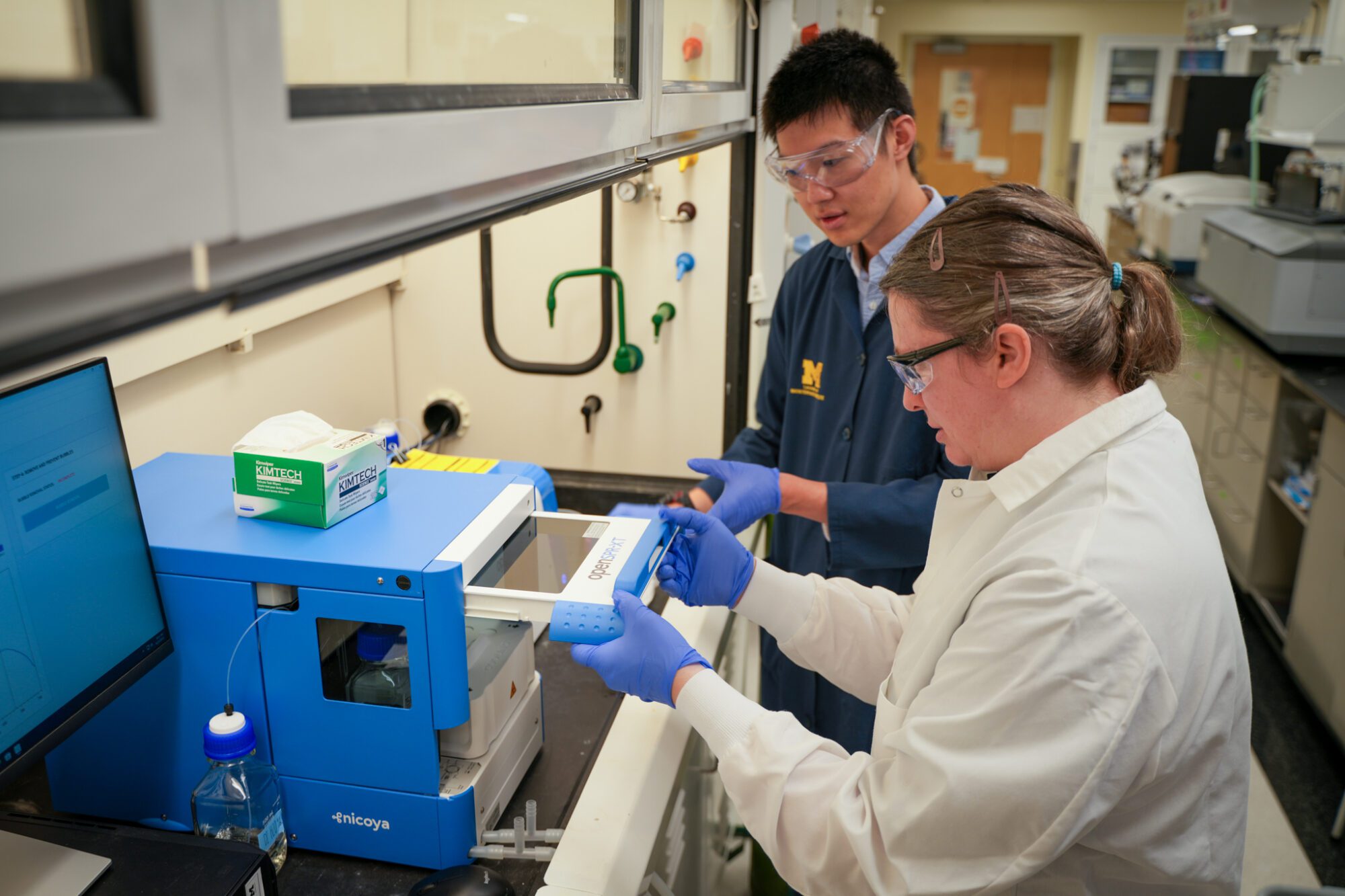
Sarah Spanninga and Albert Chang work together at the Biointerfaces Institute, preparing a sample for analysis using advanced equipment in the Nanotechnicum core facility.
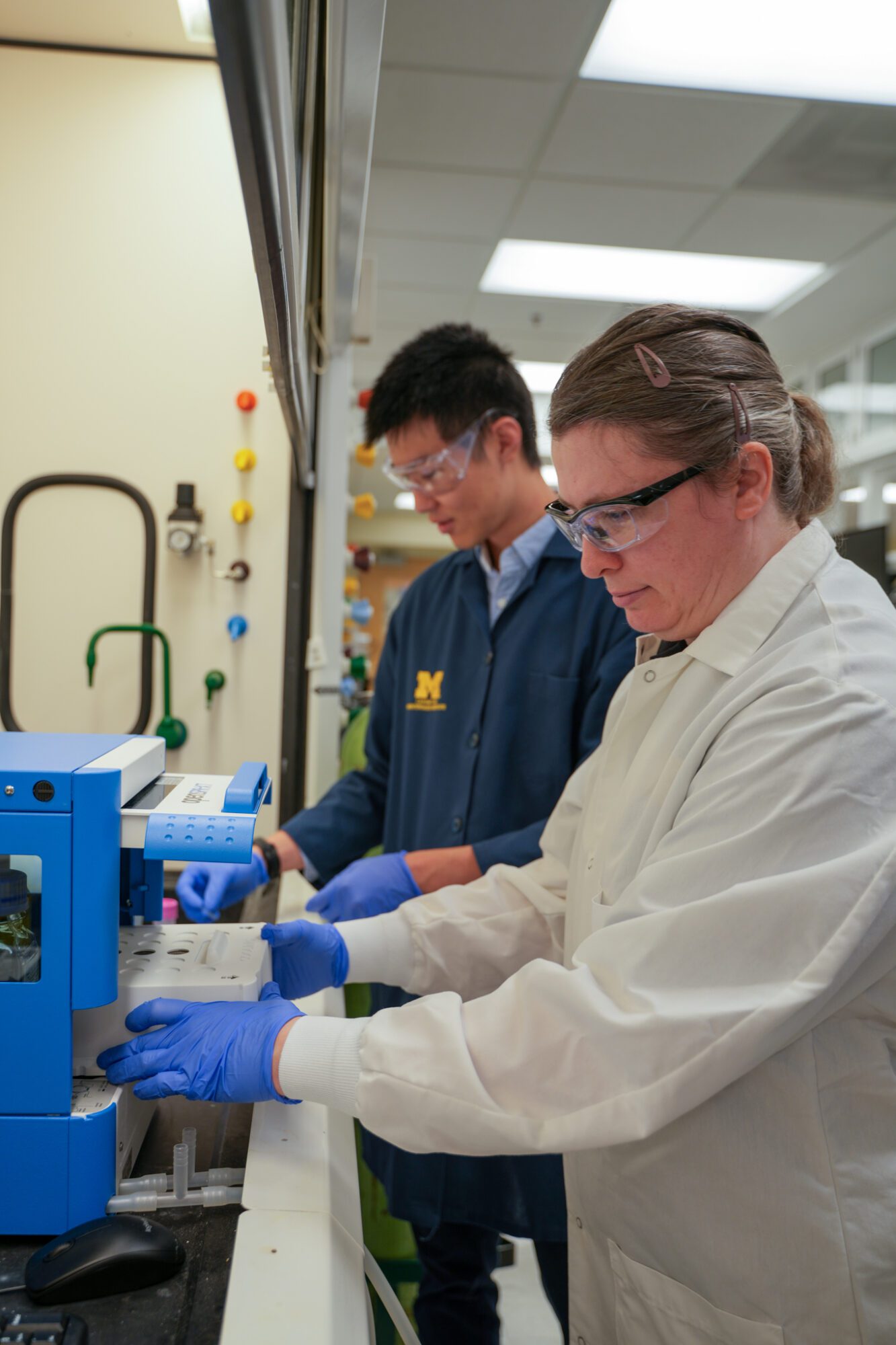
At the Biointerfaces Institute, Sarah Spanninga and Albert Chang conduct research side by side, demonstrating how shared core facilities bring expertise and training to support innovative cancer prevention studies.
“The core works well on many fronts. First, it provides a dedicated person to train all users including faculty, undergraduate and graduate students, postdocs and industry professionals and to ensure instruments are properly calibrated and maintained. Second, finances are centralized, so (principal investigators) don’t need to purchase equipment or manage service contracts. Finally, the core serves as a collaborative space that provides continuity. When students graduate or postdocs move on, their experience stays with the facility.”
A key tool in Chang’s research is surface plasmon resonance spectroscopy, a laser-based optical method that allows the team to modify surfaces to mimic drug delivery sites. With this equipment, Chang can observe how nanoparticles attach and detach under constant flow, much like conditions in the mouth. These insights help improve how their particles will work in a real-life setting.
“Using the equipment available in BI’s Nanotechnicum, we are able to encapsulate these hydrophobic drugs and design a particle capable of remaining at targeted delivery sites,” Chang said. “Sarah has been very supportive in providing the necessary instruments and helping us develop our protocols. In this well-equipped space, we can answer most questions about the particles we are developing.”
Chang’s approach is notable because while he uses the same equipment as other researchers, he is applying it in an entirely new way.
“The outside of the mucosal cells is covered with a protein called mucin,” Lahann said. “Rather than sticking to standard binding studies, Albert developed entirely new protocols to mimic the interactions of nanoparticles with the mucosal layer. This is not a typical, routine use of the instrument in the core. He developed an entirely new way of applying it to answer questions not otherwise possible.”
Their research, supported by the National Institutes of Health, is conducted in collaboration with Susan Mallery, an oral pathologist at The Ohio State University. Mallery adds experience in cancer biology and clinical trials. The team expects patient trials to begin soon and hopes the treatment will be available in the next few years.
“The Biointerfaces Institute is continually growing and remains focused on addressing society’s needs in healthcare,” said Shelly Zervos, operations and communications manager. “There are brilliant minds here who might not otherwise have the opportunity to collaborate, and that’s exactly why Joerg Lahann founded the institute in 2012. Inspired by the cross-disciplinary collaborations he saw at MIT and similar institutions, he created the institute to drive breakthroughs in drug delivery. Breaking down disciplinary barriers is what this institute was designed for.”
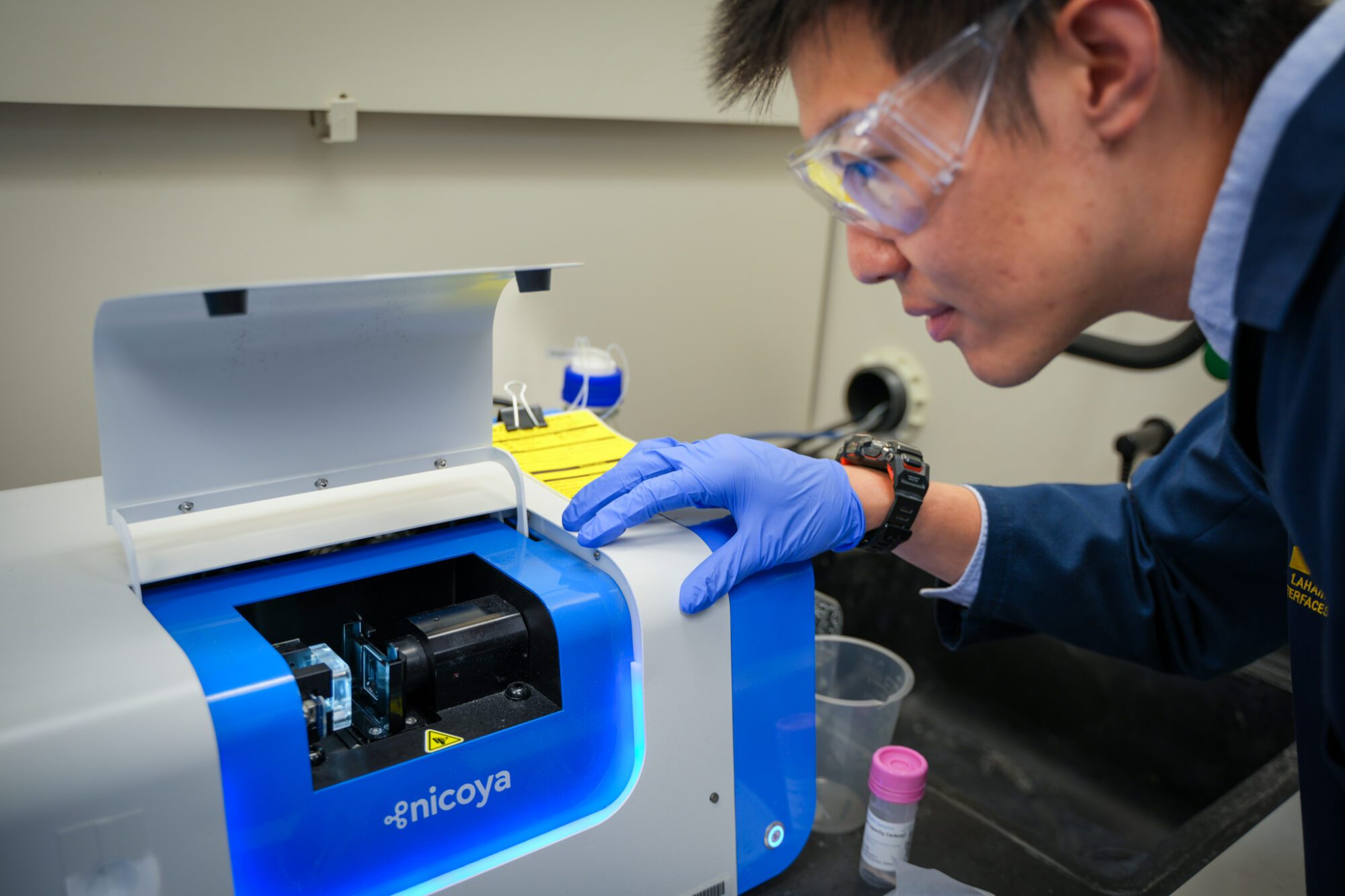
Albert Chang carefully examines a sample using a specialized instrument in the Nanotechnicum, where researchers are developing new nanoparticle-based strategies to prevent oral cancers.
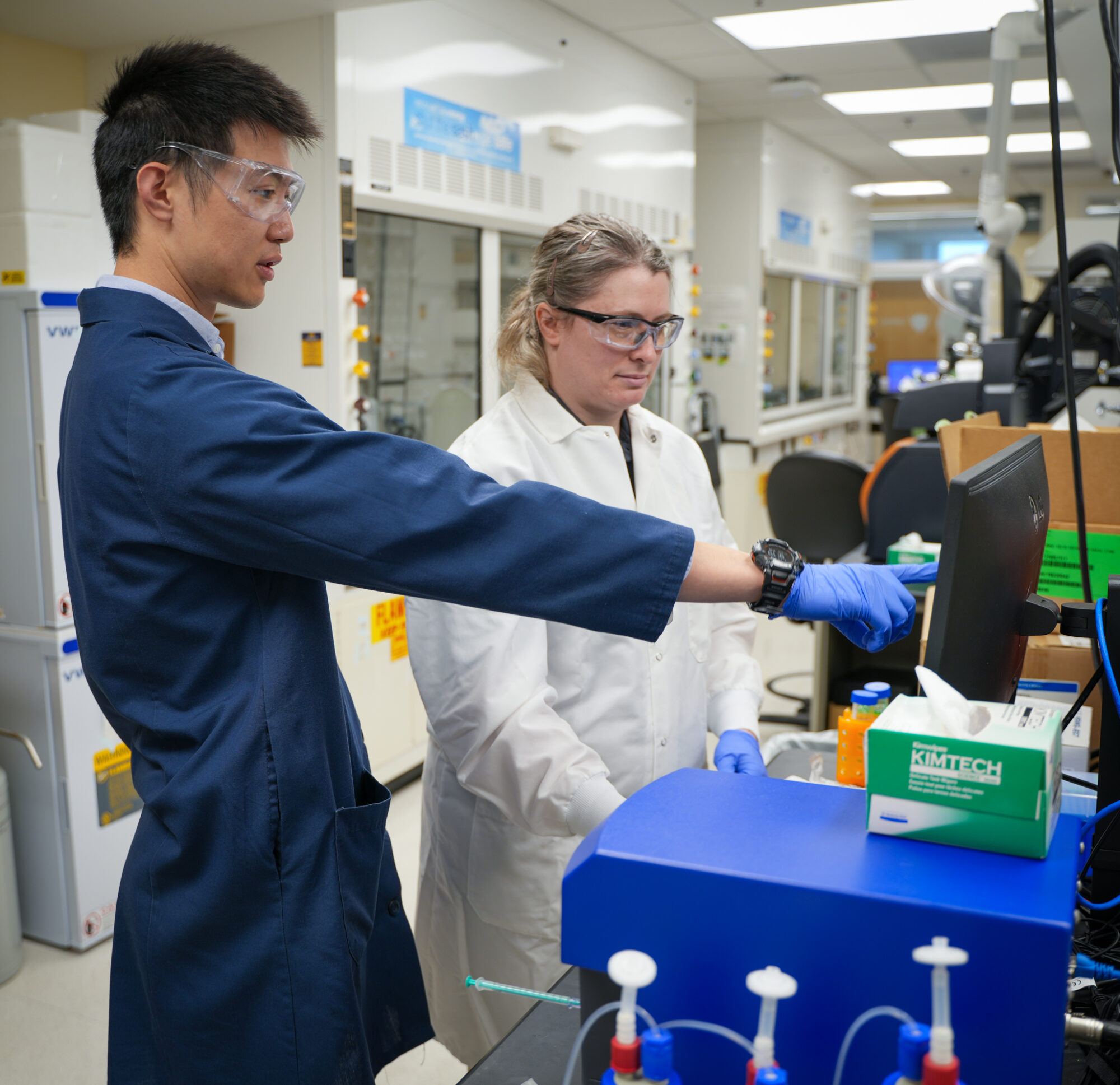
Sarah Spanninga and Albert Chang review data at the Biointerfaces Institute, highlighting the collaborative environment that drives discovery within U-M’s shared research cores.
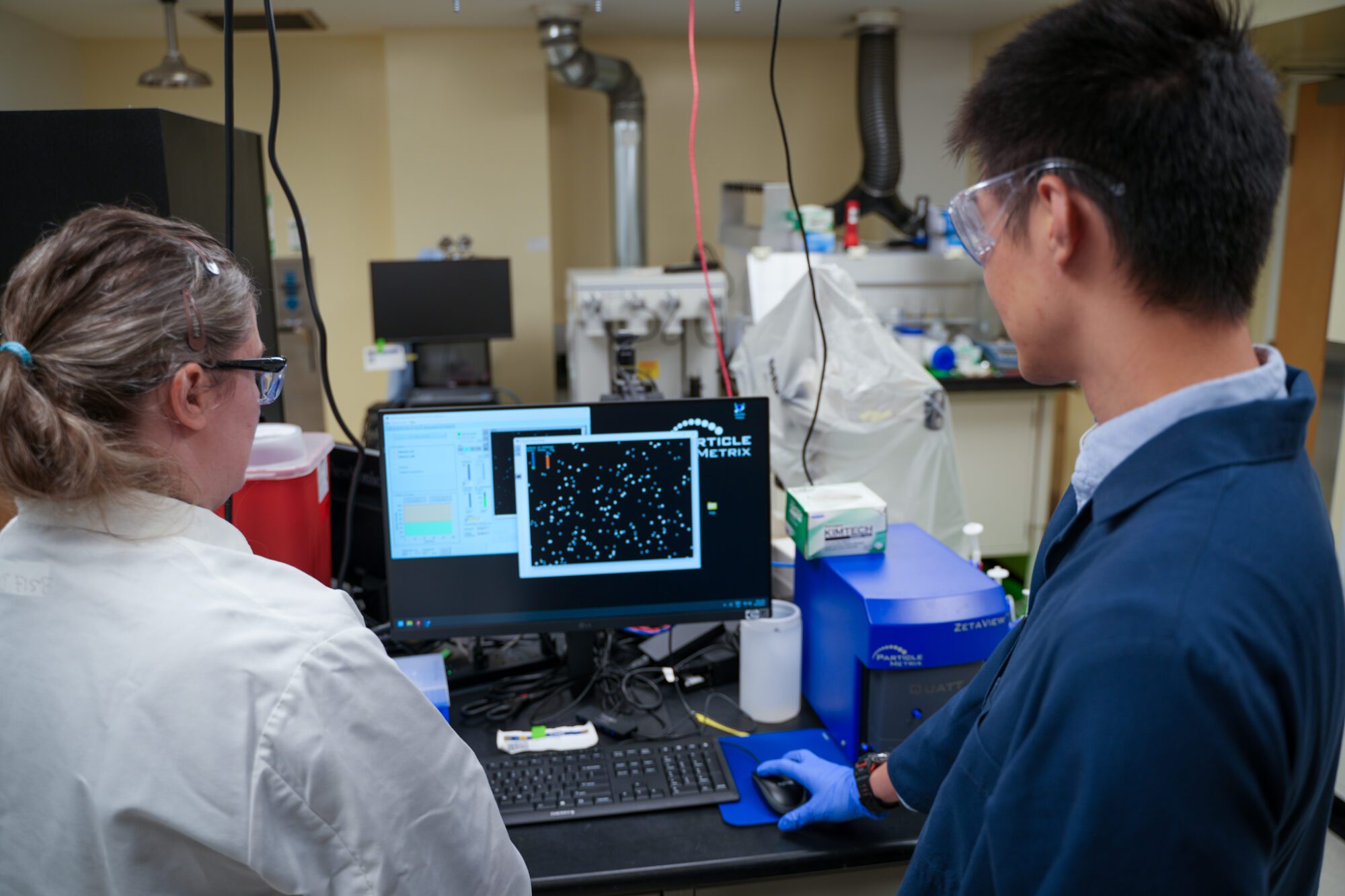
Analyzing particle behavior in real time, Sarah Spanninga and Albert Chang use advanced imaging tools at the Nanotechnicum to advance drug delivery research that could transform cancer prevention.