
A simple finger prick could help detect traumatic brain injury
By Ananya Sen
Traumatic brain injuries are caused by forceful blows to the head and are a leading cause of death and disability worldwide.
An estimated 2.5 million brain injuries occur annually in the United States. Some types can cause short-term concerns, including problems with cognition, movement and communication, while others can cause permanent disabilities.
Despite the common occurrence of brain injuries, current TBI diagnosis methods are unsuitable for point-of-care applications due to the nature of the equipment and training requirements.
Funded by the Massey TBI Grand Challenge, hosted by U-M’s Weil Institute for Critical Care Research and Innovation, University of Michigan engineers, scientists and physicians are teaming up to enhance the speed and accuracy of TBI diagnoses during the “golden hour,” when critical, specialized care can significantly improve patient outcomes.
They are developing a portable device that relies on microfluidics, which can handle small volumes of liquids. Often referred to as “lab-on-a-chip”, these devices can detect low levels of TBI biomarkers in whole blood during the early stages after a TBI has occurred. The device functions similarly to a blood glucose monitor, requiring only a very small volume of blood for rapid testing that can provide medical professionals with data they can use to tailor treatment.
“It’s a credit card-sized microfluidic device that can detect multiple biomarkers,” said Faezeh Shanehsazzadeh, a postdoctoral research fellow in mechanical engineering. “It consists of a disposable microfluidic chip and a small portable reader, so it can be used in any setting.”
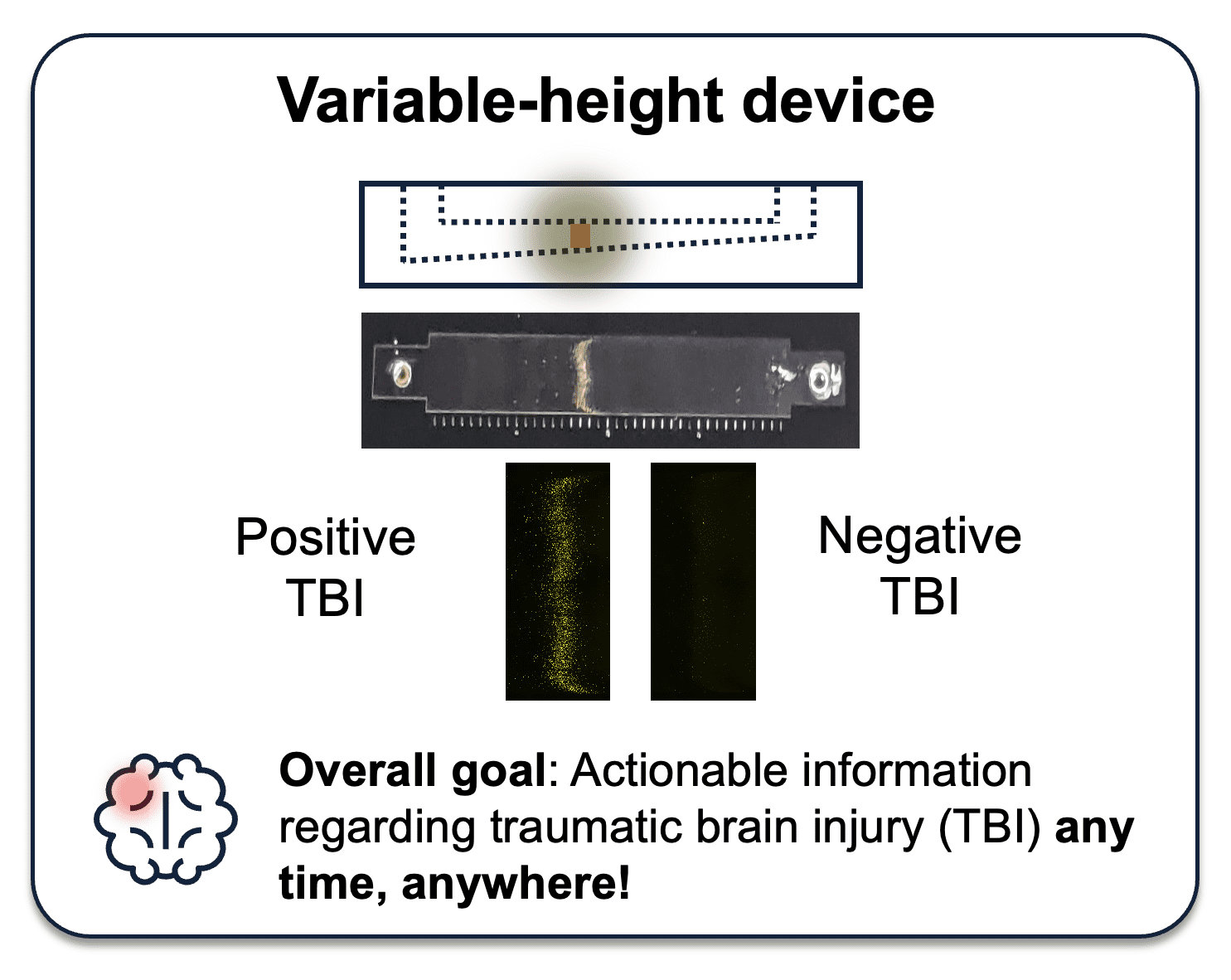
A multidisciplinary team of U-M engineers, scientists, and physicians has developed a credit card-sized microfluidic device that can enhance the speed and accuracy of TBI diagnosis during the “golden hour” of treatment.
“We’re taking lab-grade brain injury testing out of the lab and into the hands of clinicians, making it faster, more affordable and accessible anywhere”
Through preliminary experiments, the team has shown that the detection system has potential for success. They are now working on integrating the microfluidic device with the portable reader to create a fully functional prototype. They are also developing a machine learning algorithm to improve its sensitivity and accuracy.
The final product will be more precise, able to detect smaller amounts of biomarkers and adaptable for use in various clinical settings, including homes, hospitals and environments with limited resources.
“We’re taking lab-grade brain injury testing out of the lab and into the hands of clinicians, making it faster, more affordable and accessible anywhere,” said Frederick Korley, U-M professor of emergency medicine, who has studied brain injuries for nearly two decades.
Having perspectives from across engineering, science and medicine has been crucial to the design and development of this technology, Shanehsazzadeh said. The project began with a collaboration between co-leaders Mark Burns, U-M professor emeritus of chemical and biomedical engineering, and Korley, who envisioned adapting laboratory technologies for use in non-traditional settings to improve outcomes for TBI patients.
With the assistance of James Ashton-Miller, U-M research professor emeritus of mechanical and biomedical engineering, and researchers from across mechanical engineering, chemical engineering and the Michigan Institute for Data Science, the idea has been developed into a reality.
“Bringing this technology to the real world generally needs multidisciplinary collaboration because it has so many aspects,” Shanehsazzadeh said.
Burns explained that the impact of the device could extend beyond the realm of brain injuries. The team has already had success identifying biomarkers associated with inflammation, food allergies and viruses, pointing to potential future applications of their technology.
“I think that the biochemical testing platform we have developed in this collaboration has the potential to revolutionize the point-of-care testing industry, not only for TBI patients, but for a wide variety of diagnostic areas,” Burns said.