Using AI-powered mobile clinics to improve health care access in rural areas
By Kate McAlpine and Ananya Sen
In 1982, the Knight Rider series debuted with the premise that Michael Knight, a modern-day crime fighter, uses an artificially intelligent automobile to take on criminal organizations. Four decades later, the University of Michigan is trying to harness similar technology to address gaps in rural health care.
Even before rural hospitals began scaling back services and shutting down, with 92 rural hospitals closing down or ceasing inpatient services in the last decade, getting consistent medical care was challenging for people living in remote areas. The new program is working towards a future where rural health care professionals extend their knowledge on the fly with help from the vehicle they travel in.
“Rural healthcare is under attack. The distance to the nearest in-patient facility has increased eight-fold in the last decade,” said Jason Corso, U-M Toyota Professor of Artificial Intelligence and professor of robotics and electrical engineering and computer science. “So, we wanted to bring the hospital to the house, or to the church parking lot—whether that’s in Michigan’s Upper Peninsula or in the middle of Indiana—where the nearest medical center that performs the care the patient needs might be two hours away.”
The Advanced Research Projects Agency for Health recently invested in the development of such a clinic, with U-M leading one of two large teams designing and building the AI component.
Funded with up to $25 million, the U-M-led AI team brings together an extensive group of hospital specialists, rural practitioners and engineers. Together, they represent eight universities and the research and development company RTX BBN Technologies.
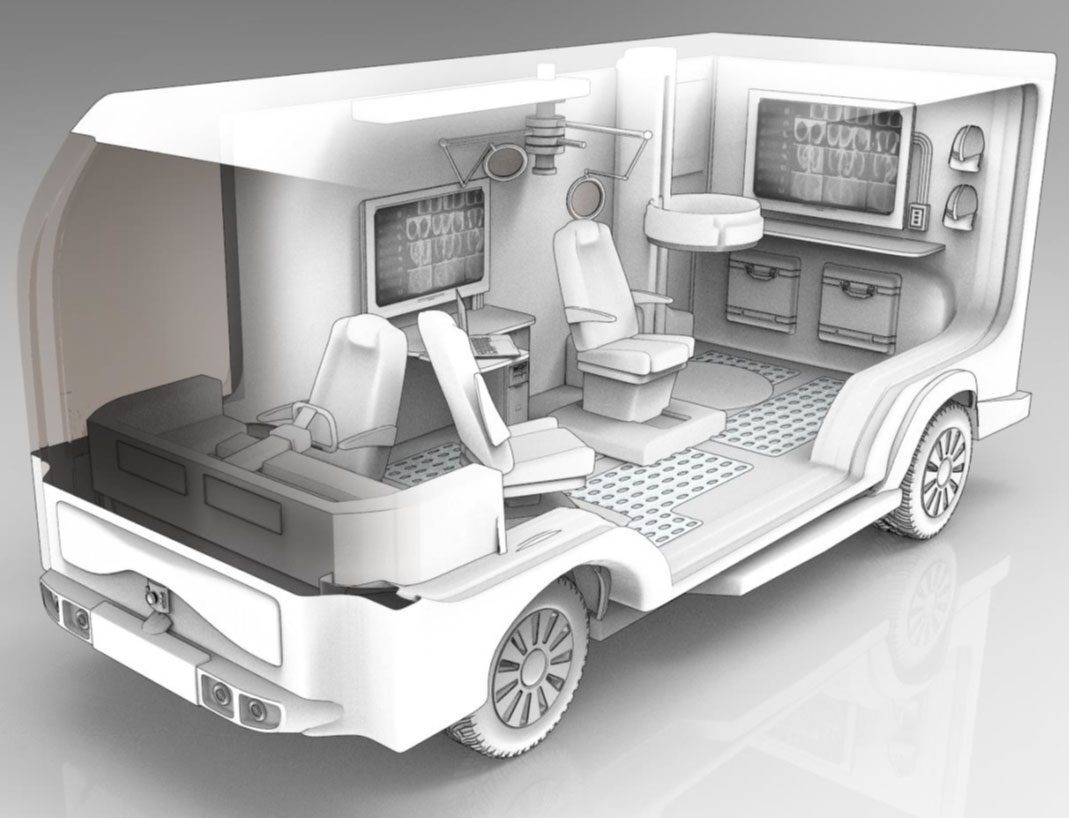
An illustration of a mobile clinic under development through a major project coordinated by the Advanced Research Projects Agency for Health (ARPA-H). The University of Michigan is leading one of two efforts to build AI guidance that can enable medical generalists to perform like specialists for common conditions.
Photo credit: ARPA-H
“This project isn’t simply bringing care closer to rural communities—it’s redefining what’s possible. By merging intelligent task guidance with real-time upskilling, we’re building a mobile clinic model that can finally meet the scale and complexity of rural healthcare. This is more than a new clinic on wheels—it’s a leap toward equitable, scalable access.”
The AI agent will be one piece of ARPA-H’s five-part program to prototype the equipment needed for this mobile medical clinic. Other parts aim to link up various data sources within the clinic, develop a miniaturized CT scanner for mobile 3D imaging and build a prototype mobile clinic. Eventually the team will test the AI agent in the mobile clinic, expected in the third year. Until then, they will use a stationary clinic, equipped like the proposed van, to assess how well the agent meets the needs of patients and clinicians.
“Use of technology, especially AI, has a substantial potential for improving access however it needs to be tested in a manner that it is safe, reliable and trusted by the providers and patients,” said Prashant Mahajan, William G. Barsan Collegiate Professor of Emergency Medicine, chair of the Department of Emergency Medicine and professor of emergency medicine and pediatrics. “If successful, this project can be scaled across multiple specialties and improve healthcare outcomes.”
The clinic AI builds on earlier work led by Corso, the project’s director, in which the team designed AI agents to provide intelligent guidance across different scenarios. They used cooking as a test bed because it involves raw materials, tools , step-by-step actions and skilled techniques, but carries relatively low risk. Building on the strategies developed to help someone improve their cooking, his team then guided soldiers through lifesaving battlefield medicine in another project.
For the current project, the team envisions the AI agent working alongside a family doctor or nurse practitioner, for instance—someone with a lot of foundational knowledge but without the training or experience of specialists.
The team breaks the work down into many pieces.
The technical team, strong in computer science, will build models capable of representing medical tasks, what’s happening in the van and with the patient, and how the patient and generalist are doing. The goal is to develop an AI agent that can not only observe the generalist’s actions and walk them through unfamiliar tasks, but that can also recognize when something unexpected has happened and adjust accordingly.
Part of that capability would be recognizing the emotional state of the humans, such as the generalist becoming stressed if the patient’s condition worsens dramatically. Collaborators in nursing will bring expertise in reading people and calibrating the assistance they provide. With their input, the AI agent may learn to alter the way that it delivers information in tense situations.
The medical team and system integration team will gather the data set to train the models that will power the AI. That task includes assessing biases in the data that could lead to inaccurate diagnoses and treatments. The medical team will also provide rich guidance on how to perform medical tasks in areas such as cardiac and trauma care.
“This project isn’t simply bringing care closer to rural communities—it’s redefining what’s possible,” Corso said. “By merging intelligent task guidance with real-time upskilling, we’re building a mobile clinic model that can finally meet the scale and complexity of rural healthcare. This is more than a new clinic on wheels—it’s a leap toward equitable, scalable access.”