
Action-based research to prevent and alleviate poverty
By Kristin Seefeldt
Incoming Faculty Director of Poverty Solutions at U-M
Associate Professor of Social Work and Public Policy
I am proud to be part of a long-tradition at the University of Michigan of conducting research on issues related to poverty and financial well-being. From the launch of the Panel Study of Income Dynamics (PSID) in the late 1960s, to serving as the home for federally-funded poverty research in the early 2000s, to our current work at Poverty Solutions, faculty, staff and students have participated in the development and execution of numerous studies that have informed debates in both academic and policy circles.
Kristin Seefeldt
Incoming Faculty Director of Poverty Solutions at U-M
Associate Professor of Social Work and Public Policy
While producing high quality scholarship remains key to our purpose, Poverty Solutions leans into the important role that universities can play, in partnership with communities, to work together to change the systems that too often do little to help people with few resources. We also leverage our skills with data and analysis to test and evaluate innovative programs and approaches to tap into the strengths of individuals and communities so that they can thrive.
Our recent work highlights this approach, much of which is happening in our backyards – Ann Arbor and Detroit. We took on a number of projects to address issues related to affordable housing. This included evaluating an eviction and foreclosure prevention program, exploring ways that land contracts could be used to build home ownership, addressing home repair needs in partnership with a number of community organizations and examining why so many Detroiters are unable to afford and secure homeowners insurance. Partnering with the Detroit Phoenix Center, we produced a mini-documentary on Detroit’s youth rapid rehousing program and convened events on the future of youth homelessness response in Detroit and the importance of meaningful youth engagement in social service design.
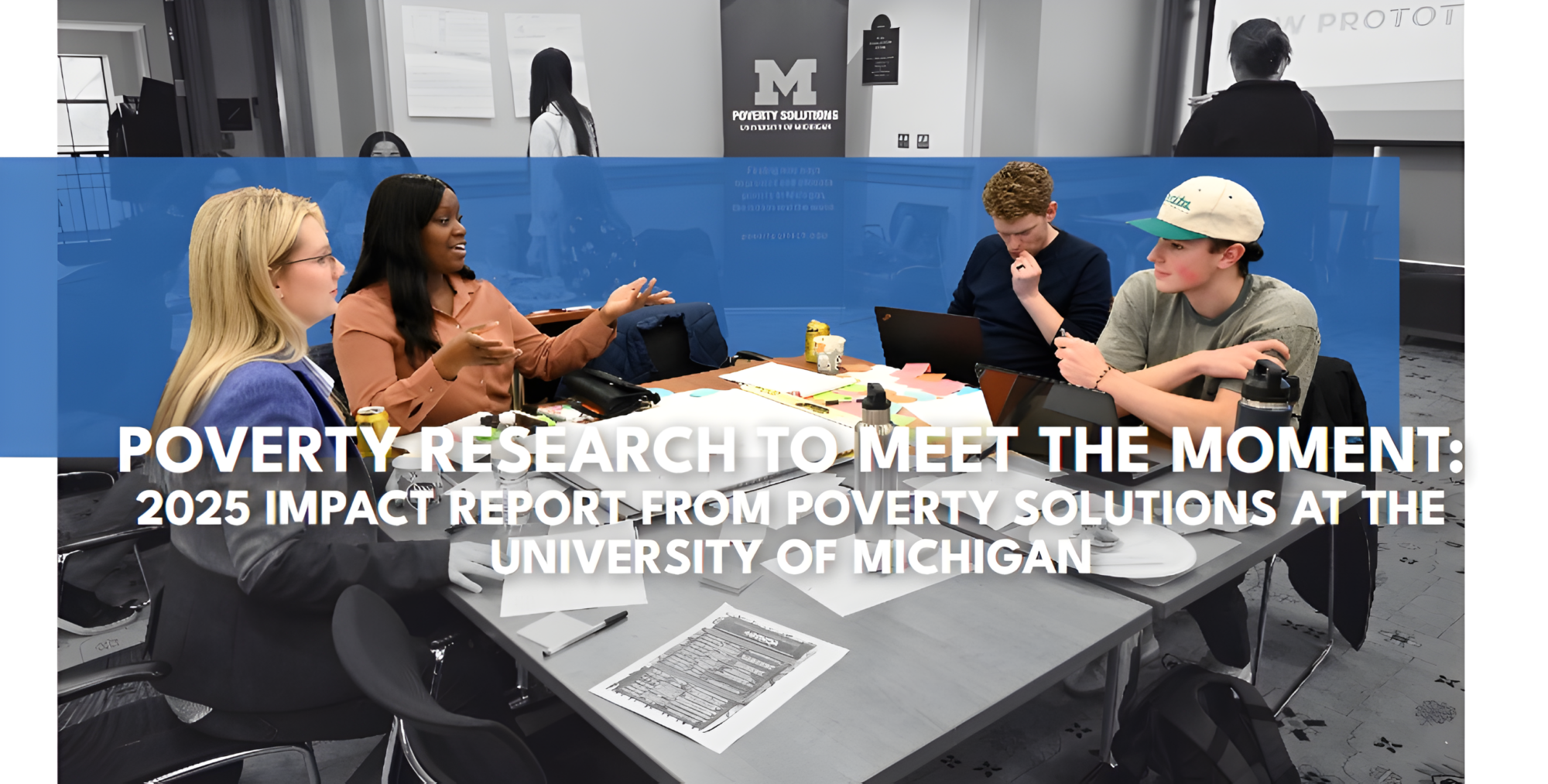
See Poverty Solutions’ annual impact report to learn more about the initiative’s action-based research and how you can join in the work to prevent and alleviate poverty. Read the full report.
We also attempt to be responsive to issues of the moment. For example, when federal policymakers proposed significant cuts to the Department of Education’s funding, Poverty Solutions developed a data tool showing how federal education funds are distributed to local school districts in each state and by congressional district. This resource helped advocacy groups make a strong case for keeping funding for at-risk students, school nutrition, special education and vocational programs.
The Detroit Metro Area Communities Study (DMACS) is crucial to our efforts to understand issues that are top of mind for Detroit residents. DMACS surveys more than 2,000 Detroit residents annually about their priorities and lived experiences, using rigorous, state-of-the-science research methods. The surveys are co-created with local partners – including city government, philanthropy and nonprofits. As a new mayoral administration begins its work in Detroit, DMACS’s numerous publications can be used to inform decision-making.
Finally, we have launched and are evaluating three cutting-edge approaches to promoting well-being and building upon the resiliency that our community members possess. Guaranteed Income to Grow Ann Arbor (GIG A2) – developed, operated and evaluated by Poverty Solutions – recently concluded providing $528 monthly payments to 100 low- to moderate-income entrepreneurs and gig workers, all of whom make important contributions to Ann Arbor’s economy. While the evaluation is ongoing, early interviews with a subset of participants find that the payments offer a sense of relief and “breathing room” to those who previously had to worry each month about their bills.
Rx Kids, first launched in Flint, Michigan, is the nation’s first community-wide prenatal and infant cash “prescription” program. Through the program, moms receive $1,500 during pregnancy and $500 per month for the first 6-12 months after the birth of a child. In October 2025, the State of Michigan committed a further $270 million to the program, with the goal of reaching one-third of babies born in Michigan over the next three years. Other states, like Mississippi, have started discussions about launching their own versions of Rx Kids; the simple design and mix of public-private funds make the program easily replicable.
The Community Tech Consultant initiative, developed by researchers from the School of Information, equips local residents to provide tech support and digital skill development for small business owners, while strengthening community ties. At a macro level, the program addresses digital inequality, which, despite efforts to increase internet availability in neighborhoods with fewer resources, still exists.
In addition to the efforts noted earlier, the Poverty Solutions team has been responding to unprecedented changes to the federal policies that shape our country’s social safety net and people’s access to housing, jobs, health care and other basic needs.
In 2026, we are partnering with researchers at the Institute for Social Research to track rates of food hardship nationally to help fill the gap left by the cancellation of the U.S. Household Food Security Survey. We also will evaluate the impact of federal changes to the national social safety net programs. In the months ahead, Poverty Solutions will continue to help people make sense of what the evidence base points to as the best ways to prevent and alleviate poverty.
This is a pivotal moment for the University of Michigan to demonstrate the power of higher education to serve our communities, both locally and elsewhere. Poverty Solutions exemplifies the meaningful positive impact that’s possible when scholars take an interdisciplinary approach to tackling society’s most pressing issues and leverage university resources to work alongside community groups, policymakers and other stakeholders.