
NASA
NASA partners with researchers across U-M to discover and expand knowledge for the benefit of humanity, while supporting innovation and technology development to advance our space exploration capabilities.

$31 Million
Research Supported by NASA in FY26

941
Active Projects Supported by NASA
University of Michigan researchers have used a U.S. Navy ocean forecasting model to predict where internal tides occur in the ocean in order to bring ocean patterns important to weather forecasting and shipping into clearer focus.
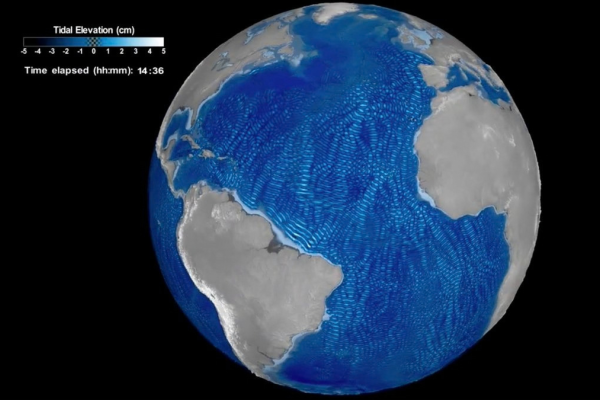
Data visualization featuring energetic internal tides on a rotating Earth. The visualization simulates data over a period of a day (24 hours) and showcases the largest internal tides on water bodies around the world. Image credit: NASA’s Scientific Visualization Studio
An international research team, including members with ties to the University of Michigan, has witnessed the earliest moments to date of planets beginning to form around a star beyond the sun.
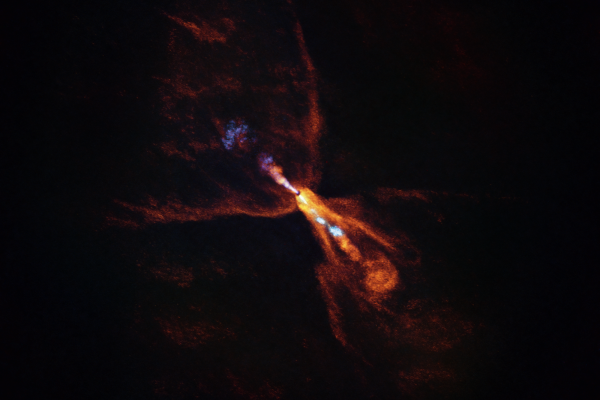
This is HOPS-315, a baby star where astronomers have observed evidence for the earliest stages of planet formation. Image credit: ALMA(ESO/NAOJ/NRAO)/M. McClure et al.
University of Michigan researchers in an international team revealed that a rocky planet in a distant star’s “habitable zone” may have an atmosphere. Potentially, this means it could have the requisite ingredients for supporting life as we know it.
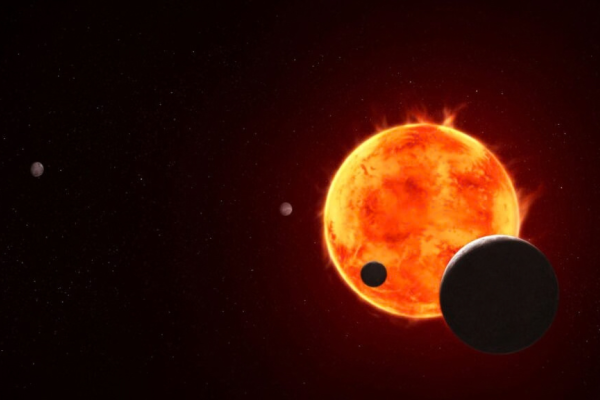
The Earth-size exoplanet TRAPPIST-1 e, depicted at the lower right, is silhouetted as it passes in front of its flaring host star in this artist’s concept of the TRAPPIST-1 system. Scientists call this event a transit, when valuable data can be gathered as the exoplanet passes between the star and the telescope and starlight illuminates the atmosphere, if one is present. Image credit: NASA, ESA, CSA, STScI, Joseph Olmsted (STScI)