
Department of Energy
The Department of Energy partners with researchers across U-M to ensure America’s security and prosperity by addressing energy, environmental and nuclear challenges through transformative science and technology solutions.

$54 Million
Research Supported by DoE in FY26

329
Active Projects Supported by DoE
Six years worth of data on nearly 670 million galaxies is helping scientists, including University of Michigan researchers, tighten the constraints on the dark energy driving the expansion of the universe.
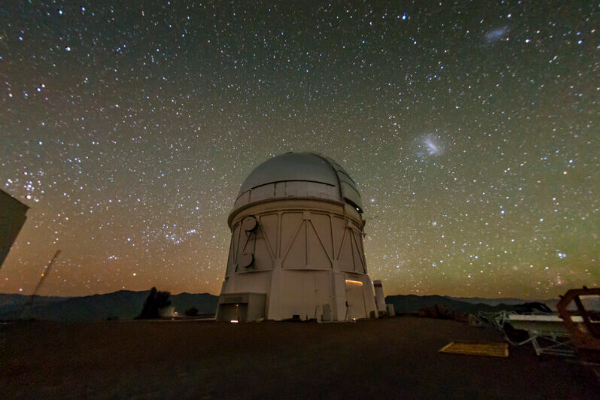
Observations for the Dark Energy Survey are made using a 570-megapixel camera developed by Fermilab that is installed on the U.S. National Science Foundation Víctor M. Blanco 4-meter telescope. The telescope is housed at the Cerro Tololo Inter-American Observatory, a program of the NSF NOIRLab, shown here in the Chilean Andes. Image credit: Reidar Hahn/Fermilab
In a step toward making ultrabright X-ray sources more widely available, an international collaboration led by the University of Michigan—with experiments at the U.K.’s Central Laser Facility—has mapped key aspects of electron pulses that can go on to generate laser-like X-ray pulses.
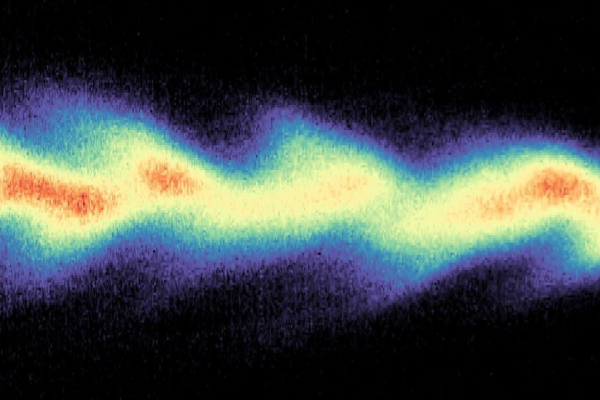
The plot shows the momentum of the electrons along the x-axis, with the angle of arrival on the y-axis. The plot resembles a fuzzy herringbone shape, the wave pattern caused by the laser pulse. The colors show the number of electrons coming in at a particular angle and momentum. This method for analyzing electron beams produced by laser pulses could help advance technologies that could make ultrabright X-ray facilities more broadly available. Image credit: Yong Ma, Center for Ultrafast Optical Science, University of Michigan.
In a process analogous to how solids melt into liquids, the electrons in many different metals form crystal-like patterns that can deform and melt, opening new pathways for neuromorphic computing and superconductors, University of Michigan Engineering researchers have found.

A gradient of defects in an electron crystal structure. The top of the image, in blue, represents cooler temperatures in which the spacing between electron clusters (white dots) is more uniform. The structure becomes less uniform moving down towards the hotter temperatures at the bottom of the image, shown in pink. Image credit: Jeremy Shen, Suk Hyun Sung and Robert Hovden, University of Michigan Engineering.