
Portable quantum chips could reshape navigation, medical imaging and more
By Wendy Sutton
Quantum science has long shaped our understanding of the energy structure of matter. Now, researchers at the University of Michigan are putting recent advances in the field to practical use.
The U-M-led Quantum Photonic Integration and Deployment project, known as QuPID, is developing portable, 1-inch optical chips capable of precision measurements that currently require laboratory-scale equipment. In the next decade, these chips could be used in vehicles, on satellites or even in smartphones, potentially enabling navigation without Global Positioning System signals and enhanced medical diagnostic imaging.
QuPID is funded by the National Science Foundation, with additional support through the Office of the Vice President for Research’s Bold Challenges Accelerate program. The program provides seed funding and proposal support to strengthen researchers’ competitiveness for large-scale funding.
The project is led by Mackillo Kira, professor of electrical engineering and computer science and co-director of the Quantum Research Institute, and Parag Deotare, Chen-Luan Family Faculty Development Professor of Electrical and Computer Engineering. The project is one of nine in the National Quantum Virtual Laboratory program, launched by the NSF to deploy quantum technologies.
The project is one of nine in the National Quantum Virtual Laboratory program, launched by the NSF to deploy quantum technologies. NQVL gives researchers across the nation “virtual” access to quantum resources in many forms, including remote use of specialized tools and online access to expertise concentrated in a few laboratories. Each of its nine projects focuses on a different area of quantum technology and addresses ways to overcome the barriers to its commercialization. Areas of focus include quantum computing, quantum sensing, quantum networks and quantum error correction.
“We are one of the pillars that the U.S. government has invested in to help make the U.S. a leader in quantum technology,” Deotare said. “We are not competing with the other NQVL projects. We’re all working together.”
QuPID draws on U-M’s long-standing leadership in optical science and spectroscopy, including advances in ultrashort, high-intensity laser pulses that earned a U-M researcher the Nobel Prize in Physics in 2018. The project also brings together technical collaborators from Harvard University, Purdue University, Stanford University, the University of Southern California, The Ohio State University and the University of Colorado.
QuPID aims to integrate quantum light sources, detectors and other optical components on a single chip using the scalable nanofabrication techniques that have revolutionized classical electronics and photonics. The U-M team has overcome a key barrier by introducing the first material platform capable of supporting all these components on one chip. The platform uses a class of materials called ferroelectric III-nitrides. The team is now assembling chips designed to detect changes too small for conventional devices to measure.
What is Quantum?
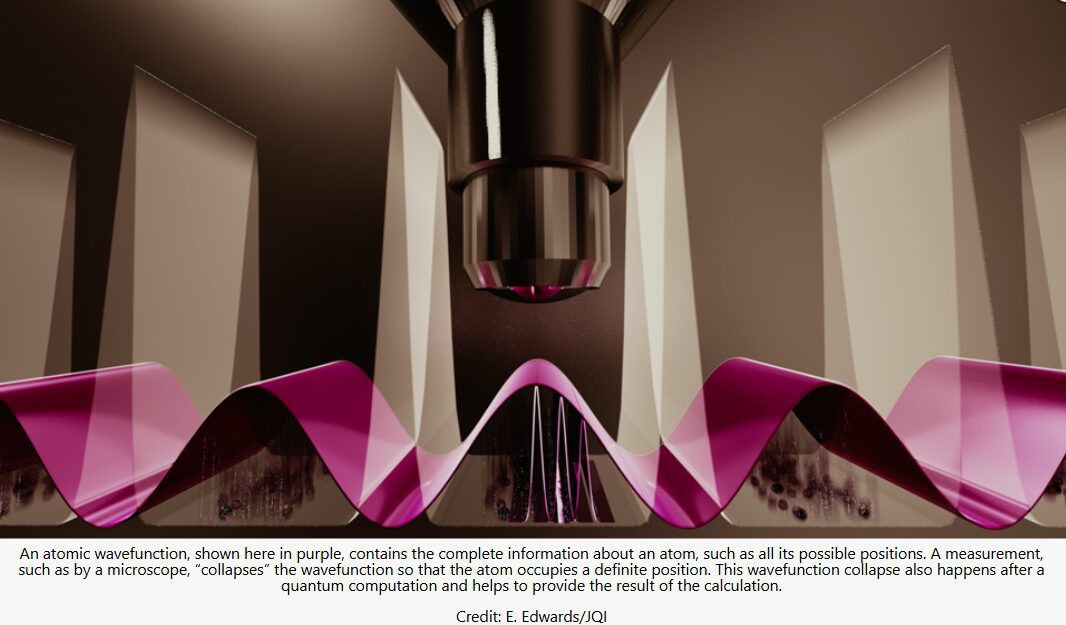
Quantum comes from Latin and means “how much.” Quantum mechanics is a field of physics that studies matter and energy at the scale of atoms and subatomic particles. It explains how, when you zoom in to the most fundamental level of matter, these particles can simultaneously show the characteristics of both particles and waves.
These concepts are difficult to visualize. Therefore, mathematical equations help scientists predict quantum behavior. Understanding quantum mechanics allows researchers to understand light and harness it for medical imaging, semiconductors and other technology including cell phones.
The resulting quantum sensing chips could provide more precise navigation for autonomous vehicles by measuring small changes in motion and rotation, eliminating the need for GPS signals that can be blocked in tunnels, dense urban areas or underground.
The chips could also support defense applications, where GPS signals can be deliberately jammed. As a first use case, the team is developing components for a quantum-enhanced optical gyroscope, a device that uses light to precisely detect changes in direction.
QuPID chips could also transform medical and biochemical applications, particularly the detection and monitoring of chemical reactions. The chips would be capable of supporting the full spectrum of wavelengths, from ultraviolet to infrared. By harnessing photon correlations, or connections between particles of light, quantum technology combines visible light with other wavelengths. This would allow medical imaging using longer wavelengths, matching the capability of X-rays or ultraviolet imaging without harming human tissue. This approach could allow doctors to scan a tumor without exposing patients to harmful radiation.
Placing this technology on a compact chip would make it portable, allowing its use for medical diagnostics in places where large instruments are not practical, including remote locations. For example, if a hiker fell in a canyon, a doctor could take a photo with a quantum chip-equipped cellphone to determine whether the hiker’s leg was broken.
Industry partners are central to the QuPID project. The research team is working with about 10 partners, including NASA, General Motors, Toyota, imec and Honeywell. Experts from Honeywell and imec are helping the team overcome barriers in photonics integration and semiconductor chip manufacturing, which currently relies on foundries.
To move the project forward, industry leaders are being asked to identify practical use cases through open forums and town hall meetings. Although companies typically focus on commercialization within the next year or two, the QuPID team is asking companies to think 10 years ahead and place their customized chip orders. QuPID would then apply quantum tools to address those challenges and needs, with chip delivery expected in about a decade.
The project also emphasizes preparing the current and future quantum workforce, offering education for industry professionals on key quantum concepts. To reach students, QuPID is focused on teacher education. Working with about 10 workforce and outreach partners, QuPID is developing curricula for students at all educational levels. The team is also partnering with museums to develop field trips and photon-correlation demonstrations that make quantum science tangible and exciting for learners of all ages.
“As we develop outreach and education, we can share the work of all NQVL projects,” Kira said. “We hope to inspire the next generation of scientists and engineers who will shape the future of quantum technology. We are the only team working on quantum photonic integration, so in that sense, the University of Michigan is acknowledged as a leader in this technology. These chips would bring tremendous quantum advantages to the world.”