
Turning the Tide on American Shipbuilding
By Kelsey Keeves
In the first half of the 20th century, the U.S. was the global center of the shipbuilding industry, leading in the number of vessels produced per year. Since then, South Korea, Japan and China have taken the lead, and the gap has only widened.
Thomas McKenney, associate professor of engineering practice at the University of Michigan’s Naval Architecture & Marine Engineering Department, sees a path forward to revitalize the U.S. shipbuilding industry.
“I saw an opportunity where, as a nation, there was a lot of discussion around what the future of shipbuilding should be in the U.S., not just from the naval shipbuilding side, but also as a discussion on revitalizing the commercial shipbuilding industry in the U.S., which has basically been nonexistent for decades,” McKenney said.
McKenney’s background in designing and building cruise ships provides him with the perspective to understand the challenges of reinvigorating the industry, and working with Bold Challenges has given him an opportunity to build a multidisciplinary team interested in the complexities and challenges facing modern shipbuilding.
“The Boost program really was the most impactful by allowing us to come together and to do something other than just talk. We got feedback that we would never have been able to get otherwise. The ability to get people started working in an area where there’s not yet enough motivation or direct funding to do so naturally was really the value of the program.”
Bold Challenges, an Office of Vice President for Research initiative that supports researchers as they create dynamic teams and produce transformative discoveries, was specifically valuable to the team as they worked toward solutions to an emerging problem that large-scale funding organizations weren’t yet addressing.
As part of the 2025 Boost cohort, McKenney and a team of U-M researchers were able to come together and create a model that addresses a complicated issue: how the U.S. can quickly strengthen its strategic commercial fleet while building a resilient shipbuilding industry for the long term.
Boost is a semester-long program within the Bold Challenges initiative and is designed to support early-stage collaborative research teams like McKenney’s as they work on transdisciplinary projects with potential for producing highly competitive research grant proposals. Besides the preliminary funding for research development, the program also facilitates workshops and other early team building activities.
“I come from actual practice. I’ve designed ships and overseen the construction of large vessels, cruise ships in particular,” McKenney said. “I’ve also worked on integrating different technologies and fuels into shipbuilding. And so I had a very good idea of the general trend that the maritime industry is going. Boost allowed us to get a head start in this space that was emerging.”
McKenney’s approach to reestablishing the shipbuilding industry focuses on creating a competitive and efficient supply chain. He argues that up to 80% of the value of a ship comes from the components and systems built along the way, and the key to the U.S. becoming a leader again is leveraging its technology leadership and manufacturing workforce.
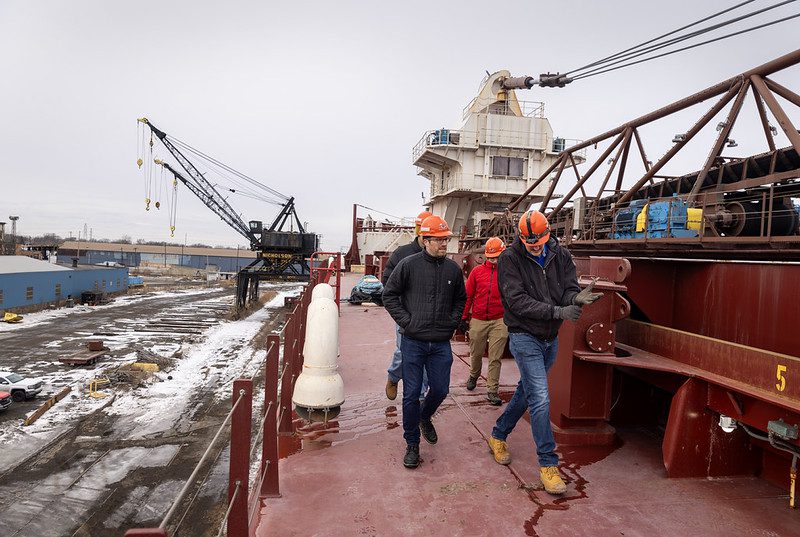
Thomas McKenney (front left) and two graduate students Logan Cox and Hal Berdichesky listen to Eric Helder, Interlake Naval Architect/Project Engineer (first right) while visiting the M/V Mark W. Barker a commercial ship overwintering at the Nicholson Dock in River Rouge, MI.
Photo by Marcin Szczepanski/Lead Multimedia Producer, University of Michigan College of Engineering
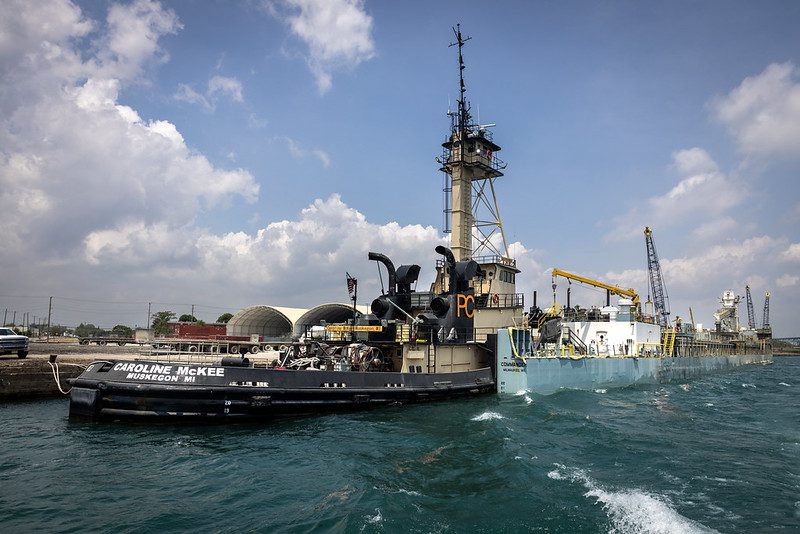
Commander barge being towed by a tugboat called Caroline McKee on Detroit River, near the Rouge River delta. Thomas McKenney and a graduate student research assistant Joseph Borgoyne tour the coast of Detroit and Rouge Rivers.
Photo by Marcin Szczepanski/Lead Multimedia Producer, University of Michigan College of Engineering
“It comes down to this broad industrial policy question of how do we leapfrog the other nations in this industry? Let’s not try to copy them. How do we do things that are specific and unique to the U.S.? And it comes down to technology,” said McKenney.
Shipbuilding is a multidisciplinary industry, requiring an extensive supply chain that intertwines a wide range of advanced technologies and systems, fuels and energies and a skilled workforce. The interdisciplinary group of experts on McKenney’s team, from the College of Engineering, Ford School of Public Policy, Ross School of Business and the School for Environment and Sustainability, has been essential to integrating complex fields into a model that can serve as a guidepost for future policy decisions.
“The Boost program really was the most impactful by allowing us to come together and to do something other than just talk,” McKenney said. “We got feedback that we would never have been able to get otherwise. The ability to get people started working in an area where there’s not yet enough motivation or direct funding to do so naturally was really the value of the program.”
The head start and competitive edge that Boost was able to give them was crucial to their ability to receive additional funding. This funding enabled them to establish the U-M Maritime Institute and develop AI-enabled robotics that can assist in ship construction, as well as attract industry partners, including Monohakobi Technology Institute, an R&D organization within the Nippon Yusen Kabushiki Kaisha Group, a Japanese company and one of the largest ship owners and operators in the world.
“We already had the team, we had the commitment, and we were able to demonstrate that we could do things right,” McKenney said. “It’s not in theory, it’s actually happening.”
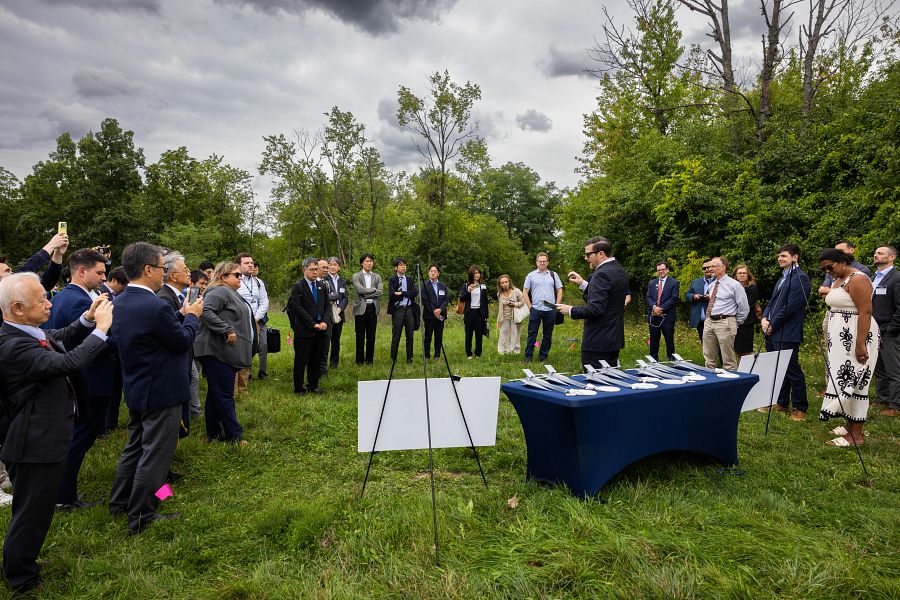
University of Michigan NAME’s Maritime Deployment to Action conference on U-M’s North Campus Thomas McKenney speaks to conference participants before a group of participants broke ground for a new ship test environment that will advance shipbuilding in the U.S. and Japan.
Photo by Marcin Szczepanski/Michigan Engineering, Communications & Marketing
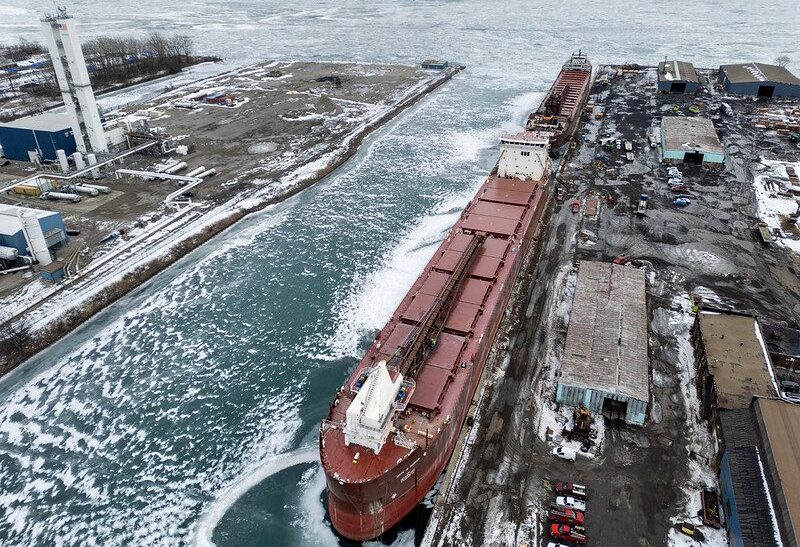
Seen from above, commercial ships M/V Mark W. Barker (left) and M/V Herbert C. Jackson overwinter at the Nicholson Dock in River Rouge, MI.
Photo by Marcin Szczepanski/Michigan Engineering, Communications & Marketing
The model also focuses on ensuring that investments are strategic and support shipbuilding in both commercial and national security spaces, allowing both spaces to grow in step with one another.
The team is currently seeking strategic industry partners for the U-M Maritime Institute and pursuing additional funding from federal agencies, including the Maritime Administration and the Department of Energy, for the next stage of their work.
“We want to solidify the University of Michigan’s role as a maritime leader nationally and even globally,” McKenney said. “Within the next five years, I think maritime will be synonymous with the University of Michigan.”