
U-M joins MOSAIC build team to power next generation of astronomers
By Kelsey Keeves
A new partnership between the University of Michigan and an intergovernmental research organization will expand the scope of possibilities for astronomers studying the universe’s first stars and galaxies and how dark matter and dark energy have evolved to the present day. Using the world’s largest telescope and its most complex instrument, U-M scientists will be able to study how the Milky Way gained its mass and shape, how other galaxies were formed, how matter is distributed in the universe and how all of these things have changed over time.
The European Southern Observatory, or ESO, is partnering with U-M in the design and construction of the Multi-Object Spectrograph, or MOSAIC, a spectrograph that can split the light of hundreds of objects simultaneously into their component optical and infrared wavelengths. It will assist astronomers in quantifying the properties of astronomical objects, including their motion, mass, temperature and atomic and molecular composition.
The MOSAIC project is just one component in the construction of the 39-meter ESO’s Extremely Large Telescope (ELT). Located in the Atacama Desert of northern Chile, it will be the world’s largest optical telescope when completed.
“It’s providing the Michigan Astronomy Department with a laboratory that will produce the world’s best data for use by the current and even the next generation of astronomers—not just to solve astronomy’s most pressing challenges today, but new mysteries that these data will uncover. When you start collecting more light on the dimmest objects or in the distant past, you see things in the universe that you didn’t know were there,” said Christopher Miller, U-M professor of astronomy.
“It’s providing the Michigan Astronomy Department with a laboratory that will produce the world’s best data for use by the current and even the next generation of astronomers—not just to solve astronomy’s most pressing challenges today, but new mysteries that these data will uncover. When you start collecting more light on the dimmest objects or in the distant past, you see things in the universe that you didn’t know were there.”
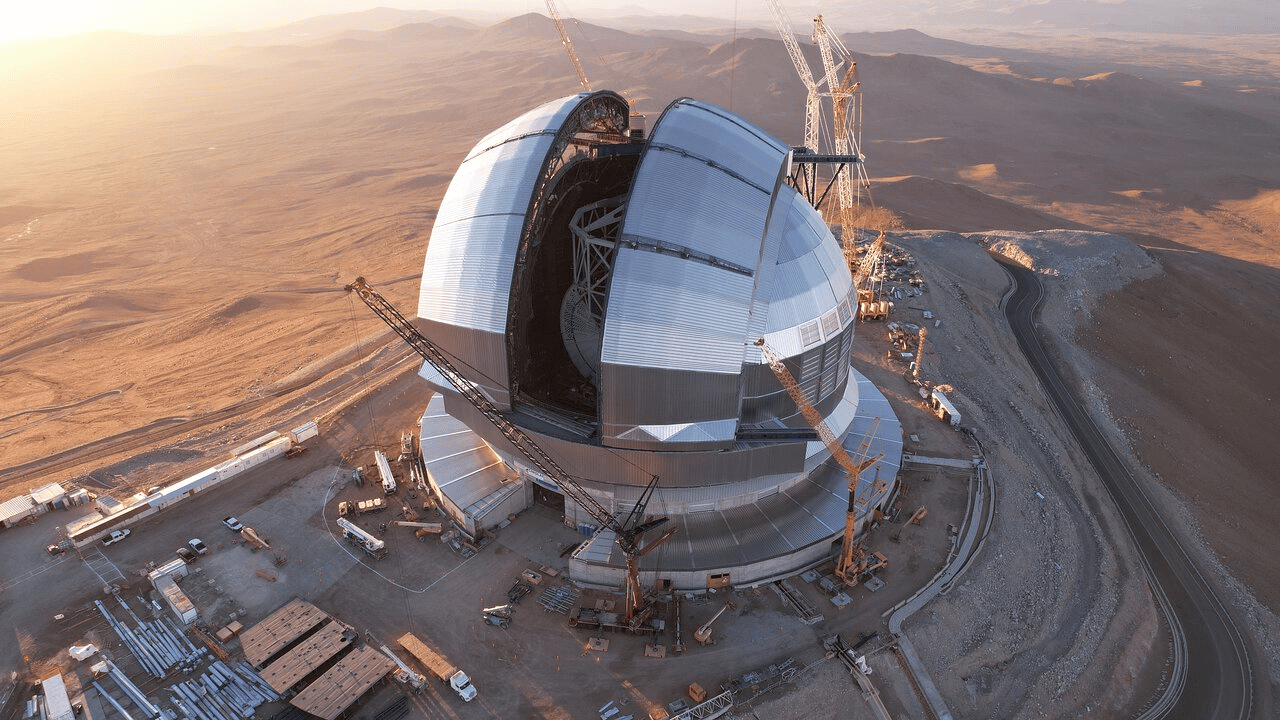
During the night, its two sliding doors will open to allow observations of the night sky. Credit: ESO/G. Vecchia
“The ELT and MOSAIC projects are long term commitments for our faculty and will enable our department to recruit the best researchers to use this data and participate alongside world-class international partners,” Miller said.
He and his colleagues Oleg Gnedin, Sean Johnson, Sally Oey and Feige Wang are participating in various roles, like leading science working groups or representing the department on its scientific and management boards.
One question Miller hopes to answer centers around dark matter and energy and how its behavior is affecting the universe’s expansion. Scientists know that after the Big Bang, the universe was expanding, but the speed of this expansion has changed. Miller’s work examines the dynamical motion of galaxies inside giant clusters. Their speeds tell us about the expansion of spacetime. A survey instrument like MOSAIC, which collects data on hundreds of objects at a time, is critical for this type of research.
“Surveys enable discovery, and the large amount of data they produce powers the statistical precision we need in modern cosmology and astrophysics,” Miller said.
This data, combined with the capabilities of machine learning, advanced statistics and AI, is enabling astronomers to conduct their science in new and innovative ways.
Founded in 1962, ESO is the most productive ground-based astronomical observatory in the world and consists of 16 member states. U-M is the only American institution involved in the ELT through its participation in four instruments.
By being a part of these teams early on, U-M researchers can forge new partnerships and contribute to conversations that will shape how the instruments will work and what they will do, helping to ensure that the data collected will be useful across disciplines.
“This is a new way for us to participate with people that have a different view, a different way of working and playing, a different process, but with the same long term science goal in mind, which is to solve the very hard problems that the universe keeps throwing at us,” Miller said.