
A faster path to finding life-saving medicines
By Wendy Sutton
Historically, scientists have relied on a technique known as “computational alchemy” to help discover new medicines.
In this approach, computers slowly transform one molecule into another during a simulation to see which one binds better to a biological target, such as a protein linked to disease. The process uses a variable called lambda, which acts like a dial controlling the transformation from molecule A to molecule B.
To get reliable results, researchers must run many separate simulations at fixed lambda settings. If they want to compare many different molecules, the number of simulations quickly multiplies. Testing dozens — or even hundreds — of possibilities can require enormous amounts of time and computing power.
Charles Brooks believes there is a better way.
Brooks, the Warner-Lambert/Parke-Davis Professor of Chemistry and Cyrus Levinthal Distinguished University Professor of Chemistry and Biophysics at the University of Michigan, has spent his career developing faster and more efficient computational tools for drug discovery. Instead of testing molecules one at a time, his methods allow scientists to explore many possibilities at once.
Brooks and his colleagues developed a technique called multisite lambda dynamics. Unlike traditional computational alchemy, where lambda stays fixed during each simulation, this new method allows lambda to change dynamically. That means the computer can automatically switch among many different molecules as a protein shifts and moves.
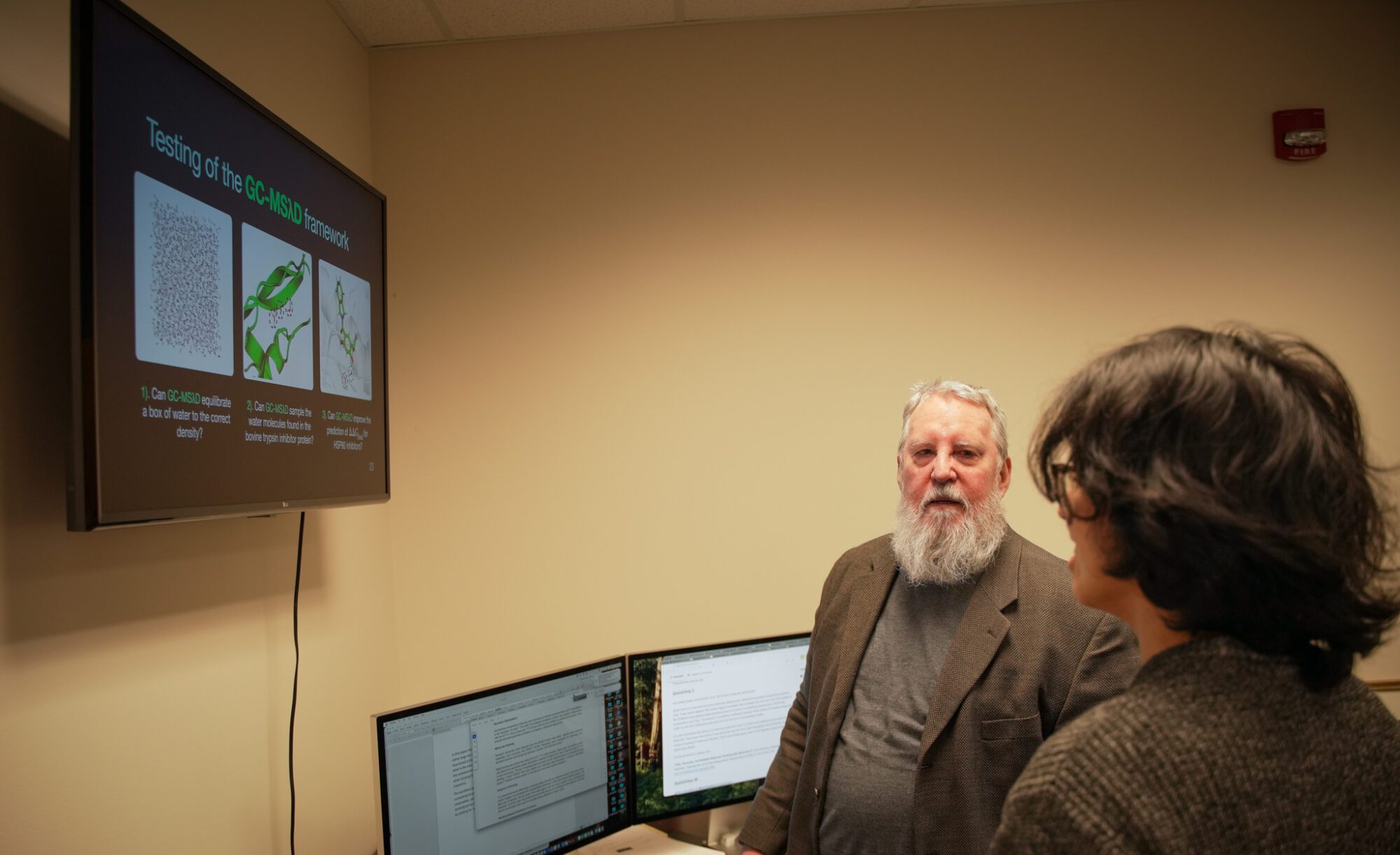
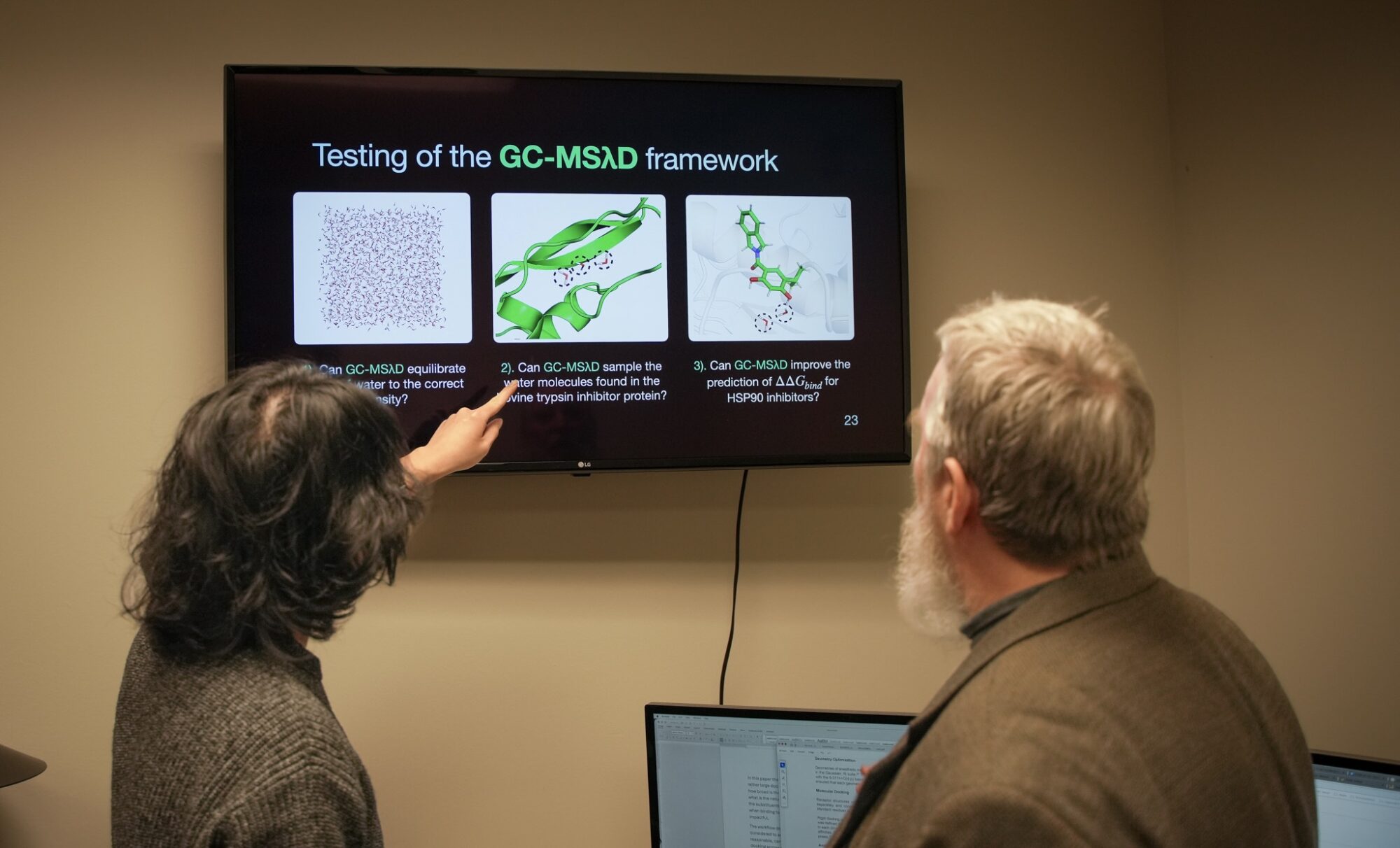
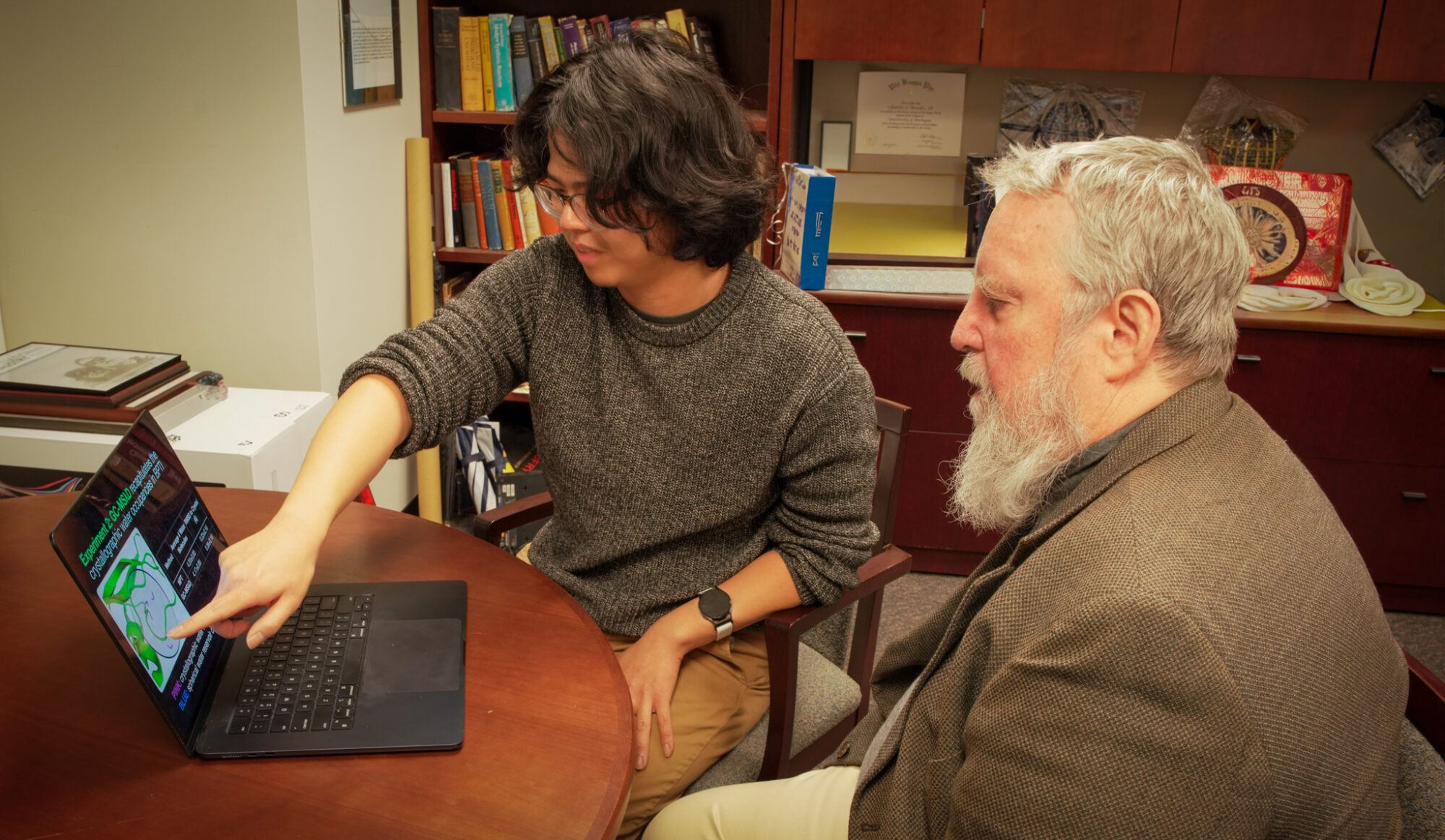
University of Michigan chemist Charles Brooks discusses computational drug-discovery research with a student in his office, reviewing molecular models and simulation results that power new approaches—like multisite lambda dynamics—to speed the search for life-saving medicines.
Rather than comparing molecules one by one, the simulation can evaluate them together. Even more powerful, it can test multiple chemical attachment points at the same time.
In some cases, this accelerates the search for promising drug candidates by as much as a thousandfold. Brooks’ team is exploring additional machine learning approaches to further improve this process using AI.
“Experimentation is like steps on the stairs,” Brooks said. “Computational modeling can provide you with an elevator to move you along more quickly. Efficiency is crucial for increasing the overall process of drug discovery.”
Brooks’ methods are most powerful when paired with experimental science. One such collaboration is with Alison Narayan, professor of chemistry, whose research focuses on discovering proteins that can convert small molecules into valuable therapeutics. Narayan uses a method called directed evolution, which involves making thousands of genetic changes to a protein and testing each new version. Success is rare, typically yielding only about one in 10,000 proteins that works as hoped.
“Based on the data we’ve collected, the success rate is near one in 10 as opposed to one in 10,000. This was another place where we have used existing machine learning frameworks to advance this question of how we find bio-catalysts in a better manner.”
Brooks’ team saw an opportunity to dramatically improve those odds. Azam Hussain, a doctoral student in Brooks’ lab, used AlphaFold2, an AI-based tool for predicting protein structures, to model ancestral proteins that are more stable and better able to tolerate change. He then used computational simulations to predict how well small molecules would bind to each protein’s active site, narrowing the field to the most promising candidates.
By combining these predictions with experimental data and machine learning, the team was able to design new protein variants before testing them in the lab. Over the past year, the results have been striking.
“Based on the data we’ve collected, the success rate is near one in 10 as opposed to one in 10,000,” Brooks said. “This was another place where we have used existing machine learning frameworks to advance this question of how we find bio-catalysts in a better manner.”
The work illustrates how Brooks and his students integrate computation, machine learning and experimentation to transform drug discovery—guided by curiosity and a willingness to challenge what already works.
“I continue to love to ask questions and explore the answers myself or through work with my students,” Brooks said. “When you have something that works well, ask yourself: ‘How am I going to break it?’ It is when you break it that you usually learn the most.”
The following author also contributed to this article: Vanessa Vinson