
What It Takes to Find a Student Facing Homelessness
By Eric Shaw
Office of the Vice President of Research
Here’s what it looks like when the system works.
A school bus driver notices that a student has started boarding at a different stop—a motel at the edge of town. She mentions it to the transportation coordinator, who passes it to the school district’s homeless liaison.
The liaison calls the student’s family, not to investigate, but to offer help: enrollment protection if they need to switch schools, a bus route back to the student’s original school if they don’t, free meals or a referral to housing assistance. With every conversation the goal is to bring together the resources and support needed to remove any barriers that prevent the student from fully participating in school like their peers.
That sequence—notice, report, connect—is what federal law intends for students who lose stable housing. But in most districts, it doesn’t happen. The bus driver isn’t trained to report. The liaison has four other jobs. The family never discloses out of fear that they might be forced to change schools or reported to child protective services, or simply because no one asks.
In Michigan, roughly one in five school districts was flagged for possible under-identification of children experiencing homelessness, with one-third of those districts likely severely under-identifying based on community-wide levels of poverty, according to analysis by Poverty Solutions at the University of Michigan. That gap means thousands of children never receive the support to which they’re legally entitled.
Statewide, Michigan schools identified about 35,500 students as experiencing homelessness in 2023–24. Nearly 60% were chronically absent, compared with 29% of their housed peers. Nationally, the count of students without a stable place to live reached 1.37 million in 2022–23, a number experts agree understates the true scope.
The question Jennifer Erb-Downward and her colleagues at Poverty Solutions have spent years trying to answer: What makes some districts better at finding these students, and what changes when they do?
Where the work began
When Poverty Solutions began exploring student homelessness, it was seen as an issue that affected a handful of urban districts. But an interactive data map that showed student homelessness rates for every school district in Michigan in 2015-16 began to change that conversation. The data revealed students in rural and suburban areas also lack stable housing as well as evidence that schools were not identifying all of the students likely facing homelessness.
In 2017-18, a university analysis found that as many as 88% of children experiencing homelessness in Detroit were never identified by their schools. Schools weren’t able to connect those dots until the district began implementing a new system across all schools that identified students living in shelters, motels and with relatives.
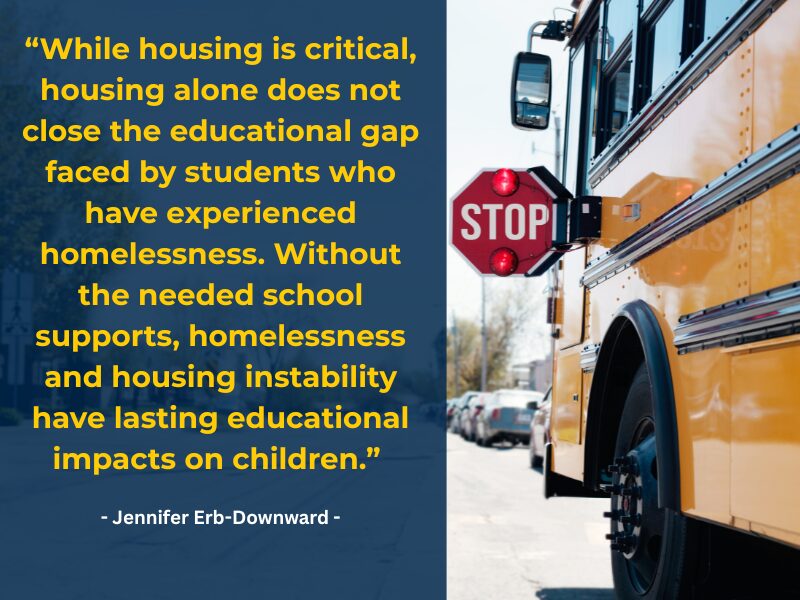
Quote by Jennifer Erb-Downward, Director of Housing Stability Programs and Policy Initiatives for Poverty Solutions at the University of Michigan
Detroit Public Schools Community District placed a trained point of contact for homeless students in every school; created online referral forms for teachers, staff and external agencies; expanded liaison capacity; created a basic needs pantry for students and their families; and explored other opportunities for identification, such as housing stability questions in schoolwide mental health screening assessments.
By the 2022-23 school year, DPSCD had identified more than 2,500 homeless students, an increase of 326% from what they identified in the 2015-16 school year.
What high-identification districts actually do
To understand what separates districts that find homeless students from those that don’t, Erb-Downward partnered with the New York State Education Department and SchoolHouse Connection to study identification patterns across New York. The team sorted districts outside New York City into three groups: those with high identification rates, those with high poverty but low identification, and those reporting zero homeless students despite enrolling more than 1,000 children.
The differences were structural, not demographic.
The research found districts with high identification rates used a housing questionnaire systematically at the start of every school year and again whenever a student’s address changed. The form asks families directly: Are you staying with others because of economic hardship? Living in a motel? Lacking a fixed place to sleep? Districts that administered a housing questionnaire only at enrollment missed students whose housing sitatution changed mid-year.
Bus drivers turned out to make a big difference in identifying students without a stable place to live. In effective districts, drivers were trained to notice a student boarding from a different location, a family living out of a car, a motel drop-off or students who were frequently missing pickup altogether. Liaisons said these reports were often the only way they learned about housing changes.
Where the student homelessness liaison sat in the organization mattered as well. In smaller districts with strong identification, the liaison was a senior administrator who could train staff and act quickly. In struggling districts, the role was tacked onto someone’s other responsibilities and sometimes not even listed on the district’s public contact page.
“Families often avoid disclosing housing instability because they fear child welfare involvement or worry about immigration status,” said Erb-Downward, director of housing stability programs and policy initiatives at Poverty Solutions. “Liaisons who could offer something concrete—a gas card, a grocery gift card—built relationships that made disclosure feel safer. Without trust, the questionnaire doesn’t work. Without the questionnaire, you miss kids.”
What dedicated funding accomplished
The COVID-19 pandemic offered an unintended test of whether targeted investment could move these numbers. In fall 2020, schools identified 28% fewer homeless students than the year before, or roughly 420,000 children who effectively disappeared from the system as schools shifted to remote learning.
Poverty Solutions and SchoolHouse Connection documented that drop in a 2020 analysis, and Erb-Downward presented the findings in testimony before a U.S. House subcommittee the following year. A bipartisan group of senators cited that research in a letter to the Department of Education about implementing the American Rescue Plan’s $800 million allocation for homeless children and youth, funding that for the first time reached a majority of school districts nationwide.
A 2025 Department of Education evaluation found meaningful gains in districts that received the funds. Math proficiency among homeless students rose from 18% to 29%; reading proficiency climbed from 27% to 36%. Graduation rates reached 72%, surpassing pre-pandemic levels. The evaluation’s authors caution that staggered implementation and incomplete data limit causal conclusions, but the pattern aligns with what liaisons described: when districts invest in dedicated systems, they find more students and support them more effectively.
“While housing is critical, housing alone does not close the educational gap faced by students who have experienced homelessness. Without the needed school supports, homelessness and housing instability have lasting educational impacts on children,” Erb-Downward said.