
Cancer touches many families, including that of University of Michigan researchers Lindsey Muir and Indika Rajapakse.
Muir, a research assistant professor of computational medicine and bioinformatics, lost both of her parents to the deadly disease.
She works alongside Rajapakse, her husband and collaborator, in the (Genome + Cell) Reprogramming Lab, dedicated to “reprogramming” skin cells to regenerate bone marrow after chemotherapy.
High-dose chemotherapy can damage healthy bone marrow, increasing a cancer patient’s risk of infection and anemia. However, 60-70% of bone marrow transplant recipients experience Graft-vs.-host disease (GVHD), a condition in which the healthy donor’s immune cells attack the recipient’s tissue, leading to inflammation and potentially serious organ damage.
Moreover, finding a suitable match is especially challenging for people with greater genetic diversity, including African Americans and people of mixed race, with only about 30% of African American patients finding a donor, compared with 80% of white patients.
“This research is about helping people and not just advancing knowledge. I am from Sri Lanka, a developing country, and I understand the burden expensive treatments place on those who cannot afford them. Our research is about making a real difference in people’s lives and eventually reducing treatment costs.”
That is why Rajapakse’s team is working to directly reprogram a patient’s own plentiful and accessible skin cells into bone marrow cells using the patient’s individual DNA.
Rajapakse, a professor of computational medicine and bioinformatics and mathematics, calls it “the treatment for the treatment.”
“This research is about helping people and not just advancing knowledge,” Rajapakse said. “I am from Sri Lanka, a developing country, and I understand the burden expensive treatments place on those who cannot afford them. Our research is about making a real difference in people’s lives and eventually reducing treatment costs.”
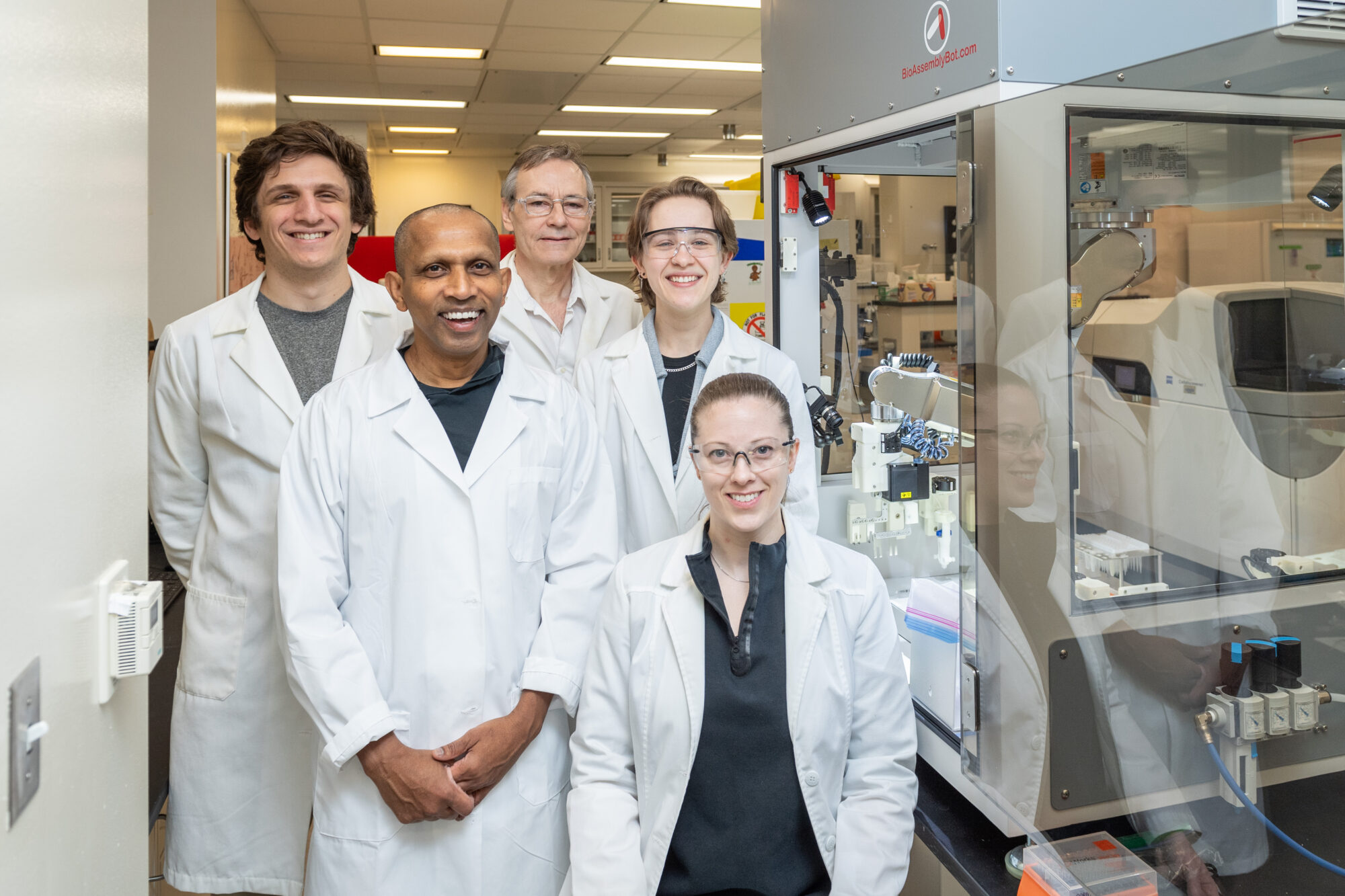
Front Left to Right: Indika Rajapakse, Lindsey Muir, “BAB”
Back Left to Right: Joshua Pickard, Walter Meixner, Jillian Cwycyshyn
At the core of the work is gene expression, the process that determines a cell’s identity. While every cell in the human body contains the same DNA, each cell type uses a unique combination of active and inactive geRnes. For example, skin cells and bone marrow cells have identical DNA, but function differently because different genes are switched on and off. By precisely controlling which genes are active, Rajapakse and his team can manipulate gene expression to transform skin cells into bone marrow cells.
To achieve this, the (Genome + Cell) Reprogramming Lab has developed an innovative algorithm that determines the most effective way to use transcription factors, which are proteins that regulate gene expression. By analyzing how genes are expressed in skin cells, it identifies the precise steps and optimal combination of transcription factors needed to convert them into bone marrow cells or any other cell type.
The potential of this technology is significant.
With the ability to reprogram cells into any type, these methods could extend far beyond bone marrow regeneration. Someday it may be possible to regenerate heart muscle cells after a heart attack, repair macular degeneration in the eye or enable any other necessary cell replacement due to aged or nonfunctioning cells.
The lab’s BioAssemblyBot 400, or BAB, automates the care and imaging of living cells, sequences DNA and features a biological 3D printer capable of assembling tissue including live cells and structures. BAB offers vast potential, from creating human tissue for research and testing new therapies, to the future possibility of printing functional tissue or even entire organs for transplantation. Its live-streaming cameras and robotics-assisted automation allow researchers to remotely monitor and conduct experiments.
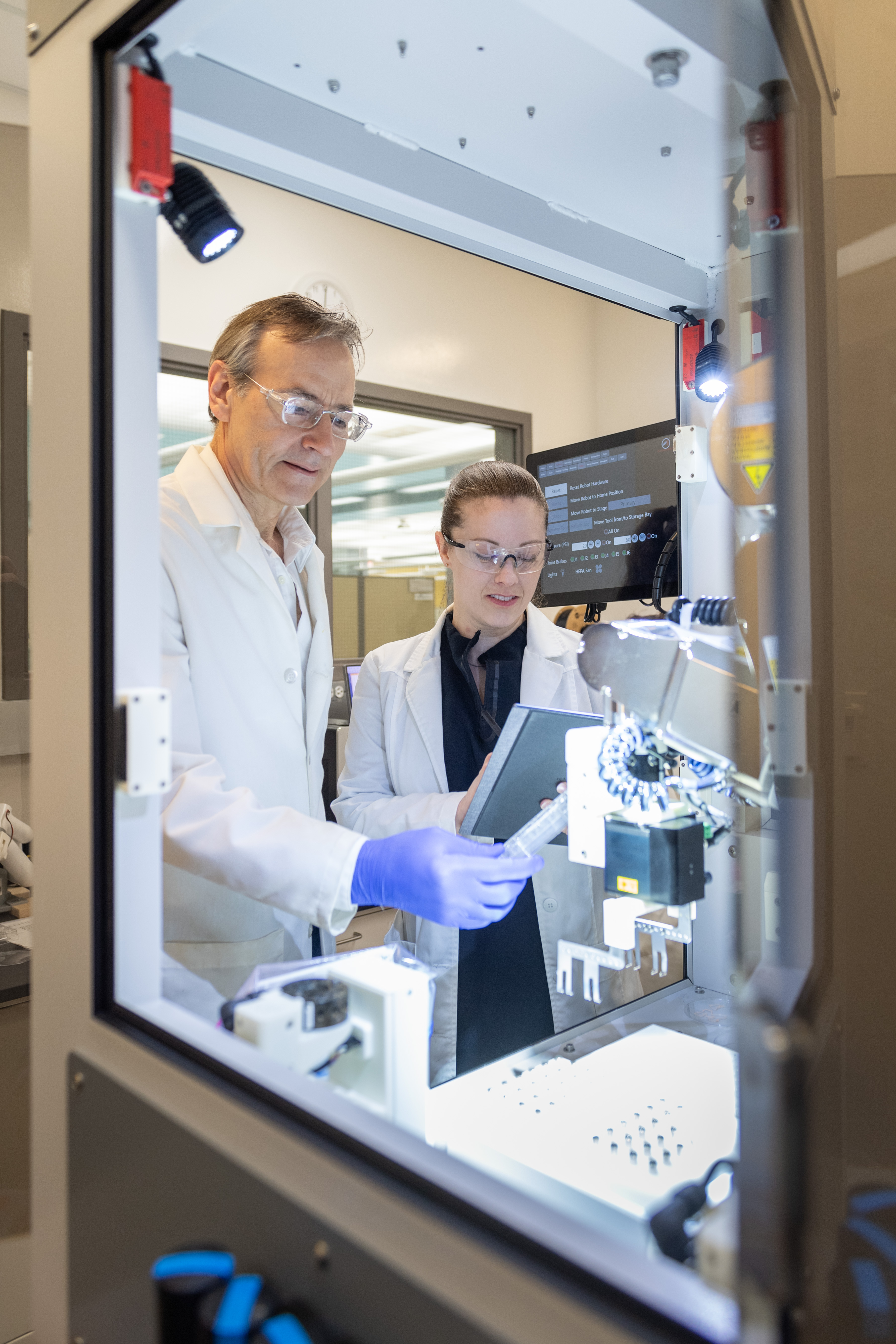
Lindsey Muir and Walter Meixner using BioAssemblyBot 400 machine
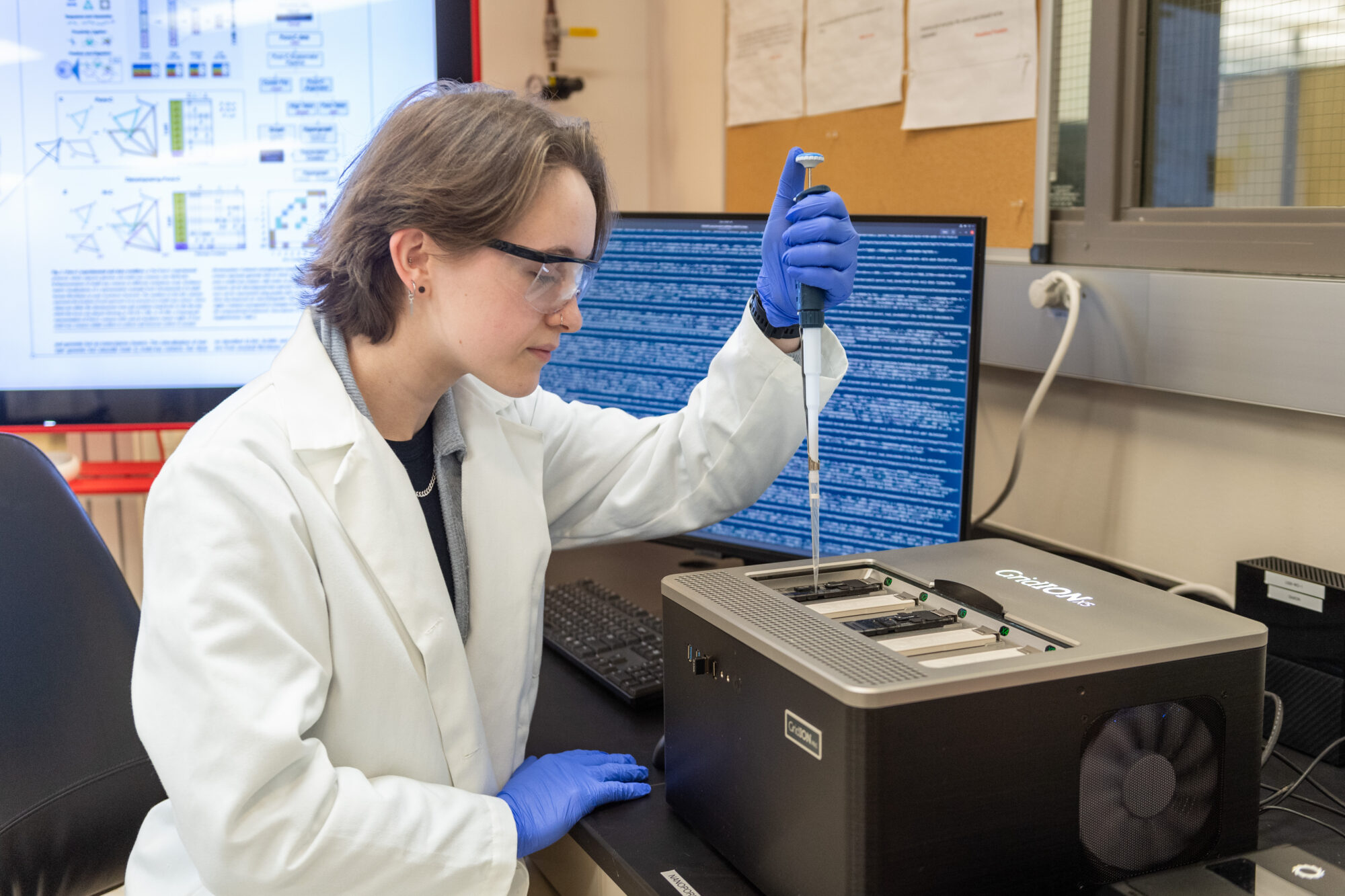
Jillian Cwycyshyn preparing cells for sequencing
“I would like to see labs at institutions with limited funding have the opportunity to use BAB,” Muir said. “This would empower more researchers, including those with fewer resources, to access BAB’s advanced technology. With its remote operation capabilities, BAB could create more equitable access to cutting-edge tools, enabling important discoveries even at under-resourced institutions.”
In 2024, Rajapakse and his collaborators received a Defense Advanced Research Projects Agency (DARPA) grant to develop the TwinCell Blueprint, an AI-assisted foundation model for direct cell reprogramming. By integrating BAB’s lab automation with advanced sequencing and imaging, the team will use AI-guided exploration to discover new methods of directly reprogramming one cell type into another.
The approach matches each real cell with a digital twin, a computer model that learns how the cell behaves and responds to changes. This creates a feedback loop where results from lab experiments help improve the model, and the model then suggests better experiments. The TwinCell approach has the potential to advance fields such as regenerative medicine, cancer research, tissue repair and drug discovery.
“Cellular reprogramming exemplifies the transformative potential of computational science and AI in medicine. Indika’s team is advancing cancer treatment while democratizing access to leading-edge therapeutic approaches,” Karthik Duraisamy said, Samir & Puja Kaul Director of MICDE. “This work represents exactly the kind of interdisciplinary innovation that will define the future of personalized medicine, bringing together expertise in computational mathematics, biology, engineering and computer science to solve critical healthcare challenges.”
Read the full article in the Michigan Institute for Computational Discovery and Engineering Spring 2025 Magazine: https://micde.umich.edu/personalizing-cancer-recovery-through-reprogrammed-cells/